Home
Class 12
PHYSICS
There is a uniform spherically symmetri...

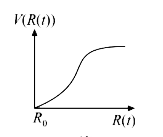
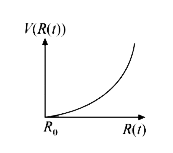
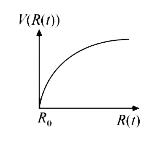
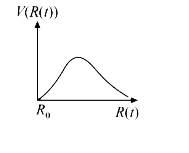
There is a uniform spherically symmetric surface charge density at a distance `R_(0)` from the origin . The charge distribution is intially at rest and starts expanding because of mutual repulsion , the figure that repeesents best the speed V (r(t)) of the distribution as a function of its intantanradius R(t) is :

A

B

C

D

Text Solution

AI Generated Solution

The correct Answer is:

To solve the problem, we need to analyze the expansion of a uniform spherically symmetric surface charge density due to mutual repulsion. We'll derive the relationship between the speed \( V(r(t)) \) of the distribution and its instantaneous radius \( R(t) \). ### Step-by-Step Solution: 1. **Understanding the System**: - We have a uniform spherically symmetric surface charge density at an initial radius \( R_0 \). - The charge distribution is initially at rest and starts expanding due to mutual repulsion among the charges. 2. **Applying Work-Energy Theorem**: - Since there are no external forces acting on the system, the work done by external forces is zero. - According to the work-energy theorem, the work done by all forces is equal to the change in kinetic energy: \[ W_{\text{total}} = \Delta KE \] 3. **Identifying Forces**: - The only forces doing work are the electric forces due to the surface charge. The work done by the electric field can be expressed as: \[ W = U_{\text{final}} - U_{\text{initial}} \] - Here, \( U \) is the electric potential energy. 4. **Calculating Electric Potential Energy**: - The potential energy \( U \) for a uniformly charged sphere can be expressed as: \[ U = \frac{KQ^2}{2R} \] - Where \( K \) is Coulomb's constant, \( Q \) is the total charge, and \( R \) is the radius. 5. **Setting Up the Energy Equation**: - Initially, at radius \( R_0 \): \[ U_{\text{initial}} = \frac{KQ^2}{2R_0} \] - At an instantaneous radius \( R \): \[ U_{\text{final}} = \frac{KQ^2}{2R} \] - The change in kinetic energy is given by: \[ KE = \frac{1}{2} MV^2 \] 6. **Equating Energies**: - Setting the work done equal to the change in kinetic energy: \[ \frac{KQ^2}{2R} - \frac{KQ^2}{2R_0} = \frac{1}{2} MV^2 \] - Rearranging gives: \[ \frac{KQ^2}{2R} - \frac{KQ^2}{2R_0} = \frac{1}{2} MV^2 \] 7. **Solving for Speed \( V \)**: - Rearranging the equation, we find: \[ MV^2 = KQ^2 \left( \frac{1}{R} - \frac{1}{R_0} \right) \] - Thus, the speed \( V \) can be expressed as: \[ V = \sqrt{\frac{KQ^2}{M} \left( \frac{1}{R_0} - \frac{1}{R} \right)} \] 8. **Differentiating with Respect to Radius**: - To understand how \( V \) changes with \( R \), we differentiate: \[ \frac{dV}{dR} = \frac{KQ^2}{M} \cdot \frac{1}{2V} \cdot \left( -\frac{1}{R^2} \right) \] - This shows that \( \frac{dV}{dR} \) is negative, indicating that as \( R \) increases, \( V \) decreases. 9. **Conclusion**: - The speed \( V \) as a function of the instantaneous radius \( R \) decreases with increasing \( R \). This means that the graph of \( V \) versus \( R \) will have a negative slope. ### Final Answer: The correct figure that represents the speed \( V(r(t)) \) of the distribution as a function of its instantaneous radius \( R(t) \) is option **third**.

To solve the problem, we need to analyze the expansion of a uniform spherically symmetric surface charge density due to mutual repulsion. We'll derive the relationship between the speed \( V(r(t)) \) of the distribution and its instantaneous radius \( R(t) \). ### Step-by-Step Solution: 1. **Understanding the System**: - We have a uniform spherically symmetric surface charge density at an initial radius \( R_0 \). - The charge distribution is initially at rest and starts expanding due to mutual repulsion among the charges. ...
Promotional Banner

Topper's Solved these Questions

  • JEE MAIN REVISION TEST 8 (2020)

    VMC MODULES ENGLISH|Exercise PHYSICS (SECTION 2)|5 Videos
  • JEE MAIN REVISION TEST 5 (2020)

    VMC MODULES ENGLISH|Exercise PHYSICS (SECTION 2)|5 Videos
  • JEE MAIN REVISION TEST- 16

    VMC MODULES ENGLISH|Exercise PHYSICS (SECTION 2)|5 Videos

Similar Questions

Explore conceptually related problems

There is a uniform spherically symmetric surface charge density at a distance R_(0) from the origin . The charge distribution is intially at rest and starts expanding because of mutual repulsion , the figure that repeesents best the speed V (r(t)) of the distribution as a function of its instant radius R(t) is :

Electric field due to an infinite non-conducting sheet of surface charge density sigma , at a distance r from it is

The maximum surface charge density of a uniformly charged spherical radius R and wall thickness 't', so that it will not burst apart, is

For spherically symmetrical charge distribution, electric field at a distance r from the centre of sphere is vec(E)=kr^(7) vec(r) , where k is a constant. What will be the volume charge density at a distance r from the centre of sphere?

The energy density u is plotted against the distance r from the centre of a spherical charge distribution on a log-log scale. Find the magnitude of slope of obtained straight line.

A long thin flat sheet has a uniform surface charge density sigma . The magnitude of the electric field at a distance .r. from it is given by

An insulating solid sphere of radius R has a uniformly positive charge density rho . As a result of this uniform charge distribution there is a finite value of electric potential at the centre of the sphere, at the surface of the sphere and also at a point out side the sphere. The electric potential at infinity is zero. Statement-1: When a charge 'q' is taken from the centre to the surface of the sphere, its potential energy changes by (qrho)/(3 in_(0)) Statement-2 : The electric field at a distance r (r lt R) from the centre of the the sphere is (rho r)/(3in_(0))

A positive charge is released from rest at a distance r_(0) from a positive line charge with uniform density . The speed (v) of the point charge , as a function of instantaneous distance r from line charge, is proportional to:

Let there be a spherical symmetric charge density varying as p(r )=p_(0)(r )/(R ) upto r = R and rho(r )=0 for r gt R , where r is the distance from the origin. The electric field at on a distance r(r lt R) from the origin is given by -

Consider a uniform spherical charge distribution of radius R_(1) centred at the origin O . In this distribution a spherical cavity of radius R_(2) , centred at P with distance OP = a = R_(1) - R_(2) (fig) is made.If the electric field inside the cavity at position vec(r ) , then the correct statement is
