Home
Class 12
PHYSICS
In the circuit shown, a four-wire potent...

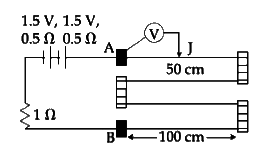
In the circuit shown, a four-wire potentiometer is made of a `400 cm` long wire, which extents between A and B . The resistance per unit length of the potentiometer wire is `r/L=0.01 Omega//cm.` If an ideal voltmeter is connected as shown with jockey J at 50 cm from end A, the expected reading of the voltmeter will be :

Text Solution

Verified by Experts

` i= (V)/(R _ (eq ) ) = ( 3 ) /(6) = 0.5 A `
` Delta V _ (AJ) = iR_ ( AJ ) = ( 0.5) (0.5) = 0.25 V `
Promotional Banner

Topper's Solved these Questions

  • JEE Main Revision Test-9 | JEE-2020

    VMC MODULES ENGLISH|Exercise PHYSICS SECTION 2|5 Videos
  • JEE Main Revision Test-6 | JEE-2020

    VMC MODULES ENGLISH|Exercise PHYSICS|2 Videos
  • JEE MAIN REVISON TEST-23

    VMC MODULES ENGLISH|Exercise PHYSICS (SECTION 2)|1 Videos

Similar Questions

Explore conceptually related problems

In the following circuit, resistance of potentiometer wire is 100 Omega . Power consumption in potentiometer wire is same when jockey is placed at 10 cm from end A or end B. Internal resistance of cell (r ) is

The potentiometer wire AB is 600 cm long . At what distance (in cm) from A should the jockey J touch the wire to get zero deflection in the galvanometer?

The potentiometer wire AB is 600cm long. At what distance (in cm) from A should the jockey J touch the wire to get zero deflection in the galvanometer?

The emf of the driver cell of a potentiometer is 2 V , and its internal resistance is negligible. The length of the potentiometer wire is 100 cm , and resistance is 5 ohm . How much resistance is to be connected in series with the potentiometer wire to have a potential gradient of 0.05 m V cm^(-1) ?

A potentiometer wire AB as shown in 40 cm long of resistance 50Omega//m free end of an ideal galvanometer is touching the potentiometer wire with the help of a jockey. What should be the velocity of the jockey as a function of time so that potential difference across the galvanometer is varying with time as (2sinpit)V

An experimental setup of verification of photoelectric effect is shown if Fig. The voltage across the electrodes is measured with the help of an ideal voltmeter, and which can be varied by moving jockey J on the potentiometer with wire. The battery used in potentiometer circuit is of 20 V and its internal resistance is 2 Omega . The resistance of 100 cm long potentiometer wire is 8 Omega . The photocurrent is measured with the help of an ideal ammeter. Two plates of potassium oxide of area 50 cm^2 at separation 0.5mm are used in the vacuum tube. Photocurrent in the circuit is very small, so we can treat the potentiometer circuit as an independent circuit. The wavelength of various colors is as follows: Q. It is found that ammeter current remains unchanged (2muA) even when the jockey is moved from the end P to the middle point of the potentiometer wire. Assuming that all the incident photons eject electrons and the power of the light incident is 4xx10^(-6) W. Then, the color of the incident light is

In a potentiometer circuit, the emf of driver cell is 2V and internal resistance is 0.5 Omega . The potentiometer wire is 1m long . It is found that a cell of emf 1V and internal resistance 0.5 Omega is balanced against 60 cm length of the wire. Calculate the resistance of potentiometer wire.

An experimental setup of verification of photoelectric effect is shown if Fig. The voltage across the electrodes is measured with the help of an ideal voltmeter, and which can be varied by moving jockey J on the potentiometer with wire. The battery used in potentiometer circuit is of 20 V and its internal resistance is 2 Omega . The resistance of 100 cm long potentiometer wire is 8 Omega . The photocurrent is measured with the help of an ideal ammeter. Two plates of potassium oxide of area 50 cm^2 at separation 0.5mm are used in the vacuum tube. Photocurrent in the circuit is very small, so we can treat the potentiometer circuit as an independent circuit. The wavelength of various colors is as follows: Q. Calculate the number of electrons that appear on the surface of the cathode plate, when the jockey is connected at the end P of the potentiometer wire. Assume that no radiation is falling on the plates.

An experimental setup of verification of photoelectric effect is shown if Fig. The voltage across the electrodes is measured with the help of an ideal voltmeter, and which can be varied by moving jockey J on the potentiometer with wire. The battery used in potentiometer circuit is of 20 V and its internal resistance is 2 Omega . The resistance of 100 cm long potentiometer wire is 8 Omega . The photocurrent is measured with the help of an ideal ammeter. Two plates of potassium oxide of area 50 cm^2 at separation 0.5mm are used in the vacuum tube. Photocurrent in the circuit is very small, so we can treat the potentiometer circuit as an independent circuit. The wavelength of various colors is as follows: Q. When radiation falls on the cathode plate, a current of 2muA is recorded in the ammeter. Assuming that the vacuum tube setup sollows Ohm's law, the equivalent resistance of vacuum tube operating in this case when jockey is at end P is

An experimental setup of verification of photoelectric effect is shown if Fig. The voltage across the electrodes is measured with the help of an ideal voltmeter, and which can be varied by moving jockey J on the potentiometer with wire. The battery used in potentiometer circuit is of 20 V and its internal resistance is 2 Omega . The resistance of 100 cm long potentiometer wire is 8 Omega . The photocurrent is measured with the help of an ideal ammeter. Two plates of potassium oxide of area 50 cm^2 at separation 0.5mm are used in the vacuum tube. Photocurrent in the circuit is very small, so we can treat the potentiometer circuit as an independent circuit. The wavelength of various colors is as follows: Q. Which of the following colors may not give photoelectric effect for this cathode? if power of incident light is 4*10^-6 and currenr 2micro ampere.
