Home
Class 12
CHEMISTRY
A bacterial infection in an internal wou...

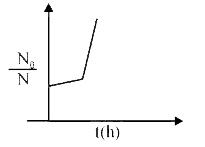
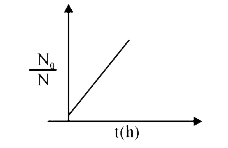
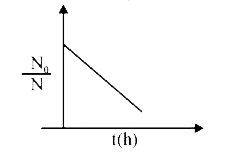
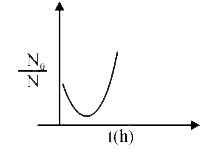
A bacterial infection in an internal wound grows as `N'(t) = N_(0) exp (t)`, where the time t is in hours.A dose of antibiotic, taken orally, needs 1 hour to reach the wound. Once it reaches there, the bacterial population goes down as `(dN)/(dt)= -5 N^(2)`. What will be the plot of `N_(0)/N` vs. t after 1 hour?

A

B

C

D

Text Solution

AI Generated Solution

The correct Answer is:

To solve the problem, we need to analyze the growth of the bacterial population and the effect of the antibiotic over time. Let's break it down step by step. ### Step 1: Determine the bacterial population before the antibiotic reaches the wound The growth of the bacterial population is given by the equation: \[ N'(t) = N_0 e^t \] where \( N_0 \) is the initial population at \( t = 0 \). To find the population at \( t = 1 \) hour, we can integrate this equation: \[ N(t) = \int N'(t) dt = \int N_0 e^t dt = N_0 e^t + C \] At \( t = 0 \), \( N(0) = N_0 \), so: \[ N(0) = N_0 e^0 + C \] \[ N_0 = N_0 + C \] Thus, \( C = 0 \). Therefore, the bacterial population at \( t = 1 \) hour is: \[ N(1) = N_0 e^1 = N_0 e \] ### Step 2: Analyze the effect of the antibiotic after it reaches the wound After 1 hour, the antibiotic starts to take effect, and we have the differential equation: \[ \frac{dN}{dt} = -5N^2 \] We can rearrange this equation: \[ \frac{dN}{N^2} = -5 dt \] ### Step 3: Integrate the equation Integrating both sides: \[ \int \frac{dN}{N^2} = \int -5 dt \] This gives: \[ -\frac{1}{N} = -5t + C' \] ### Step 4: Determine the constant of integration At \( t = 1 \), we know \( N(1) = N_0 e \): \[ -\frac{1}{N_0 e} = -5(1) + C' \] \[ C' = \frac{1}{N_0 e} + 5 \] ### Step 5: Substitute back to find \( N(t) \) Now substituting \( C' \) back into the integrated equation: \[ -\frac{1}{N} = -5t + \left(\frac{1}{N_0 e} + 5\right) \] Rearranging gives: \[ \frac{1}{N} = 5t - \frac{1}{N_0 e} - 5 \] ### Step 6: Find \( \frac{N_0}{N} \) Taking the reciprocal: \[ \frac{N_0}{N} = \frac{N_0 e}{5N_0 e(5t - 5 - \frac{1}{N_0 e})} \] This simplifies to: \[ \frac{N_0}{N} = 5N_0 e(5t - 5 - \frac{1}{N_0 e}) \] ### Step 7: Plot \( \frac{N_0}{N} \) vs. \( t \) The relationship we derived is linear in terms of \( t \), indicating that the plot of \( \frac{N_0}{N} \) vs. \( t \) will be a straight line. ### Conclusion The plot of \( \frac{N_0}{N} \) vs. \( t \) after 1 hour will be a straight line with a positive slope. ---

To solve the problem, we need to analyze the growth of the bacterial population and the effect of the antibiotic over time. Let's break it down step by step. ### Step 1: Determine the bacterial population before the antibiotic reaches the wound The growth of the bacterial population is given by the equation: \[ N'(t) = N_0 e^t \] where \( N_0 \) is the initial population at \( t = 0 \). ...
Promotional Banner

Topper's Solved these Questions

  • JEE MAIN REVISION TEST -14

    VMC MODULES ENGLISH|Exercise CHEMISTRY (SECTON 2)|5 Videos
  • JEE MAIN REVISION TEST - 7|JEE - 2020

    VMC MODULES ENGLISH|Exercise Chemistry (Section - 2) Numercial Value type|5 Videos
  • JEE MAIN REVISION TEST -17 (2020)

    VMC MODULES ENGLISH|Exercise CHEMISTRY|25 Videos

Similar Questions

Explore conceptually related problems

If y(t) is a solution of (1+t)(dy)/(dt)-t y=1a n dy(0)=-1 then show that y(1)=-1/2dot

If y(t) is a solution of (1+t)(dy)/(dt)-t y=1a n dy(0)=-1 then show that y(1)=-1/2dot

The half-life of a sample of a radioactive substance is 1 hour. If 8 xx 10^10 atoms are present at t = 0 , then the number of atoms decayed in the duration t = 2 hour to t = 4 hour will be

For the functions f(x)= int_(0)^(x) (sin t)/t dt where x gt 0 . At x=n pi f(x) attains

select the correct representation of density of population (N) which can be expressed after a period of time t+1 .

Internal energy of n moles of helium at temperature T_1 K is equal to the internal energy of 2n moles of oxygen gas at temperature T_2 K then the value of T_1 /T_2 will be

Write the indicated terms in each of the following sequences whose nth terms are: t_n=n^2(n+1): t_4, t_5

If in Bohr's model, for unielectronic atom, time period of revolution is represented as T_(n,z) where n represents shell no. and Z represents atomic number then the value of T_(1,2):T_(2,1) , will be :

If (7 + 4 sqrt(3))^(n) + 5 + t , where n and s are positive integers and t is a proper fraction , show that (1 - t) (s + t) = 1

Miriam and Jessica are growing bacteria in a laboratory. Miriam uses the growth function f(t)=n^(2t) to model her experiment while Jessica uses the function g(t)=((n)/(2))^(4t) to model her experiment. In each case, n represents the initial number of bacteria, and t is the time, in hours. If Miriam starts with 6 bacteria, how many bacteria should Jessica start with to achieve the same growth over time?
