Home
Class 12
PHYSICS
Which of the following graph represents ...

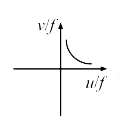
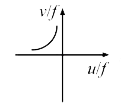
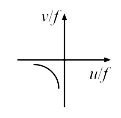
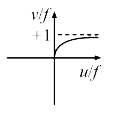
Which of the following graph represents v/f vs u/f graph for a virtual erect image by a diverging lens?

A

B

C

D

Text Solution

AI Generated Solution

The correct Answer is:

To solve the problem of identifying the correct graph that represents the relationship between \( v/f \) and \( u/f \) for a virtual erect image formed by a diverging lens, we can follow these steps: ### Step-by-Step Solution: 1. **Understand the Lens Formula**: For a diverging lens, the lens formula is given by: \[ \frac{1}{f} = \frac{1}{v} + \frac{1}{u} \] Here, \( f \) is the focal length, \( v \) is the image distance, and \( u \) is the object distance. For a diverging lens, both \( v \) and \( u \) are negative. 2. **Express \( v \) in terms of \( u \)**: Rearranging the lens formula gives: \[ \frac{1}{v} = \frac{1}{f} - \frac{1}{u} \] This can be rewritten as: \[ v = \frac{fu}{u - f} \] 3. **Introduce Velocity and Frequency**: If we consider the velocities \( v \) and \( u \) as proportional to the frequencies \( f \) and \( f' \) respectively, we can express: \[ \frac{v}{f} = \frac{fu}{f(u - f)} \] Simplifying this gives: \[ \frac{v}{f} = \frac{u}{u - f} \] 4. **Graphical Representation**: The relationship \( \frac{v}{f} = \frac{u}{u - f} \) suggests that as \( u \) increases, \( \frac{v}{f} \) approaches 1. This indicates that the graph will start from the origin (0,0) and will approach a horizontal asymptote at \( y = 1 \) as \( x \) approaches infinity. 5. **Identify the Correct Graph**: From the options provided, we need to identify a graph that starts at the origin and approaches \( y = 1 \) as \( x \) increases. This will typically be a hyperbolic shape that lies in the first quadrant. ### Conclusion: The correct graph that represents the relationship \( v/f \) vs \( u/f \) for a virtual erect image by a diverging lens will have the characteristics described above.

To solve the problem of identifying the correct graph that represents the relationship between \( v/f \) and \( u/f \) for a virtual erect image formed by a diverging lens, we can follow these steps: ### Step-by-Step Solution: 1. **Understand the Lens Formula**: For a diverging lens, the lens formula is given by: \[ \frac{1}{f} = \frac{1}{v} + \frac{1}{u} \] ...
Promotional Banner

Topper's Solved these Questions

  • JEE MAIN REVISION TEST - 26 (2020)

    VMC MODULES ENGLISH|Exercise PHYSICS (SECTION 2)|5 Videos
  • JEE MAIN REVISION TEST - 25 | JEE - 2020

    VMC MODULES ENGLISH|Exercise PHYSICS|25 Videos
  • JEE MAIN REVISION TEST - 27 - JEE -2020

    VMC MODULES ENGLISH|Exercise PHYSICS (SECTION 2)|5 Videos

Similar Questions

Explore conceptually related problems

Which of the following I-V graph represents ohmic conductors?

Which of the following graph between (x//m) vs P is correct?

Which of the following P-V diagram represent the graph of isometric process?

The following graph represents the titration of pH vs volume

Which of the following graphs represents the relationship between the force F between two point charges and the distance r between them :

Which of the following graph represents relation between the image position (v) and object position (u) from the concave lens.

Name the lens that always forms a virtual and erect image.

Which of the following form(s) a virtual and erect image for all position of the object?

Which of the following graph represent the function f (x) = int _(0) ^(sqrtx) e ^((u ^(2))/(x )) du, for x gt 0 and f (0) =o"
