Home
Class 12
MATHS
f: (0,oo) to (-pi/2,pi/2)" be defined as...

`f: (0,oo) to (-pi/2,pi/2)" be defined as, "f(x)=tan^(-1) (log_(e)x)`.
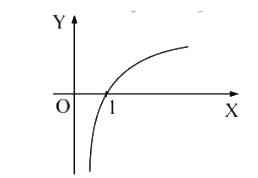
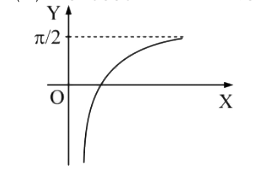
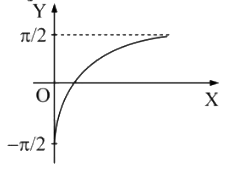
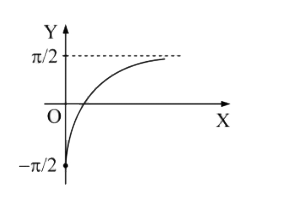
The graph of y = f (x) is best represented by

A

B

C

D

Text Solution

AI Generated Solution

The correct Answer is:

To analyze the function \( f(x) = \tan^{-1}(\log_e x) \) and determine the behavior of its graph, we will follow these steps: ### Step 1: Determine the limit of \( f(x) \) as \( x \) approaches 0 from the right. We start by evaluating \( f(x) \) as \( x \) approaches 0 from the right: \[ \lim_{x \to 0^+} f(x) = \lim_{x \to 0^+} \tan^{-1}(\log_e x) \] As \( x \) approaches 0, \( \log_e x \) approaches \( -\infty \). Therefore: \[ \lim_{x \to 0^+} f(x) = \tan^{-1}(-\infty) = -\frac{\pi}{2} \] ### Step 2: Determine the limit of \( f(x) \) as \( x \) approaches infinity. Next, we evaluate \( f(x) \) as \( x \) approaches infinity: \[ \lim_{x \to \infty} f(x) = \lim_{x \to \infty} \tan^{-1}(\log_e x) \] As \( x \) approaches infinity, \( \log_e x \) approaches \( +\infty \). Therefore: \[ \lim_{x \to \infty} f(x) = \tan^{-1}(\infty) = \frac{\pi}{2} \] ### Step 3: Analyze the behavior of \( f(x) \) in the interval \( (0, \infty) \). Since \( f(x) \) is continuous in the interval \( (0, \infty) \) and we have established the limits at both ends: - As \( x \to 0^+ \), \( f(x) \to -\frac{\pi}{2} \) - As \( x \to \infty \), \( f(x) \to \frac{\pi}{2} \) ### Step 4: Conclusion about the graph of \( f(x) \). The function \( f(x) \) is increasing because the logarithm function is increasing and the arctangent function is also increasing. Therefore, the graph of \( f(x) \) will start from \( -\frac{\pi}{2} \) at \( x = 0 \) and approach \( \frac{\pi}{2} \) as \( x \) goes to infinity. ### Final Answer: The graph of \( y = f(x) \) is best represented by a curve that starts from \( -\frac{\pi}{2} \) and approaches \( \frac{\pi}{2} \) as \( x \) increases. ---
Promotional Banner

Topper's Solved these Questions

  • DIFFERENTIAL CALCULUS 2

    VMC MODULES ENGLISH|Exercise Numerical ValueType for JEE Main|14 Videos
  • DIFFERENTIAL CALCULUS 2

    VMC MODULES ENGLISH|Exercise JEE Main (Archive)|36 Videos
  • DIFFERENTIAL CALCULUS 2

    VMC MODULES ENGLISH|Exercise Level -1|102 Videos
  • DIFFERENTIAL CALCULUS

    VMC MODULES ENGLISH|Exercise JEE Advanced (Archive)|75 Videos
  • DIFFERENTIAL EQUATIONS

    VMC MODULES ENGLISH|Exercise JEE ADVANCE (ARCHIVE )|32 Videos

Similar Questions

Explore conceptually related problems

f: (0,oo) to (-pi/2,pi/2)" be defined as, "f(x)=tan^(-1) (log_(e)x) . The above function can be classified as :

f: (0,oo) to (-pi/2,pi/2)" be defined as, "f(x)=tan^(-1) (log_(e)x) . If x_(1),x_(2) and x_(3) are the points at which g(x) =[f (x)] is discontinuous (where, [.] denotes the greatest integer function), then (x_(1)+x_(2)+x_(3))" is :"

Let f : R to [0, pi/2) be defined by f ( x) = tan^(-1) ( 3x^(2) + 6x + a)". If " f(x) is an onto function . then the value of a si

Let f : I - {-1,0,1} to [-pi, pi] be defined as f(x) = 2 tan^(-1) x - tan^(-1)((2x)/(1 -x^(2))) , then which of the following statements (s) is (are) correct ?

Let f: (e, oo) -> R be defined by f(x) =ln(ln(In x)) , then

Let f:(-pi/2,pi/2)-> RR be given by f(x) = (log(sec x + tan x))^3 Then which of the following is wrong?

Let f: R ->[0,pi/2) be defined by f(x)=tan^(-1)(x^2+x+a)dot Then the set of values of a for which f is onto is (a) (0,oo) (b) [2,1] (c) [1/4,oo] (d) none of these

If f : [0, oo) rarr [2, oo) be defined by f(x) = x^(2) + 2, AA xx in R . Then find f^(-1) .

Let a function f:R to R be defined as f (x) =x+ sin x. The value of int _(0) ^(2pi)f ^(-1)(x) dx will be:

The function f(x)=(log(pi+x))/(log(e+x)) s is

VMC MODULES ENGLISH-DIFFERENTIAL CALCULUS 2-Level -2
  1. Let f(x) be a non-constant twice differentiable function defined on (-...

    Text Solution

    |

  2. f: (0,oo) to (-pi/2,pi/2)" be defined as, "f(x)=tan^(-1) (log(e)x). ...

    Text Solution

    |

  3. f: (0,oo) to (-pi/2,pi/2)" be defined as, "f(x)=tan^(-1) (log(e)x). ...

    Text Solution

    |

  4. f: (0,oo) to (-pi/2,pi/2)" be defined as, "f(x)=tan^(-1) (log(e)x). ...

    Text Solution

    |

  5. Given a function f:[0,4]toR is differentiable ,then prove that for som...

    Text Solution

    |

  6. With the help of Lagrange's formula, prove that (a-b)/(a) le log (a/b)...

    Text Solution

    |

  7. The function f(x)=int(0)^(x)sqrt(1-t^(4)) dt is such that

    Text Solution

    |

  8. The function (sin(x+a))/(sin(x+b)) has no maxima or minima if

    Text Solution

    |

  9. The set of value(s) of a for which the function f(x)=(a x^3)/3+(a+2)x^...

    Text Solution

    |

  10. If f(x) is a cubic polynomial which has local maximum at x=-1,If f(2...

    Text Solution

    |

  11. If f(x) is a polynomial of degree 4 having extremum at x=1,2 and lim(x...

    Text Solution

    |

  12. The maximum value of the function f(x)=3x^(3)-18x^(2)+27x-40 on the s...

    Text Solution

    |

  13. If the function f(x)=x^(4)+bx^(2)+8x+1 has a horizontal tangent and a...

    Text Solution

    |

  14. Let p(x) be a real polynomial of least degree which has a local maximu...

    Text Solution

    |

  15. The equation x^3-3x+[a]=0, where [*] denotes the greatest integer func...

    Text Solution

    |

  16. If the function f:[0,4]vecR is differentiable, the show that for a , b...

    Text Solution

    |

  17. For a twice differentiable function f(x),g(x) is defined as g(x)=f^(pr...

    Text Solution

    |

  18. A function y=f(x) has a second-order derivative f''(x)=6(x-1)dot It it...

    Text Solution

    |

  19. Function f(x), g(x) are defined on [-1, 3] and f''(x) > 0, g''(x) > 0 ...

    Text Solution

    |

  20. If a << b << c << d and x in R then the least value of the function,...

    Text Solution

    |
