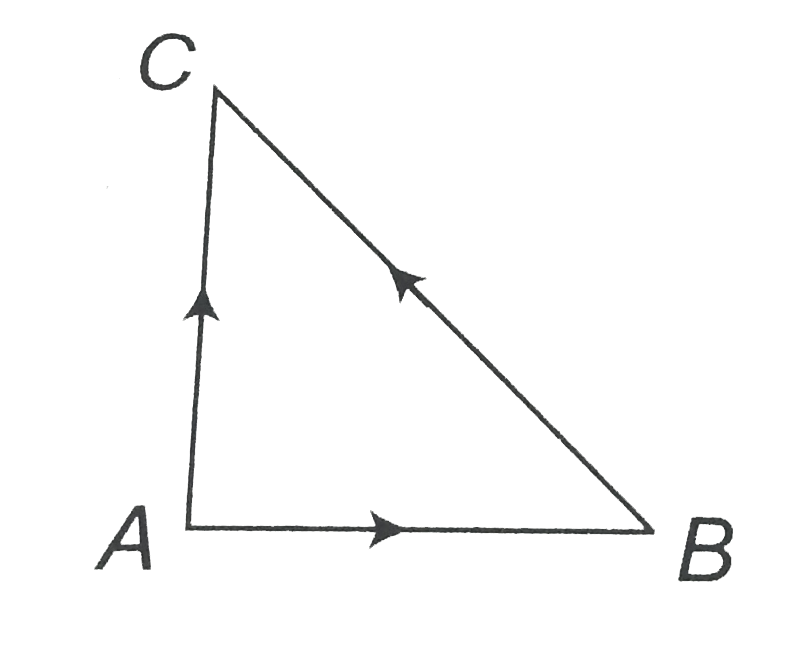
A
B
C
D
Text Solution
Verified by Experts
The correct Answer is:



Topper's Solved these Questions
INTRODUCTION TO VECTORS & FORCES
VMC MODULES ENGLISH|Exercise JEE Advanced ( ARCHIVE LEVEL-2)|12 VideosINTRODUCTION TO VECTORS & FORCES
VMC MODULES ENGLISH|Exercise level 2|65 VideosGRAVITATION
VMC MODULES ENGLISH|Exercise JEE Advance (Archive) TRUE/FALSE|1 VideosJEE MAIN - 5
VMC MODULES ENGLISH|Exercise PART I : PHYSICS (SECTION - 2)|5 Videos
Similar Questions
Explore conceptually related problems
VMC MODULES ENGLISH-INTRODUCTION TO VECTORS & FORCES -JEE Main ( ARCHIVE ) ( LEVEL-1)
- Two forces are such that the sum of their magnitudes is 18N and their ...
Text Solution
|
- When forces F(1) , F(2) , F(3) are acting on a particle of mass m such...
Text Solution
|
- Three forces start acting simultaneously on a particle moving with vel...
Text Solution
|
- A horizontal force of 10N is necessary to just hold a block stationary...
Text Solution
|
- If barA xx barB =barB xx barA then the angle between A and B is :
Text Solution
|
- A block rests on a rough inclined plane making an angle of 30^@ with t...
Text Solution
|
- The minimum force required to start pushing a body up rough (frictiona...
Text Solution
|
- A person climbs up a stalled escalator in 60s. If standing on the same...
Text Solution
|
- A heavy box is to be dragged along a rough horizontal floor. To do so,...
Text Solution
|
- A uniform sphere of weight W and radius 5 cm is being held by string a...
Text Solution
|
- Given in the figure are two blocks A and B of weight 20 N and 100 N re...
Text Solution
|
- Two moasses m(1)=5kg and m(2)=10kg, connected by an inextensible strin...
Text Solution
|