Home
Class 12
PHYSICS
Two moasses m(1)=5kg and m(2)=10kg, conn...

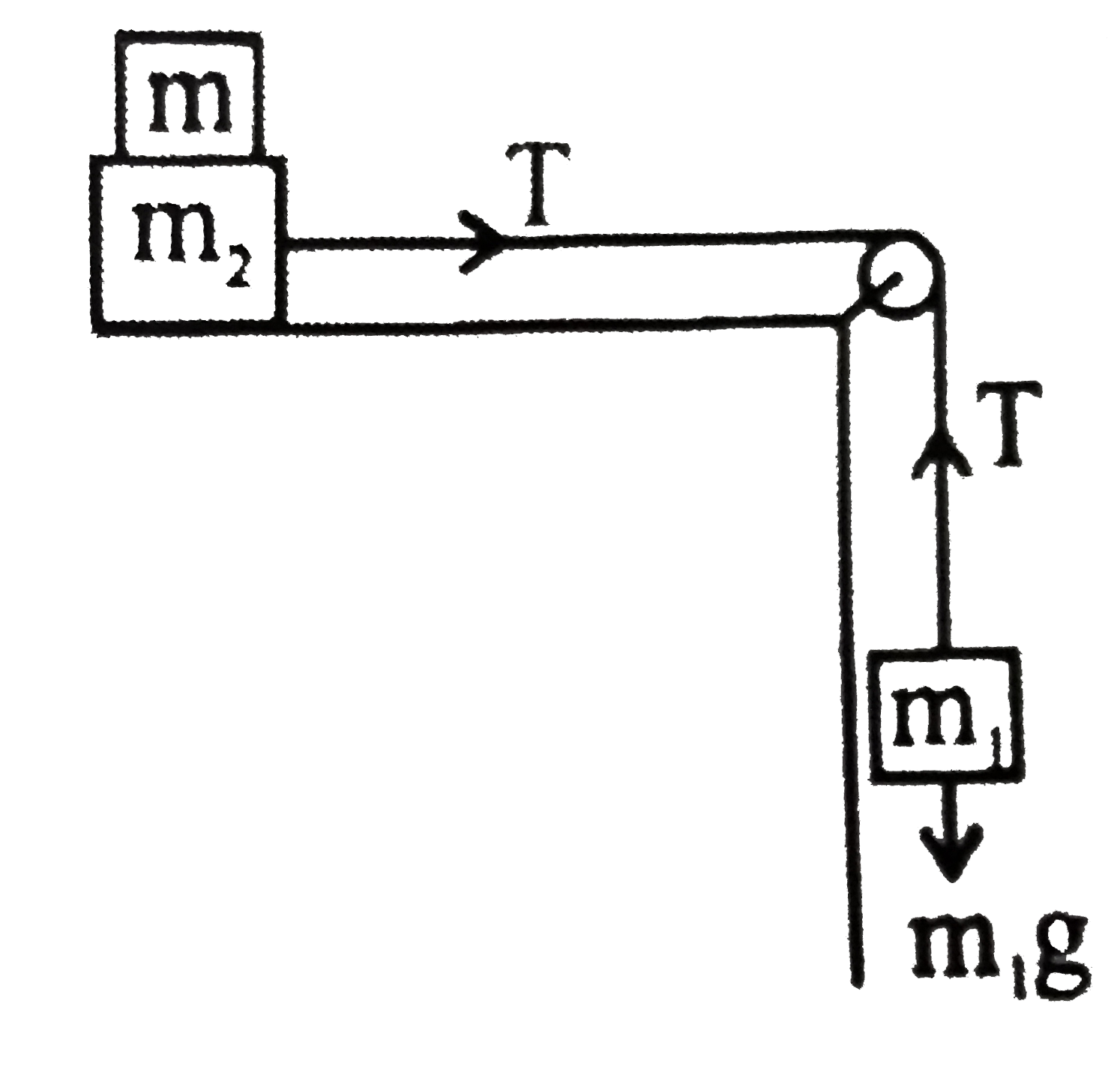
Two moasses `m_(1)=5kg and m_(2)=10kg,` connected by an inextensible string over a frictionless pulley, are moving as shown in the figure. The coefficient of friction of horizontal surface is `0.15.` The minimum weitght m that should be put on top of `m_(2)` to stop the motion is :-

A

43.3 kg

B

10.3 kg

C

18.3 kg

D

27.3 kg

Text Solution

Verified by Experts

The correct Answer is:
d

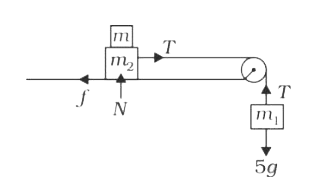
for `m_(1)` to be at rest
T=5g
for m & `m_(2)` to be at rest
`f=T =5g fle mu (N)`
`rarr f le 0.15 m +m_(2) g rarrr m ge 23.33 kg`
amongst the options minimum mass that can be kept for no motion is 27.3 kg
Promotional Banner

Topper's Solved these Questions

  • INTRODUCTION TO VECTORS & FORCES

    VMC MODULES ENGLISH|Exercise JEE Advanced ( ARCHIVE LEVEL-2)|12 Videos
  • INTRODUCTION TO VECTORS & FORCES

    VMC MODULES ENGLISH|Exercise level 2|65 Videos
  • GRAVITATION

    VMC MODULES ENGLISH|Exercise JEE Advance (Archive) TRUE/FALSE|1 Videos
  • JEE MAIN - 5

    VMC MODULES ENGLISH|Exercise PART I : PHYSICS (SECTION - 2)|5 Videos

Similar Questions

Explore conceptually related problems

Two blocks of masses of 40 kg and 30 kg are connected by a weightless string passing over a frictionless pulley as shown in the figure.

Two masses of 10 kg and 20 kg are connected with an inextensible string passing over two smooth pulleys as shown in the figure. The acceleration of 20 kg mass will be :

Two blocks A and B of respective masses 6 kg and 4 kg are connected with a string passing over a light friction less pulley as shown in the figure . The coefficient of friction between the block A and horizontal surface is 0.4 . Then the minimum mass of block C which should be placed over A to prevent it from moving is :

Two masses A and B of 15 kg and 10 kg are connected with a string passing over a frictionless pulley fixed at the corner of a table (as shown in figure). The coefficient of friction between the table and block is 0.4. The minimum mass of C, that may be placed on A to prevent it from moving is:

Two blocks of masses m_(1) and m_(2) are connected by a string of negligible mass which pass over a frictionless pulley fixed on the top of an inclined plane as shown in figure. The coefficient of friction between m_(1) and plane is mu .

Two masses m_1=5kg and m_2=4.8kg tied to a string are hanging over a light frictionless pulley. What is the acceleration of the masses when left free to move?

Two blocks of masses m_(1) and m_(2)(m_(1) gt m_(2)) connected by a massless string passing over a frictionless pulley Magnitude of acceleration of blocks would be

Two masses A and B of 10 kg and 5 kg , respectively , are connected with a string passing over a frictionless pulley fixed at the corner of a table as shown. The coefficient of static friction between A and the table is 0.2 . The minimum mass C that should be placed on A to prevent it from moving is equal to

Two masses A and B of 10 kg and 5 kg , respectively , are connected with a string passing over a frictionless pulley fixed at the corner of a table as shown. The coefficient of static friction between A and the table is 0.2 . The minimum mass C that should be placed on A to prevent it from moving is equal to

Two masses m_(1) =10 Kg and m_(2)=5kg are connected by an ideal string as shown in the figure. The coefficient of friction between m_(1) and the surface is mu=0.2 Assuming that the system is released from rest calculate the velocity of blocks when m_(2) has descended by 4m . (g=10 m//s^(2)) .

