Home
Class 12
PHYSICS
A ballon of mass m is rising up with an ...

A ballon of mass m is rising up with an acceleration a show that the fraction og weight of balloon that must be detached in order to double its acceleration , assuming the upthrust of air to remain the same

Text Solution

Verified by Experts
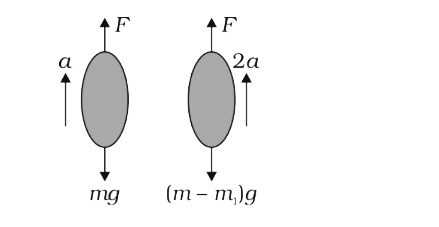
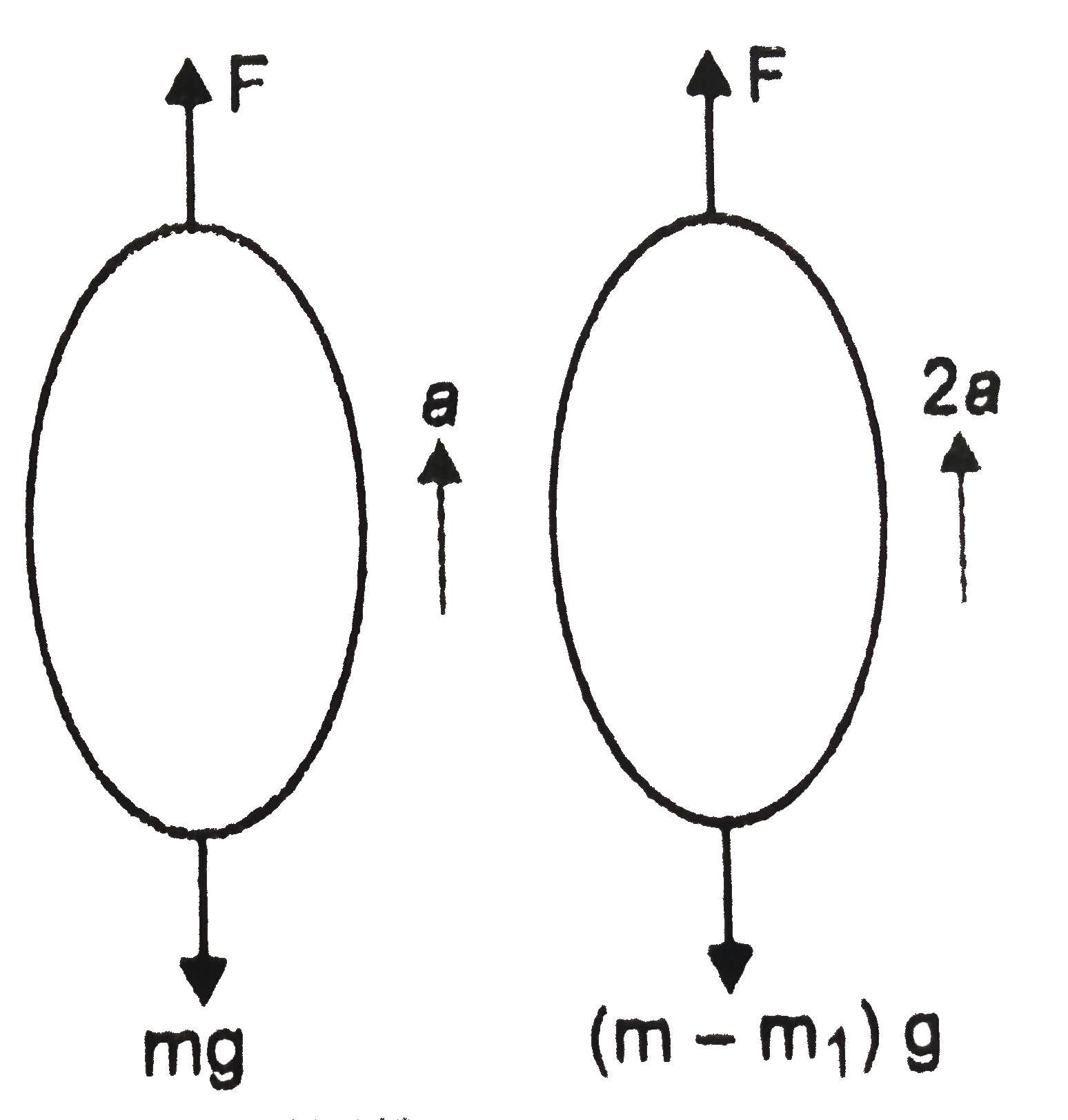
Let F be the upthrust of air. As the balloon rises with acceleration a (see figure)
`:. F - mg = ma` or f = m (g + a) - (i)
When was `m_(1)` is removed from the ballon, acceleration becomes (2 a). Therefore
`F - (m - m_(1)) g = (m - m_(1)) 2a`
or `F = (m - m_(1)) (g + 2a)`
From (i) and (ii), `(m - m_(1)) (g + 2a) = m (g + a)`
`m = m_(1) = m (g + a)// (g + 2a)`, `m_(1) = m - (m(g + a))/(g + 2a) = (ma)/(g + 2a)`
Promotional Banner

Topper's Solved these Questions

  • DYNAMICS OF A PARTICLE

    VMC MODULES ENGLISH|Exercise LEVEL 0 (LONG ANSWER TYPE)|4 Videos
  • DYNAMICS OF A PARTICLE

    VMC MODULES ENGLISH|Exercise LEVEL 1|75 Videos
  • DYNAMICS OF A PARTICLE

    VMC MODULES ENGLISH|Exercise LEVEL 0 (SHORT ANSWER TYPE - I)|7 Videos
  • DC CIRCUIT

    VMC MODULES ENGLISH|Exercise JEE ADVANCED ARCHIVE|68 Videos
  • ELECTROMAGNETIC INDUCTION & ALTERNATING CURRENT

    VMC MODULES ENGLISH|Exercise IN-CHAPTER EXERCISE-G|10 Videos

Similar Questions

Explore conceptually related problems

A balloon os mass 2 KG is rising up with an acceleration of 4m/s^2 . The upward force acting on the balloon is (g = 10 ms^-2)

A balloon of mass m is descending down with an acceleration How much mass should be g/2 removed from it so that it starts moving up with same acceleration?

A balloon of mass M descends with an acceleration a_(0) . The mass that must be thrown out in order to give the balloon an equal upwards acceleration will be

A balloon of mass M is descending at a constant acceleration a When a mass m is released from the balloon it starts rising with the same acceleration a.(Assuming that its volume does not change),what is the value of m

A balloon with mass m is descending down with an acceleration a (where altg) . How much mass should be removed from it so that it starts moving up with an acceleration a?

A balloon of mass 10 kg is raising up with an acceleration of 20 ms^(-2) . If a mass of 4 kg is removed from the balloon its acceleration becomes ( take, g=10ms^(-2) )

A balloons of mass M is descending at a constant acceleration alpha . When a mass m is released from the balloon, it starts rising. With the same acceleration alpha . Assuming that its volumes does not change, what is the valule of m?

A balloon is descending with a constant acceleration a, less than the acceleration due to gravity g. The weight of the balloon, with its basket and contents, is w. What weight w, should be released so that the balloon will begin to accelerate upward with constant acceleration a? Neglect air resistance.

A pulley fixed to the ceiling of an elevator car carries a thread whose ends are attached to the masses m_(1) and m_(2) . The car starts going up with an acceleration a_(0) . Assuming the masses of the pulley and the thread as well as the friction to be negligible, find: (a) the acceleration of the load m_(1) relative to the elevator shaft and relative to the car (b) the force exerted by the pulley on the ceiling of the car. Given m_(1) gt m_(2) .

A person of mass m is on the floor of a lift. The lift is moving down with an acceleration 'a'. Then : a) the net force is acting in downward direction and is equal to mg b) the force mg must be greater than reaction force c) the man appears to be lighter than his true weight by a factor (a/g)

