Home
Class 12
PHYSICS
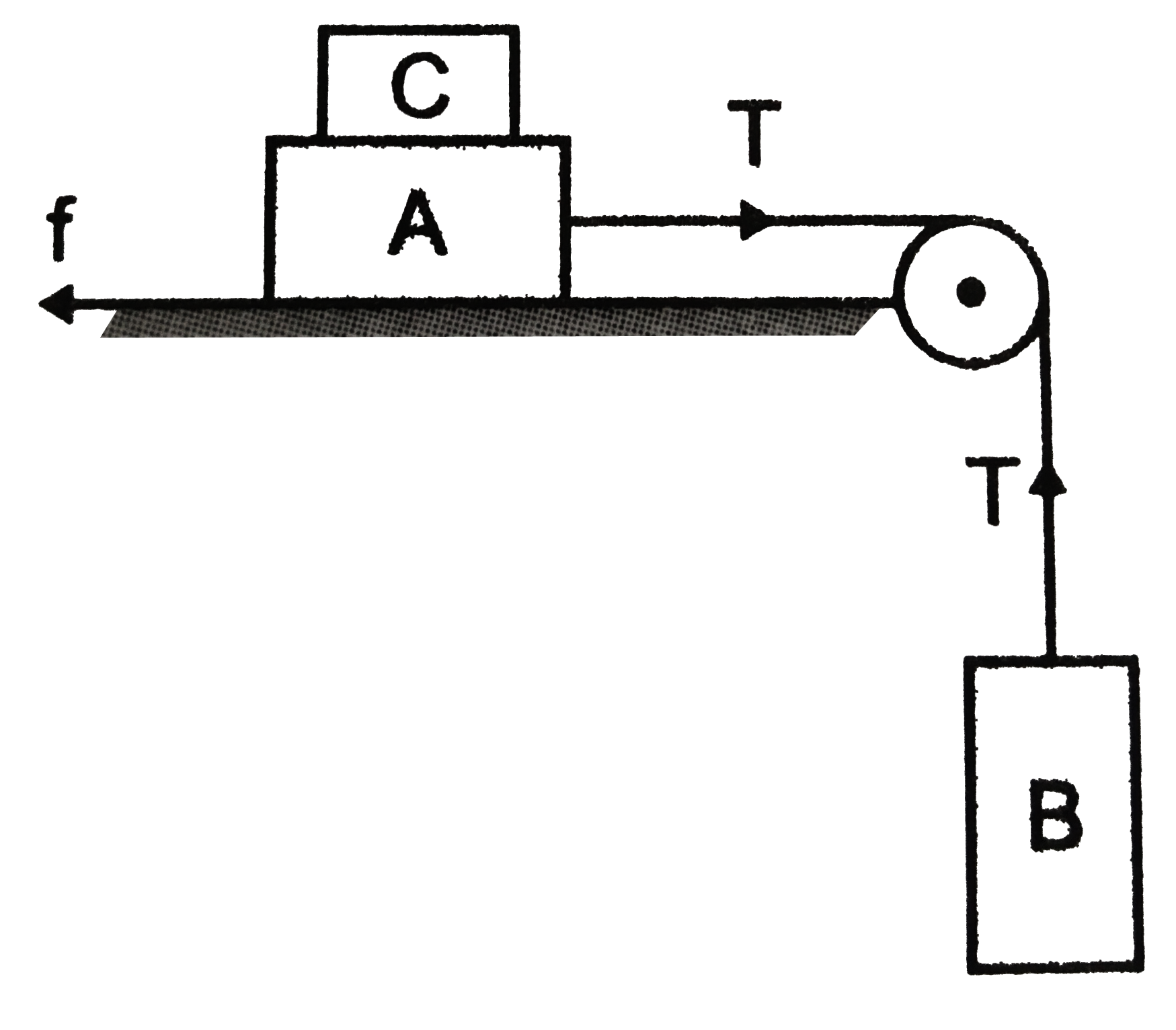
In the masses of A and B are 10 kg and 5...

In the masses of A and B are 10 kg and 5 kg . Calculate the minimum mass of C which may stop A from slipping Coefficient of static friction between block A and table is 0.2
.

Text Solution

Verified by Experts

Here, `m_(A) = 10 kg, m_(B) = kg`, `m_(c) = ? Mu = 0.2`
To avoid slipping of A, Force of friction = T = wt. of B
`mu (m_(c) + m_(A)) g = M_(B) g` 0.2 (m + 10) s, `m + 10 = (5)/(0.2) = 25` m = 25 - 10 = 15 kg
Promotional Banner

Topper's Solved these Questions

  • DYNAMICS OF A PARTICLE

    VMC MODULES ENGLISH|Exercise LEVEL 0 (LONG ANSWER TYPE)|4 Videos
  • DYNAMICS OF A PARTICLE

    VMC MODULES ENGLISH|Exercise LEVEL 1|75 Videos
  • DYNAMICS OF A PARTICLE

    VMC MODULES ENGLISH|Exercise LEVEL 0 (SHORT ANSWER TYPE - I)|7 Videos
  • DC CIRCUIT

    VMC MODULES ENGLISH|Exercise JEE ADVANCED ARCHIVE|68 Videos
  • ELECTROMAGNETIC INDUCTION & ALTERNATING CURRENT

    VMC MODULES ENGLISH|Exercise IN-CHAPTER EXERCISE-G|10 Videos

Similar Questions

Explore conceptually related problems

A block on table shown in figure is just on the wedge of slipping. Find the coefficient of static friction between the block and table top.

Block B of mass m_(B) = 0.5 kg rests on block A, with mass m_(A) = 1.5kg which in turn is on a horizontal tabletop (as shown in figure) .The coefficient of kinetic friction between block A and the tabletop is mu_(k) = 0.4 and the coefficient of static friction between block A and blockB is mu_(s) = 0.6 A light string attached block A passes over a frictionless, massless pulley and block C is suspeneded from the other end of the string. What is the largest mass m_(c) (in kg) that block C can have so that block A and B still slide together when the system is relaced from rest?

In the arrangement shown in figure mass of blocks A,B and C is 18.5 kg .8 kg and 1.5 kg respectively . The bottom surface of A is A is smooth while coefficient of friction that between block A and C is mu_(1) = 1//3 between B and floor is mu_(2) = 1//5 System is relased from rest r = 0 and pulley are light and friction Calculate acceleration of block A ,B and C

Two masses A and B of 10 kg and 5 kg , respectively , are connected with a string passing over a frictionless pulley fixed at the corner of a table as shown. The coefficient of static friction between A and the table is 0.2 . The minimum mass C that should be placed on A to prevent it from moving is equal to

Two masses A and B of 10 kg and 5 kg , respectively , are connected with a string passing over a frictionless pulley fixed at the corner of a table as shown. The coefficient of static friction between A and the table is 0.2 . The minimum mass C that should be placed on A to prevent it from moving is equal to

A block of mass 2kg rests on a rough inclined plane making an angle of 30^@ with the horizontal. The coefficient of static friction between the block and the plane is 0.7. The frictional force on the block is

A block of mass 2kg rests on a rough inclined plane making an angle of 30^@ with the horizontal. The coefficient of static friction between the block and the plane is 0.7. The frictional force on the block is

A block B of mass 5kg is placed on a slab A of mass 20kg which lies on a frictionless surface as shown in the figure. The coefficient of static friction between the block and the slab is 0.4 and that of kinetic friction is 0.2. If a force F = 25N acts on B, the acceleration of the slab will be:

In fig. A is a 1kg block and B is a 0.5kg block. (a) Find the minimum weight of block C which must be placed on A to keep it from sliding , if mu_(s) between A and the table is 0.2 . The block C is suddenly lifted off A. What is the acceleration of block A if mu_(k) between A and the table is 0.2 ?

A block of mass 3 kg rests on a rough inclined plane making an angle of 30^(@) . With the horizontal. The coefficient of static friction between the block and the plane is 0.7. The frictional force on the block is

