Home
Class 12
PHYSICS
A block of mass m is pressed against a w...

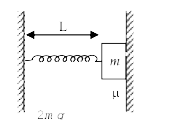
A block of mass m is pressed against a wall by a spring as shown in the figure. The spring has natural length , `l (l gt L)`, and the coefficient of friction between the block and the wall is `mu` . The minimum spring constant K necessary for equilibrium is:

A

(a)`(2 mg)/(mu (l - L))`

B

(b)`(mg)/(mu(l - L))`

C

(c)`(mg)/(2mu (l - L))`

D

(d)`(2 mg)/(mu l)`

Text Solution

Verified by Experts

The correct Answer is:

B

`N = k (l - L) implies F_("max") = mu k (l - L)`
For equilibrium : `mg le f_("max") implies mg le mu k (l - L)` `implies k ge (mg)/(mu (l - L))`
Promotional Banner

Topper's Solved these Questions

  • DYNAMICS OF A PARTICLE

    VMC MODULES ENGLISH|Exercise LEVEL 2|49 Videos
  • DYNAMICS OF A PARTICLE

    VMC MODULES ENGLISH|Exercise LEVEL 2 ( NUMERICAL TYPE FOR JEE MAIN )|16 Videos
  • DYNAMICS OF A PARTICLE

    VMC MODULES ENGLISH|Exercise LEVEL 0 (LONG ANSWER TYPE)|4 Videos
  • DC CIRCUIT

    VMC MODULES ENGLISH|Exercise JEE ADVANCED ARCHIVE|68 Videos
  • ELECTROMAGNETIC INDUCTION & ALTERNATING CURRENT

    VMC MODULES ENGLISH|Exercise IN-CHAPTER EXERCISE-G|10 Videos

Similar Questions

Explore conceptually related problems

A block of mass 1 kg is pressed against a wall by applying a horizontal force of 10N on the block. If the coefficient of friction between the block and the wall is 0.5, magnitude of the frictional force acting on the block is

A block of mass m is suspended by different springs of force constant shown in figure.

A block of mass M is held against a rough vertical wall by pressing it with a finger . If the coefficient of friction between the block and the wall is mu and the acceleration due to gravity is g , calculate the minimum force required to be applied by the finger to hold the block against the wall.

A block of mass M is held against a rough vertical wall by pressing it with a finger . If the coefficient of friction between the block and the wall is mu and the acceleration due to gravity is g , calculate the minimum force required to be applied by the finger to hold the block against the wall.

A block of mass m is connected to a spring of spring constant k as shown in figure. The frame in which the block is placed is given an acceleration a towards left. Neglect friction between the block and the frame walls. The maximum velocity of the block relative to the frame is

A block of mass m compresses a spring iof stifffness k through a distacne l//2 as shown in the figure .If the block is not fixed to the spring the period of motion of the block is

Two block of same mass'm' are joined with an dideal spring of spring constant k and sept on a rough surface as shown in figure. The spring is initially unstretched and coefficient of friction between the blocks and horizontal surface is mu and 2 mu respectively. What should be the maximum speed of block 'A' such that the block 'B' does not move ?

A block of mass m is attached with a spring in vertical plane as shown in the figure. If initially spring is in its natural length and the block is released from rest, then maximum extension in the spring will be

A block of mass m is attached to one end of a mass less spring of spring constant k. the other end of spring is fixed to a wall the block can move on a horizontal rough surface. The coefficient of friction between the block and the surface is mu then the compession of the spring for which maximum extension of the spring becomes half of maximum compression is .

A spring, placed horizontally on a rough surface is compressed by a block of mass m, placed on the same surface so as to store maximum energy in the spring. If the coefficient of friction between the block and the surface is mu , the potential energy stored in the spring is

VMC MODULES ENGLISH-DYNAMICS OF A PARTICLE-LEVEL 1
  1. Consider the situation shown in the figure. Find acceleration of...

    Text Solution

    |

  2. Consider the situation shown in the figure. Find acceleration of...

    Text Solution

    |

  3. In the pulley-block arrangement shown in figure , find the relation be...

    Text Solution

    |

  4. Find the relation between acceleration a(1) and a(2)

    Text Solution

    |

  5. A sphere of radius R is in contact with a wedge. The point of contact ...

    Text Solution

    |

  6. A block can slide on a smooth inclined plane of inclination theta kept...

    Text Solution

    |

  7. A block is sliding along an inclined plane as shown in figure . If the...

    Text Solution

    |

  8. In the figure the wedge is pushed with an acceleration of sqrt3 m//s ^...

    Text Solution

    |

  9. A small ball is suspended by a string from the ceiling of a car. As th...

    Text Solution

    |

  10. All the surfaces are smooth as shown in figure. The acceleration of ma...

    Text Solution

    |

  11. An object is kept on a smooth inclined plane of height 1 unit and len...

    Text Solution

    |

  12. Consider the situation as shown in the figure. All the surface are smo...

    Text Solution

    |

  13. In the given situation, what is the minimum mass of block A so that bl...

    Text Solution

    |

  14. A body of mass 8 kg is suspended through two light springs X and Y con...

    Text Solution

    |

  15. A dynamometer D is attached to two bodies of masses M=6 kg and m=4 kg....

    Text Solution

    |

  16. A block of mass m is pressed against a wall by a spring as shown in th...

    Text Solution

    |

  17. A block A of mass M rests on a wedge B of mass 2M and inclination thet...

    Text Solution

    |

  18. A mass of 10 kg is suspended from a spring balance. It is pulled aside...

    Text Solution

    |

  19. The masses of 10 kg and 20 kg, respectively, are connected by a light ...

    Text Solution

    |

  20. Two block of mass 4 kg and 5 kg attached a light spring are suspended ...

    Text Solution

    |
