Home
Class 12
PHYSICS
Two Camot engines A and B are operated i...

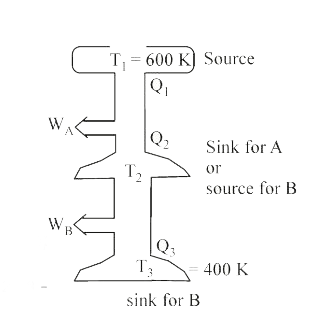
Two Camot engines A and B are operated in series. The first one, A , receives heat at `T_(1)(=600 K)` and rejects to a reservoir at temperature `T_(2)`. The second engine B receives heat rejected by the first engine and, in turn, rejects to a heat reservoir at `T_(3)(=400K).` Calculate the temperature `T_(2)` if the work outputs of the two engines are equal :

A

`600 K`

B

`300 k`

C

`500 k`

D

`400 K`

Text Solution

Verified by Experts

The correct Answer is:
C

`W_A=W_B`
`Q_1-Q_2=Q_2-Q_3`
`implies (Q_1)/(Q_2)-1=1-(Q_3)/(Q_2)`,
`(600+400)/(T_2)=2`
Promotional Banner

Topper's Solved these Questions

  • GASEOUS STATE & THERMODYNAMICS

    VMC MODULES ENGLISH|Exercise JEE ADVANCED (ARCHIVE )|111 Videos
  • GASEOUS STATE & THERMODYNAMICS

    VMC MODULES ENGLISH|Exercise Level - 2|40 Videos
  • ENERGY & MOMENTUM

    VMC MODULES ENGLISH|Exercise JEE ADVANCE (ARCHIVE) - TRUE/FALSE TYPE|1 Videos
  • GRAVITATION

    VMC MODULES ENGLISH|Exercise JEE Advance (Archive) TRUE/FALSE|1 Videos

Similar Questions

Explore conceptually related problems

Two carnot engines A and B are operated in series. The first one A receives heat at 900K and rejects it to a reservoir at T K . The second engine B receives the heat rejected by the first engine and rejects it to a heat reservoir at 400K . Calculate the value of T , when the efficiency of two engines is the same.

Two carnot engines A and B are operated in series. The first one A receives heat at 900K and rejects it to a reservoir at T K . The second engine B receives the heat rejected by the first engine and rejects it to a heat reservoir at 400K . Calculate the value of T , when the efficiency ot two engines is the same.

Two carnot engines A and B are operated in series .Engine A receives heat from a reservoier at 600 K and rejectrs heat to a reservoir at temperatures T. Engine B receives heat rejected by engine A and in turn rejects it to a reservoir at 100 K .If the efficiencies of the two engines A and B are represented by eta_(A) and eta_(B) repectively then what is the value of (eta_(B))/(eta_(A)) ?

Two Carnot engines A and B are operated in series. The engine A receives heat from the source at temperature T_1 and rejects the heat to the sink at temperature T. The second engine B receives the heat at temperature T and rejects to its sink at temperature T_(2) . For what value of T the efficiencies of the two engines are equal?

Two ideal Carnot engines operate in cascade (all heat given up by one engine is used by the other engine to produce work) between temperatures, T_(1) and T_(2) . The temperature of the hot reservoir of the first engine is T_(1) and the temperature of the cold reservoir of the second engine is T_(2) . T is temperature of the sink of first engine which is also the source for the second engine. How is T related to T_(1) and T_(2) , if both the engines perform equal amount of work?

A Carnot engine absorbs 750 J of heat energy from a reservoir at 137^(@)C and rejects 500 J of heat during each cycle then the temperature of sink is

A heat engine operates between a cold reservoir at tempreture T_(2)=300 K and a hot reservior at tempreture T_(1) . It takes 200 J of heat from the hot reservior and delivers 120 J of heat to the cold reservior in a cycle. What could be the minimum tempreture of the hot reservior ?

A carnot engine operates between two reservoirs of temperature 900K and 300K. The engine performs 1200 J of work per cycle. The heat energy delivered by the engine to the low temperature reservoir in a cycle is:

A carnot engine operates between two reservoirs of temperature 900K and 300K. The engine performs 1200 J of work per cycle. The heat energy delivered by the engine to the low temperature reservoir in a cycle is:

A Carnot's engine works as refrigerator between 250 K and 300K. It receives 500 cal heat from the reservoir at the lower temperature. The amount of work done in each cycle to operate the refrigerator is :

VMC MODULES ENGLISH-GASEOUS STATE & THERMODYNAMICS-JEE MAIN (ARCHIVE )
  1. The mass of hydrogen molecule is 3.32xx10^(-27) kg. If 10^(23) hydroge...

    Text Solution

    |

  2. Two moles of an ideal monatomic gas occupies a volume V at 27 °C. The ...

    Text Solution

    |

  3. Two Camot engines A and B are operated in series. The first one, A , r...

    Text Solution

    |

  4. A mass M = 15 g of nitrogen is enclosed in a vessel at temperature T =...

    Text Solution

    |

  5. A mixture of 2 moles of helium gas ( (atomic mass)=4a.m.u ) and 1 mole...

    Text Solution

    |

  6. A gas can be ken from A to B via two different processes ACB and ADB. ...

    Text Solution

    |

  7. Two kg of a monoatomic gas is at a pressure of 4 xx 10^(4) N//m^(2). T...

    Text Solution

    |

  8. Half mole of an ideal monoatomic gas is heated at constant pressure of...

    Text Solution

    |

  9. Three Carnot engines operate in series between a heat source at a temp...

    Text Solution

    |

  10. In a process, temperature and volume of one mole of an ideal monoato...

    Text Solution

    |

  11. A gas mixture consists of 3 moles of oxygen and 5 moles of argon at te...

    Text Solution

    |

  12. A rigid diatomic ideal gas undergoes an adiabatic process at room temp...

    Text Solution

    |

  13. A vertical closed cylinder is separated into two parts by a frictionle...

    Text Solution

    |

  14. An ideal gas is enclosed in a cylinder at pressure of 2atm and tempera...

    Text Solution

    |

  15. An ideal gas occupies a volume of 2m^(3) at a pressure of 3xx10^(6...

    Text Solution

    |

  16. for the given cyclic process CAB as shown for a gas , the work don...

    Text Solution

    |

  17. The pressure exerted by the gas molecule is

    Text Solution

    |

  18. The given diagrams shows four processes i.e., isochoric , isobaric , i...

    Text Solution

    |

  19. The temperature ,a t which the root mean square velcity of hydrogen mo...

    Text Solution

    |

  20. For a given gas at 1 atm pressure, rms speed of the molecules is 200 m...

    Text Solution

    |

