Home
Class 12
PHYSICS
Two point charges -q and +q are located ...

Two point charges `-q and +q` are located at points `(0,0,-a) and (0,0,a)` respectively. The potential at a point `(0,0,z)`, where `z gt a` is

A

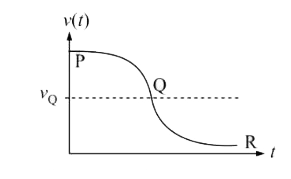
The plot below represents schematically the variation of beat frequency with time

B

`v_(P)+v_(R)=2v_(Q)`

C

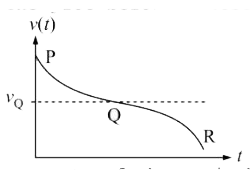
The plot below represents schematically the variation of beat frequency with time

D

The rate of change in beat frequency is maximum when the car passes through Q

Text Solution

Verified by Experts

The correct Answer is:
A, B, D

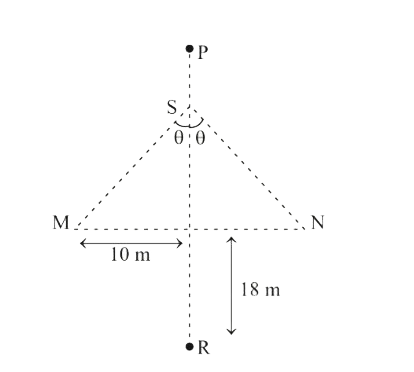
Sped of car, `V=60 km//h`
`(500)/(3) m//s`
At a point S,between P & Q
`v_m=v_m((c+v costheta)/(c)),v_n=v_n((v+v costheta)/(c))`
`implies trianglev=(v_n-v_n)(1-(v costheta)/(c))`
similarly between Q & R
`implies trianglev=(v_n-v_n)(1-(v costheta)/(c))`
`(d (trianglev))/dt=pm(v_n-v_n)v/csintheta(d theta)/dt`
`theta approx 0^(@)` at P & R as they are large distance apert
`implies` slope of graph is zero
at Q,`theta=90^(@)`
`implies sin theta` is max
also valued of `(d theta)/(dt)` is max
as `(d theta)/(dt)=v/x` where V is its velocity and r is length of kine joining P & S
and r is minimum at Q
`implies` slope is maximum at Q
`implies` (A) & (B) are correct
At p,`triangle v=(v_n-v_n)(1+(v)/(c)) ( theta=0^(@)`
At R, `triangle v=(v_n-v_n)(1-(v)/(c)) ( theta=0^(@)`
At Q, `triangle v=(v_n-v_n) (theta=90^(@))`
`implies trianglev_p+trianglev_R=2(v_n-v_n)=2trianglev_Q` Hence (B) is correct.
Promotional Banner

Topper's Solved these Questions

  • WAVE MOTION

    VMC MODULES ENGLISH|Exercise JEE ADVANCED ARCHIVE LEVEL 2 (PARAGRAPH TYPE)|6 Videos
  • WAVE MOTION

    VMC MODULES ENGLISH|Exercise JEE ADVANCED ARCHIVE LEVEL 2 (MATRIX MATCH TYPE)|3 Videos
  • WAVE MOTION

    VMC MODULES ENGLISH|Exercise JEE ADVANCED ARCHIVE LEVEL 2|32 Videos
  • UNITS, MEASUREMENTS & ERRORS

    VMC MODULES ENGLISH|Exercise IN - CHAPTER EXERCISE - B|10 Videos
  • WORK ENERGY AND POWER

    VMC MODULES ENGLISH|Exercise IMPECCABLE|54 Videos

Similar Questions

Explore conceptually related problems

Two point charges -q and +q are located at points (0,0-a) and (0,0,a) respectively. The electric potential at point (0,0,z) is (Z gt a)

Two point charges q and - q are located at points (0 , 0 , - a ) and (0 , 0 , a) respectively : (a) Find the electrostatic potential at (0 , 0 , z) and ( x, y , 0). (b) How much work is done in moving a small test charge from the point (5 , 0 , 0 , ) to (-7 , 0 , 0 ) along the x - axis ? (c) How would your answer change if the path of the test charge between the same points is not along the x axis but along any other random path ? (d) If the above point charges are now placed in the same position in a uniform external electric field vecE , what would be the potential energy of the charge system in its orientation of unstable equilibrium ? Justify your answer in each case .

Two point charges q and –q are at positions (0,0,d) and (0,0, –d) respectively . What is the electric field at (a,0,0 ) ?

Two point charges q and –q are at positions (0,0,d) and (0,0, –d) respectively . What is the electric field at (a,0,0 ) ?

Where are the point: (0,0,-4)

Point charges +4q, -q and +4q are kept on the x-axis at points x=0,x=a and x=2a respectively, then

(i) Can two equaipotential surfaces intersect each other ? Give reasons (ii) Two charges -q and +q are located at point A (0, 0 -a) and B(0, 0, +a) respectively. How much work is done in moving a test charge from point P (7, 0, 0) " to " Q(-3, 0, 0) ?

Two fixed charges -2Q and +Q are located at points (-3a,0) and (+3a,0) respectively. Then which of the following statement is correct?

Two point charges +q and -q are held fixed at (-a,0) and (a,0) respectively of a x-y coordinate system then

Two point charge -q and +q//2 are situated at the origin and the point (a,0,0) respectively. The point along the X -axis where the electic field Vanishes is

VMC MODULES ENGLISH-WAVE MOTION-JEE ADVANCED ARCHIVE LEVEL 2 (MUTIPLE CORRECT TYPE)
  1. A wave equation which given the dispplacement along the y-direction is...

    Text Solution

    |

  2. An air column in a pipe, which is closed at one end, will be in resona...

    Text Solution

    |

  3. The displacement of particles in a string stretched in the x-direction...

    Text Solution

    |

  4. velocity of sound in air is 320 m/s. A pipe closed at one end has a le...

    Text Solution

    |

  5. A wave is represented by the equation y = A sin (10 pi x + 15 pi t +...

    Text Solution

    |

  6. Two identical straight wires are stretched so as to products 6 beats//...

    Text Solution

    |

  7. A sound wave of frequency f travels horizontally to the right . It is ...

    Text Solution

    |

  8. The equation of a wave disturbance is given as y=0.02cos((pi)/(2)+50pi...

    Text Solution

    |

  9. The (x, y) co-ordinates of the corners of a square plate are (0, 0), (...

    Text Solution

    |

  10. A transverse sinusoidal wave of amplitude a, wavelength lamda and freq...

    Text Solution

    |

  11. y(x, t) =(0.8)/([(4x + 5t)^(2) +5]) represents a moving pulse where x ...

    Text Solution

    |

  12. y(x,t)=asin(kx-omegat+phi) represents a

    Text Solution

    |

  13. Standing waves can be produced

    Text Solution

    |

  14. A person blows into open- end of a long pipe. As a result,a high pres...

    Text Solution

    |

  15. Two vehicles, each moving with speed u on the same horizontal straight...

    Text Solution

    |

  16. A horizontal stretched string, fixed at two ends, is vibrating in its ...

    Text Solution

    |

  17. One end of a taut string of length 3 m along the x-axis is fixed at x ...

    Text Solution

    |

  18. Two point charges -q and +q are located at points (0,0,-a) and (0,0,a)...

    Text Solution

    |

  19. A block M hangs vertically at the bottom end of a uniform rope of cons...

    Text Solution

    |

  20. In an experiment to measure the speed of sound by a resonating air col...

    Text Solution

    |

