Home
Class 12
PHYSICS
A ball falls from a height ‘h’ and colli...

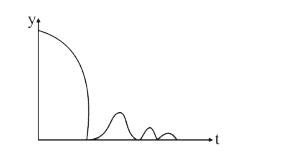
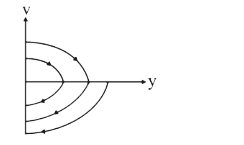
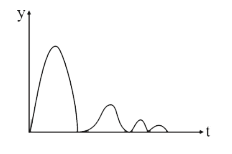
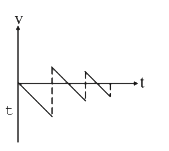
A ball falls from a height ‘h’ and collides with the ground. Each time it collides, its velocity is halved. Which of the following graphs are correct? Here t, v and y represent time, velocity and height above ground respectively. (vertically upwards direction is taken as positive and ground as y = 0)

A

B

C

D

Text Solution

AI Generated Solution

The correct Answer is:

To solve the problem, we need to analyze the motion of the ball as it falls and bounces back up, considering the conditions given in the question. ### Step-by-Step Solution: 1. **Understanding the Motion**: - The ball falls from a height \( h \) and collides with the ground. - Each time it collides, its velocity is halved. - The downward direction is taken as negative, and the upward direction is positive. 2. **Initial Conditions**: - When the ball is dropped from height \( h \), it starts with an initial velocity \( v_0 = 0 \) (just before it starts falling). - As it falls, it accelerates due to gravity, reaching a maximum downward velocity just before it hits the ground. 3. **Velocity After Each Collision**: - Let’s denote the velocity just before the first collision as \( v_1 \). - After the first collision, the velocity becomes \( v_2 = \frac{v_1}{2} \) (half of \( v_1 \)). - After the second collision, the velocity becomes \( v_3 = \frac{v_2}{2} = \frac{v_1}{4} \). - This pattern continues, where after the \( n^{th} \) collision, the velocity is \( v_n = \frac{v_1}{2^{n-1}} \). 4. **Height After Each Collision**: - The height reached after each bounce will also decrease because the velocity is halved each time. - The maximum height after the first bounce can be calculated using the kinematic equation: \[ h_1 = \frac{v_1^2}{2g} \] - After the second bounce, the height reached will be: \[ h_2 = \frac{v_2^2}{2g} = \frac{(\frac{v_1}{2})^2}{2g} = \frac{v_1^2}{8g} \] - Continuing this, after the \( n^{th} \) bounce, the height will be: \[ h_n = \frac{v_1^2}{2g \cdot 2^{n-1}} = \frac{v_1^2}{2g \cdot 2^{n-1}} \] 5. **Graph Analysis**: - For the **velocity graph (v vs. t)**: The velocity will be maximum just before the first collision, then it will decrease to half after the first bounce, and continue to decrease after each subsequent bounce. The graph will show a series of peaks decreasing over time. - For the **height graph (y vs. t)**: The height will start from \( h \) and decrease to 0 when the ball hits the ground. After each bounce, the height will reach a lower maximum height, creating a series of decreasing peaks on the graph. 6. **Conclusion**: - The correct graphs will show a decreasing velocity after each collision and a decreasing height after each bounce.

To solve the problem, we need to analyze the motion of the ball as it falls and bounces back up, considering the conditions given in the question. ### Step-by-Step Solution: 1. **Understanding the Motion**: - The ball falls from a height \( h \) and collides with the ground. - Each time it collides, its velocity is halved. - The downward direction is taken as negative, and the upward direction is positive. ...
Promotional Banner

Topper's Solved these Questions

  • KINEMATICS OF A PARTICLE

    VMC MODULES ENGLISH|Exercise JEE MAIN (archive)|19 Videos
  • KINEMATICS OF A PARTICLE

    VMC MODULES ENGLISH|Exercise JEE Advanced (archive)|14 Videos
  • KINEMATICS OF A PARTICLE

    VMC MODULES ENGLISH|Exercise LEVEL 1|75 Videos
  • JEE MAIN REVISON TEST-23

    VMC MODULES ENGLISH|Exercise PHYSICS (SECTION 2)|1 Videos
  • LAWS OF MOTION

    VMC MODULES ENGLISH|Exercise IMPECCABLE|53 Videos

Similar Questions

Explore conceptually related problems

A ball is dropped from a height h above ground. Neglect the air resistance, its velocity (v) varies with its height (y) above the ground as :-

A particle is thrown vertically upwards with a velocity v . It returns to the ground in time T. which of the following graphs correctly represents the motion ?

A ball thrown vertically upward with initial velocity u. Which of the following graphs represent the velocity of ball correctly as function of time? (Take upward direction as positive)

A body is falling from height 'h' it takes t_(1) time to reach the ground. The time taken to cover the first half of height is:-

A small metallic spherical ball is dropped from a height h . If it collides with the ground inelastically and rebounds, then

A ball is projected upwards from a height h above the surface of the earth with velocity v. The time at which the ball strikes the ground is

A ball is projected upwards from a height h above the surface of the earth with velocity v. The time at which the ball strikes the ground is

Which of the following is the graph between the height (h) of a projectile and time (t), when it is projected from the ground

A ball is thrown vertically upwards. Which of the following graph/graphs represent velocity-time graph of the ball during its flight (air resistance is neglected)

A ball is dropped vertically from a height d above the ground. It hits the ground and bounces up vertically to a height d/2. Neglecting subsequent motion and air resistance, its velocity v varies with the heiht h above the ground as

VMC MODULES ENGLISH-KINEMATICS OF A PARTICLE -LEVEL 2
  1. A body is thrown up with a velocity 1000 m s^(-1). It travels 5 m in t...

    Text Solution

    |

  2. Figure shows the velocity-displacement curve for an object moving alon...

    Text Solution

    |

  3. A ball falls from a height ‘h’ and collides with the ground. Each time...

    Text Solution

    |

  4. In the graph represent direction of distance (d) vs time (t) ?

    Text Solution

    |

  5. Acceleration of a particle has a value 'a' for a time t. It is followe...

    Text Solution

    |

  6. A particle starts from rest and traverses a distance l with uniform ac...

    Text Solution

    |

  7. The velocity-time plot for a particle moving on a straight line is sho...

    Text Solution

    |

  8. The velocity-time graph of a particle moving along a straight line is ...

    Text Solution

    |

  9. The velocity-time graph of a particle moving along a straight line is ...

    Text Solution

    |

  10. The velocity-time graph of a particle moving along a straight line is ...

    Text Solution

    |

  11. In a Young's double slit experiment lamda= 500nm, d=1.0 mm andD=1.0m. ...

    Text Solution

    |

  12. A particle of mass m initially at rest is acted upon by a unidirection...

    Text Solution

    |

  13. A particle starts from rest and moves with an acceleration of a={2+|t-...

    Text Solution

    |

  14. The displacement x of a particle varies with time t as x = ae^(-alpha ...

    Text Solution

    |

  15. A point moves in a straight line so its displacement x meter at time t...

    Text Solution

    |

  16. A car starts from rest with an acceleration of 6 m//s^(2) which dec...

    Text Solution

    |

  17. The relation between time t and displacement x is t = alpha x^2 + beta...

    Text Solution

    |

  18. The relation between acceleration and distance is is : a= ( 4-2x) ....

    Text Solution

    |

  19. A particle moves with an initial v(0) and retardation alphav, where v ...

    Text Solution

    |

  20. At time t = 0, a car moving along a straight line has a velocity of 16...

    Text Solution

    |
