Home
Class 12
PHYSICS
A ball is dropped vertically from a heig...

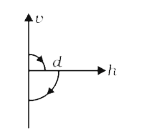
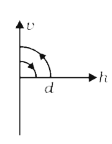
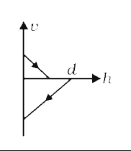
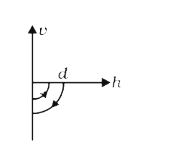
A ball is dropped vertically from a height d above the ground. It hits the ground and bounces up vertically to a height d/2. Neglecting subsequent motion and air resistance, its velocity v varies with the heiht h above the ground as

A

B

C

D

Text Solution

Verified by Experts

The correct Answer is:

A

For the given condition initial height h = d and velocity of the ball is zero. When the ball moves downwards its velocity increases and it will be maximum when the ball hits the ground and just after the collision it becomes half and in opposite direction. As the ball moves upward its velocity again decreases and becomes zero at height d/2. This explanation matches with graph (a).Alternate solution
We know for uniformly accelerated / decelerated motion ` v^(2) =u^(2) +-2gh `
Before hitting the ground, the velocity v is given by (quadratic equation and hence parabolic path) Downwards direction means negative velocity. After collision, the direction becomes positive and velocity decreases
` (##VMC_PHY_XI_WOR_BOK_01_C02_E05_006_S01.png" width="80%"> As the direction is reversed and speed is decreased and hence graph (a) represents these conditions correctly.
Promotional Banner

Topper's Solved these Questions

  • KINEMATICS OF A PARTICLE

    VMC MODULES ENGLISH|Exercise JEE MAIN (archive)|19 Videos
  • JEE MAIN REVISON TEST-23

    VMC MODULES ENGLISH|Exercise PHYSICS (SECTION 2)|1 Videos
  • LAWS OF MOTION

    VMC MODULES ENGLISH|Exercise IMPECCABLE|53 Videos

Similar Questions

Explore conceptually related problems

A ball is dropped from a height h above ground. Neglect the air resistance, its velocity (v) varies with its height (y) above the ground as :-

A ball is thrown upwards with a speed u from a height h above the ground.The time taken by the ball to hit the ground is

A ball is dropped from a height of 19.6 m above the ground. It rebounds from the ground and raises itself up to the same height. Take the starting point as the origin and vertically downward as the positive X-axis. Draw approximate plots of x versus t, v versus t and a versus t. Neglect the small interval during which the ball was in contact with the ground.

A ball dropped from a height of 2 m rebounds to a height of 1.5 m after hitting the ground. Then fraction of energy lost is

An object is dropped from a height h from the ground. Every time it hits the ground it looses 50% of its kinetic energy. The total distance covered as t to oo is -

A ball P is dropped vertically and another ball Q is thrown horizontally with the same velocities from the same height and at the same time. If air resistance is neglected, then

A body is thrown vertically upward from a point A 125 m above the ground. It goes up to a maximum height of 250 m above the ground and passes through A on its downward journey. The velocity of the body when it is at a height of 70 m above the ground is (g=10 m//s^(2))

A stone A is dropped from rest from a height h above the ground.A second stone B is simultaneously thrown vertically up from a point on the ground with velocity v.The line of motion of both the stones is same .Find if the value of v which would enable the stone B to meet the stone A midway between their initial positions =

A stone is dropped from a rising balloon at a height of 76 m above the ground and reaches the ground in 6s. What was the velocity of the balloon when the stone was dropped?

A ball is dropped from a height h on the ground If the coefficient of restitution is e, the height to which the ball goes up after it rebounds for the nth time is
