Home
Class 12
PHYSICS
A block of mass 1 kg is moving towards a...

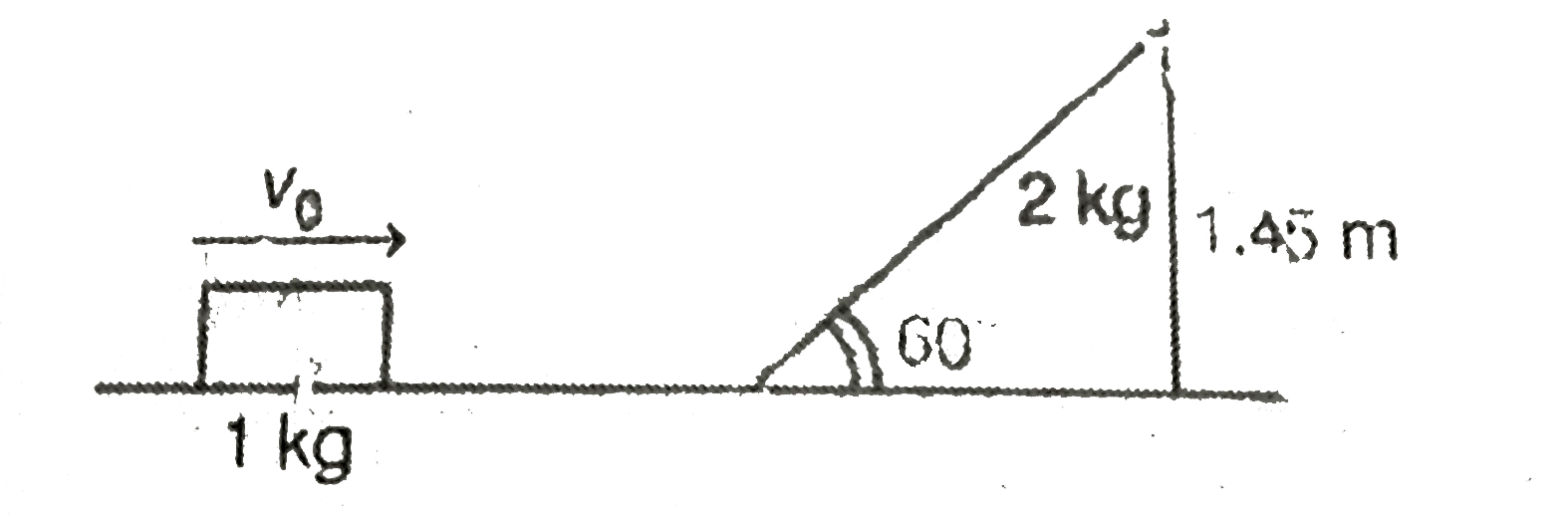
A block of mass 1 kg is moving towards a movable wedge of mass 2 kg as shown in figure. All surfaces are smooth. When the block leaves the wedge from top, its velocity is making an angle `theta =30^(@)` with horizontal.

The value of `v_(0)` in m/s is

A

1.9 m

B

2.7 m

C

1.6 m

D

1.45 m

Text Solution

Verified by Experts

The correct Answer is:

C

`H = 1.45 + (v_b^2 sin^2 30^@)/(2g) " " = 1.45 + (3v^2)/(8g) " "(v_b = sqrt(3)v)`
`= 1.45 + (3v_0^2)/(98 g) " "(v = 2/7 v_0) " " = 1.45 + (3 xx 49)/(98 xx 10) " " = 1.6 m`
Promotional Banner

Topper's Solved these Questions

  • ENERGY & MOMENTUM

    VMC MODULES ENGLISH|Exercise JEE MAIN (ARCHIVE)|53 Videos
  • ENERGY & MOMENTUM

    VMC MODULES ENGLISH|Exercise JEE ADVANCE (ARCHIVE)|80 Videos
  • ENERGY & MOMENTUM

    VMC MODULES ENGLISH|Exercise LEVEL - 2|48 Videos
  • ELECTROSTATICS

    VMC MODULES ENGLISH|Exercise JEE Advanced (Archive)|89 Videos
  • GASEOUS STATE & THERMODYNAMICS

    VMC MODULES ENGLISH|Exercise JEE ADVANCED (ARCHIVE )|111 Videos

Similar Questions

Explore conceptually related problems

A block of mass 1 kg is moving towards a movable wedge of mass 2 kg as shown in figure. All surfaces are smooth. When the block leaves the wedge from top, its velocity is making an angle theta =30^(@) with horizontal. In the whole process let J be the magnitude of net impulse given to the block by the wedge, J_(H) its horizontal component and J_(V) its vertical component. Then

A block of mass 1 kg is moving towards a movablen vedge of amss 2 kg as shown in figure. All surfaces are smooth. When the block leaves the wedge from top, its velocity is making an angle theta =30^(@) with horizontal. To what maximum height will the block rise

A block of mass m is released from a wedge of mass m as shown in figure . Find the time taken by the block to reach the end of the wedge.

Two smooth wedges of equal mass m are placed as shown in figure. All surfaces are smooth. Find the velocities of A & B when A hits the ground.

A block of mass m is placed on a smooth wedge of mass M, as shown in the figure . Just after placiing block m over wedge M.

A block of mass m is pushed towards a movable wedge of mass nm and height h , with a velocity u . All surfaces are smooth. The minimum value of u for which the block will reach the top of the wedge is

A block of mass 1 kg is pushed towards another block of mass 2 kg from 6 m distance as shown in figure. Just after colision velocity of 2 kg block becomes 4 m//s .

A block of mass 1 kg is released from the top of a wedge of mass 2 kg. Height of wedge is 10 meter and all the surfaces are frictionless. Then

A block of mass 10 kg, moving with acceleration 2m//s^(2) on horizontal rough surface is shown in figure

A block of mass m is placed at rest on a smooth wedge of mass M placed at rest on a smooth horizontal surface. As the system is released
