Home
Class 12
PHYSICS
Consider a two particle system with the ...

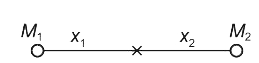
Consider a two particle system with the particles having masses `m_1 and m_2`. If the first particles pushed towards the centre of mass through a distance d, by what distance should the second particle be moved so as the keep the centre of mass at the same position?

A

`(m_2)/(m_1)d`

B

`(m_1)/(m_1 + m_2)d`

C

`(m_1)/(m_1)d`

D

d

Text Solution

Verified by Experts

The correct Answer is:
C

To keep the centre of mass at the same position, velocity of centre of mass is zero, so
`(m_1v_1 + m_2v_2)/(m_1 + m_2) = 0`
Where, `v_1 and v_2` are the velocities of particles 1 and 2, respectively.
`implies m_1(dr_1)/(dt) + m_2(dr_2)/(dt) = 0 " "[ :' v_1 = (dr_1)/(dt) and v_2 = (dr_2)/(dt)]`
`implies m_1 dr_1 + m_1dr_2 = 0`
`dr_1 and dr_2` represent the change in displacement of particles.
Let `2^(nd) particle has been displaced by distance x. `implies` m_1(d) + m_2(x) = 0 " or " x = - (m_1d)/(m_2)` .

`X_(CM) = (m_1x_1 + m_2x_2)/(m_1 + m_2) " ".....(i)`
After moving `m_1` through a distance towards CM and to keep the position of CM unchanged, let be the shift of `m_2`.
`X_(CM) = (m_1(x_1 - d) + m_2(x_2 + d'))/(m_1 + m_2) " ".....(iii)`
From Eqs. (i) and (ii), we get
`(m_1x_1 + m_2x_2)/(m_1 + m_2) = (m_1(x_1 -d)+m_2(x_2 + d))/(m_1 + m_2) implies -m_1d + m_2d' = 0 " ":. " "d' = (m_1)/(m_2)d` .
Promotional Banner

Topper's Solved these Questions

  • ENERGY & MOMENTUM

    VMC MODULES ENGLISH|Exercise JEE ADVANCE (ARCHIVE)|80 Videos
  • ENERGY & MOMENTUM

    VMC MODULES ENGLISH|Exercise JEE ADVANCE (ARCHIVE) - PARAGRAPH QUESTIONS|5 Videos
  • ENERGY & MOMENTUM

    VMC MODULES ENGLISH|Exercise LEVEL - 2 PARAGRAPH QUESTIONS|2 Videos
  • ELECTROSTATICS

    VMC MODULES ENGLISH|Exercise JEE Advanced (Archive)|89 Videos
  • GASEOUS STATE & THERMODYNAMICS

    VMC MODULES ENGLISH|Exercise JEE ADVANCED (ARCHIVE )|111 Videos

Similar Questions

Explore conceptually related problems

Consider a system of two particles having masses m_(1) and m_(2) . If the particle of mass m_(1) is pushed towards the centre of mass of particles through a distance d , by what distance would the particle of mass m_(2) move so as to keep the mass centre of particles at the original position?

Consider a sytem of two particles having masses m_(1) and m_(2) . If the particle of mass m_(1) is pushed towards the centre of mass of particles through a distance d , by what distance would the particle of mass m_(2) move so as to keep the mass centre of particles at the original position?

Consider a system of two particles having masses 2kg and 5 kg the particle of mass 2 kg is pushed towards the centre of mass of particles through a distance 5 m,by what distance would particle of mass 5kg move so as to keep the centre of mass of particles at the original position?

Considering a system having two masses m_(1) and m_(2) in which first mass is pushed towards centre of mass by a distance a, the distance required to be moved for second mass to keep centre of mass at same position is :-

The reduce mass of two particles having masses m and 2 m is

Two bocks of masses 10 g and 20 kg are plced on the X-axis. The first mass is moved on the axis by a distance of 2 cm. By what distance should the second mass be moved to keep the position of the centre of mass unchanged?

Consider a system of two identical particles. One of the particles is at rest and the other has an acceleration. The centre of mass has an acceleration.

Where does the centre of mass of two particle system lie, if one particle is more massive than the other ?

Four identical particles each of mass m are arranged at the corners of a square of sie a. If mass of one of th particle is doubled, the shift in the centre of mass of the system is

The centre of mass of a system of two particle of masses m_1 and m_2 is at a distance d_1 from mass m_1 and at a distance d_2 from mass m_2 such that.

VMC MODULES ENGLISH-ENERGY & MOMENTUM-JEE MAIN (ARCHIVE)
  1. The potential energy of a 1 kg particle free to move along the x- axis...

    Text Solution

    |

  2. A mass of M kg is suspended by a weightless string. The horizontal for...

    Text Solution

    |

  3. Consider a two particle system with the particles having masses m1 and...

    Text Solution

    |

  4. A 2 kg block slides on a horizontal floor with a speed of 4 m/s. It st...

    Text Solution

    |

  5. A circular disc of radius R is removed from a bigger circular disc of ...

    Text Solution

    |

  6. A block of mass 0.50 kg is moving with a speed of 2.00 m/s on a smooth...

    Text Solution

    |

  7. A thin rod of length L is lying along the x-axis with its ends at x=0...

    Text Solution

    |

  8. Consider a rubber ball freely falling from a height h = 4.9 m onto a h...

    Text Solution

    |

  9. Assertion Two particles moving in the same direction do not lose all t...

    Text Solution

    |

  10. The figure shows the position - time (x - t) graph of one-dimensional ...

    Text Solution

    |

  11. The potential energy function for the force between tow atoms in a dia...

    Text Solution

    |

  12. This question has Statement I and Statement II. Of the four choices g...

    Text Solution

    |

  13. When a rubber band is streched by a distance x , if exerts restoring f...

    Text Solution

    |

  14. A particle of mass m moving in the x direction with speed 2v is hit by...

    Text Solution

    |

  15. Distance of the centre of mass of a solid uniform cone from its vertex...

    Text Solution

    |

  16. It is found that if a neutron suffers an elastic collinear collision w...

    Text Solution

    |

  17. In a collinear collision, a particle with an initial speed v0 strikes ...

    Text Solution

    |

  18. A particle moves in one dimension from rest under the influence of a f...

    Text Solution

    |

  19. Four particles A,B,C and D with masses m(A)=m,m(B)=2m, m(C)=3m and m(D...

    Text Solution

    |

  20. A body of mass m(1) moving with an unknown velocity of v(1)hat i, unde...

    Text Solution

    |

