Home
Class 12
PHYSICS
In a collinear collision, a particle wit...

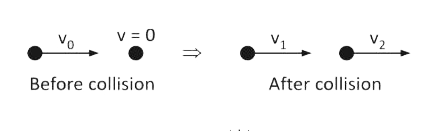
In a collinear collision, a particle with an initial speed v0 strikes a stationary particle of the same mass. If the final total kinetic energy is 50% greater than the original kinetic energy, the magnitude of the relative velocity between the two particles, after collision, is :

A

`(v_0)/(2)`

B

`(v_0)/(sqrt2)`

C

`(v_0)/(4)`

D

`sqrt(2)v_0`

Text Solution

Verified by Experts

The correct Answer is:
D

It is given that final total kinetic energy has increased, so some internal energy of the system must have been converted into kinetic energy.
`1/2 mv_1^2 + 1/2 mv_2^2 = 1.5(1/2 mv_0^2) implies v_1^2 + v_2^2 = 1.5 v_0^2 " "……(i)`
Since, there is no external force, momentum can be conserved
`mv_1 + mv_2 = mv_0 implies v_1 + v_2 = v_0 " "......(ii)`
From (i) & (ii)
`v_1 + (v_0 - v_1)^2 = 1.5 v_0^2 , " "2v_1^2 - 2 v_0v_1 - 0.5 v_0^2 = 0`
Relative velocity `=|v_2 - v_1| =` Difference of roots `=(sqrtD)/(a) = sqrt(2)v_0`.
Promotional Banner

Topper's Solved these Questions

  • ENERGY & MOMENTUM

    VMC MODULES ENGLISH|Exercise JEE ADVANCE (ARCHIVE)|80 Videos
  • ENERGY & MOMENTUM

    VMC MODULES ENGLISH|Exercise JEE ADVANCE (ARCHIVE) - PARAGRAPH QUESTIONS|5 Videos
  • ENERGY & MOMENTUM

    VMC MODULES ENGLISH|Exercise LEVEL - 2 PARAGRAPH QUESTIONS|2 Videos
  • ELECTROSTATICS

    VMC MODULES ENGLISH|Exercise JEE Advanced (Archive)|89 Videos
  • GASEOUS STATE & THERMODYNAMICS

    VMC MODULES ENGLISH|Exercise JEE ADVANCED (ARCHIVE )|111 Videos

Similar Questions

Explore conceptually related problems

A particle of mass 2m moving with velocity v strikes a stationary particle of mass 3m and sticks to it . The speed of the system will be

A particle moving with kinetic energy E makes a head on elastic collision with an identical particle at rest. During the collision

A particle of mass 100 g moving at an initial speed u collides with another particle of same mass kept initially at rest. If the total kinetic energy becomes 0.2 J after the collision what could be minimum and the maximum value of u.

A particle of mass 100 g moving at an initial speed u collides with another particle of same mass kept initially at rest. If the total kinetic energy becomes 0.2 J after the collision what could be minimum and the maximum value of u.

A particle of mass 100 g moving at an initial speed u collides with another particle of same mass kept initially at rest. If the total kinetic energy becomes 0.2 J after the collision what could be minimum and the maximum value of u.

A particle of mass m_0 , travelling at speed v_0 . Strikes a stationary particle of mass 2m_0 . As a result of the particle of mass m_0 is deflected through 45^@ and has a final speed of v_0/sqrt2 . Then the speed of the particle of mass 2m_0 after this collision is

Binding energy of a particle on the surface of earth is E. Kinetic energy grater than E is given to this particle. Then total energy of particle will become

A neutral particle at rest in a magnetic field decays into two charged particles of different mass. The energy released goes into their kinetic energy. Then what can be the path of the particles. Neglect any interaction between the two charges.

A particle of mass m moving with speed u collides perfectly inelastically with another particle of mass 2m at rest. Find loss of kinetic energy of system in the collision.

A particle of mass m moving with speed u collides perfectly inelastically with another particle of mass 2m at rest. Find loss of kinetic energy of system in the collision.

VMC MODULES ENGLISH-ENERGY & MOMENTUM-JEE MAIN (ARCHIVE)
  1. Distance of the centre of mass of a solid uniform cone from its vertex...

    Text Solution

    |

  2. It is found that if a neutron suffers an elastic collinear collision w...

    Text Solution

    |

  3. In a collinear collision, a particle with an initial speed v0 strikes ...

    Text Solution

    |

  4. A particle moves in one dimension from rest under the influence of a f...

    Text Solution

    |

  5. Four particles A,B,C and D with masses m(A)=m,m(B)=2m, m(C)=3m and m(D...

    Text Solution

    |

  6. A body of mass m(1) moving with an unknown velocity of v(1)hat i, unde...

    Text Solution

    |

  7. A uniform rectangular thin sheet ABCD of mass M has length a and bread...

    Text Solution

    |

  8. A body of mass 2 kg makes an elastic collision with a second body at r...

    Text Solution

    |

  9. A uniform cable of mass 'M' and length 'L' is placed on a horizontal s...

    Text Solution

    |

  10. A ball is through vertically up (taken as +z-axis) from the ground. Th...

    Text Solution

    |

  11. A wedge of mass M=4m lies on a frictionless plane. A particle of mass ...

    Text Solution

    |

  12. Two particles, of masses M and 2M, moving as shown, with speeds of 10m...

    Text Solution

    |

  13. A bullet of mass 20 g has a n initial speed of 1ms^(-1) just before it...

    Text Solution

    |

  14. Three particles of masses 50 g, 100 g and 150 g are placed at the vert...

    Text Solution

    |

  15. A person of mass M is setting on a swing of length L and swinging with...

    Text Solution

    |

  16. A man (mass =50kg) and his son (mass =20kg) are standing on a friction...

    Text Solution

    |

  17. A force acts on a 2 kg object so that its position is given as a funct...

    Text Solution

    |

  18. Three blocks A, B and C are lying on a smooth horizontal surface, as s...

    Text Solution

    |

  19. A particle which is experiencing a force, given by vec(F) = 3 vec(i) -...

    Text Solution

    |

  20. A piece of wood of mass 0.03 kg is dropped from the top of a 100 m hei...

    Text Solution

    |

