Home
Class 12
PHYSICS
The pressure gauge shown in figure has a...

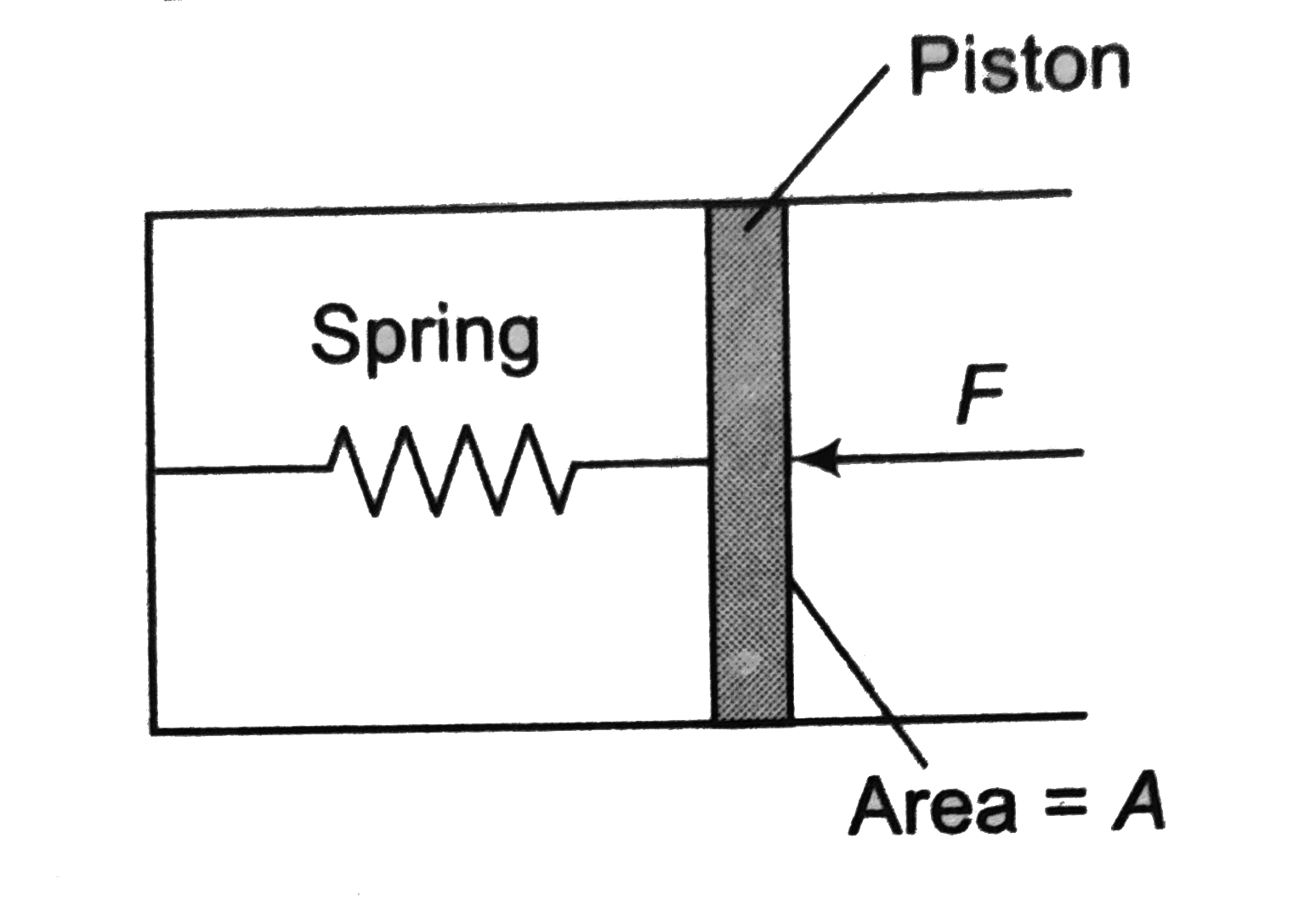
The pressure gauge shown in figure has a spring for which `k=60N//m` and the area of the piston is `0.50cm^(2)`. Its right end is connected to a closed container of gas at a gauge pressure of `30kPa`. How far will the spring be compressed if the region containing the spring is (a) in vacuum and (b) open to the atmosphere? Atmospheric pressure is `101kPa`.

Text Solution

Verified by Experts

(i) 10.9 cm (ii) 2.5 cm
(i) Pressure to the right of piston, P ` = (30 + 101 ) k Pa = 131 kPa `
Compressive force, F ` = PA = (131 xx 10 ^(3) Pa ) (0.50 xx 10 ^(-4) m ^ 2 ) = 6.55 N `
As ` F = kx, x = (F)/(k) = (6.55 N ) /(60 N//m) = 0.109 m = 10.9 cm `
(ii) The force is now due to the gauge pressure (30 kPa) acting on the piston area and is given by
` F' = (30 xx 10 ^(3) Pa ) ( 0.50 xx 10 ^( - 4 ) m ^ 2 ) = 1.5 N , x = (F' )/(k) = (1.5 N ) /( 60 N//m) = 0.025 m = 2.5 cm `
Promotional Banner

Topper's Solved these Questions

  • LIQUIDS

    VMC MODULES ENGLISH|Exercise LEVEL -1|90 Videos
  • LIQUIDS

    VMC MODULES ENGLISH|Exercise LEVEL -2|50 Videos
  • LIQUIDS

    VMC MODULES ENGLISH|Exercise LEVEL-0 ( Short Answer Type - I )|7 Videos
  • LAWS OF MOTION

    VMC MODULES ENGLISH|Exercise IMPECCABLE|53 Videos
  • MAGNETIC EFFECTS OF CURRENT

    VMC MODULES ENGLISH|Exercise JEE Advanced (Archive)|78 Videos

Similar Questions

Explore conceptually related problems

A U - tube filled with mercury is connected to bulb containing a gas as shown . If atmospheric pressure is 1.013 xx10^(5) Pa and H = 0.05 m , then

2.00 mole of a monatomic ideal gas (U=1.5nRT) is enclosed in an adiabatic, fixed , vertical cylinder fitted with a smooth, light adiabatic piston. The piston is connected to a vertical spring of spring constant 200 N m^(-1) as shown in .the area of cross section of the cylinder is 20.0 cm^(2) . initially, the spring is at its natural length and the temperature of the gas is 300K at its natural length. the atmosphere pressure is 100 kPa. the gas is heated slowly for some time by means of an electric heater so as to move the position up through 10 cm. find (a) the work done by the gas (b) the final temperature of the gas and (c ) the heat supplied by the heater.

The pulley shown in figure has a radius of 20 cm and moment of inertial 0.2 kg-m^2. The string going over it is attached at one end to a vertical sprign of spring constant 50 N/m fixed from below and supports a 1 kg mas at other end. The system is released from rest with the spring at its natural length. Find the speed of the block when it has desceds through 10 cm. Take g=10 m/s^2 .

A manometer reads the pressure of a gas in a enclosure as shown in figure(a) When some of the gas is removed by a pump, the manometer reads as in (b). The liquid used in the manometers is mercury and the atmospheric pressure is 76 cm of mercury. (i) Give the absolute and gauge pressure of the gas in the enclosure for cases (a) and (b) in units of cm of mercury . (ii) How would the level change in case (b) if 13.6 cm of water are poured into the right limb of the manometer?

A manometer reads the pressure of a gas in a enclosure as shown in figure(a) When some of the gas is removed by a pump, the manometer reads as in (b). The liquid used in the manometers is mercury and the atmospheric pressure is 76 cm of mercury. (i) Give the absolute and gauge pressure of the gas in the enclosure for cases (a) and (b) in units of cm of mercury . (ii) How would the level change in case (b) if 13.6 cm of water are poured into the right limb of the manometer?

A thin, uniform rod with negligible mass and length 0.200m is attached to the floor by a frictionless hinge at point P (as shown in fig) A horizontal spring with force constant k=4.80Nm^-1 connects the other end of the rod to a vertical wall.The rod is in a uniform magnetic field B=0.340T directed into the plane of the figure. There is current I=6.50 A in the rod, in the direction shown. When the rod is in equilibrium and makes an angle of 53.0^@ with the floor, is the spring stretched or compressed?

A cylinder is fitted with a piston, beneath which is a spring, as in the figure. The cylinder is open at the top. Friction is absent. The spring is 3600 N//m . The piston has a negligible mass and a radius of 0.025m (a) when air beneath the piston is completely pumped out, how much does the atmospheric pressure cause the spring to compress? (b) How much work does the atmospheric pressure do in compressing the spring?

Air is contained in a piston-cylinder arrangement as shown in Fig. with a cross-sectional area of 4 cm^(2) and an initial volume of 20 cm^3 . The air is initially at a pressure of 1 atm and temperature of 20^(@)C . The piston is connected to a spring whose spring constant is k = 10^(4) N//m , and the spring is initially underformed. How much heat must be added to the air inside cylinder to increase the pressure to 3 atm (for air, CV = 718 J//kg.^(@)C , molecular of air 28.97)?

A gas is enclosed in a cylindrical vessel fitted with a frictionless piston.the gas is slowly heated for some time. During the process, 10 J of heat is supplied and the piston is found to move out 10cm. Find the increase in the internal energy of the gas, the area of cross section of the cylinder= 4 cm^(2) and the atmospheric pressure =100 kPa.

Two moles of nitrogen gas is kept in a cylinder of cross-section area 10 cm^(3) . The cylinder is closed by a light frictionless piston. Now the gas is slowly heated such that the displacement of piston during process is 50cm , find the rise in temperature of gas when 200 J of heat is added in it. (Atmospheric pressure =100 kPa, R = 25//3 J//mol-K)
