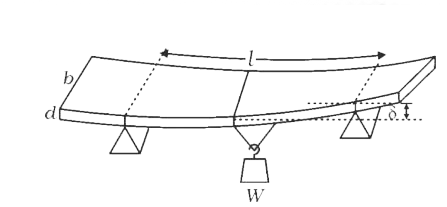
(i) The knowledge of elasticity is applied in designing a bridge such that it does not bend too much or break under the load of traffic, the force of wind and under its own weight. Consider a rectangular bar length l, breadth b and thickness d supported at both ends, as shown in figure. When a load W is suspended at its middle, the bar gests depressed by an amount given by
`delta=(Wl^(3))/(4Ybd^(3))`
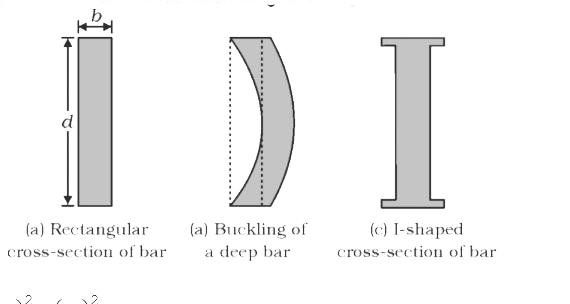
(ii) Bending can be reduced by using a material with a large Young’s modulus Y. As `delta` is proportional to `d^(-3)and ` only to `b^(1)` so depression can be decreased more effectively by increasing the depth d rather than the breadth b. But a deep bar has tendency to bend under the weight of a moving traffic, as shown in figure (b). This bending is called buckling. Hence a better choice is to have a bar of I-shaped cross-section, as shown in figure (c). This section provides a large load bearing surface and enough depth to prevent bending. Also, this shape reduces the weight of the beam without sacrificing its strength and hence reduces of cost.