Home
Class 12
PHYSICS
In the shown circuit involving a resista...

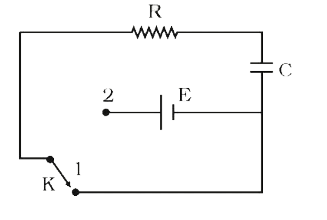
In the shown circuit involving a resistance `Romega`, capacitor of capacitance C farad and an ideal cell of emf E volts, the capacitor is initially uncharged and the key is in position 1. At t = 0, second the key is pushed to position 2 for `t_(0)=RC` second and then key is pushed back to position 1 for `t_(0)=RC` seconds. This process is repeated again and again. Assume the time taken to push key from position 1 to 2 and vice versa to be negligible.
The current through the resistance at seconds is:

A

(a) `(E)/(e^(2)R)(1-(1)/(e))`

B

(b) `(E)/(eR)(1-(1)/(e))`

C

(c) `E/R(1-(1)/(e))`

D

(d) `(E)/(sqrt(eR))(1-(1)/(e))`

Text Solution

Verified by Experts

The correct Answer is:
D

For t=0 to `t_(0)=RC` seconds, the circuit is of charging type. The charging equation for this time is
`q=CE(1-e^(-t//RC))`
Therefore the charge on capacitor at time `t_(0)=RC` is `q_(0)=CE(1-(1)/(e))`
For t=RC to t=2RC seconds, the circuit is of discharging type.
The charge and current equation for this time is
`q=q_(0)^(-((2RC-RC))/(RC))=(q_(0))/(e)=(1)/(e)CE(1-(1)/(e)) and i=(q_(0))/(RC) e^(-((1.5RC-RC))/(RC))=(q_(0))/(sqrt(e)R)(1-(1)/(e))`.
Respectively.
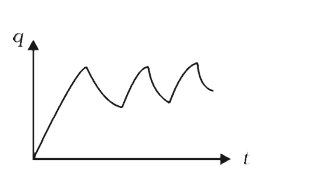
Since the capacitor gets more charged up from t=2RC to t=3RC than the interval t=0 to t=RC, the graph respresenting the charge variation is as shown in figure.
Promotional Banner

Topper's Solved these Questions

  • CAPACITORS

    VMC MODULES ENGLISH|Exercise JEE Main (Archive) LEVEL-1|36 Videos
  • CAPACITORS

    VMC MODULES ENGLISH|Exercise JEE Advance ( Archive ) LEVEL 2|1 Videos
  • CAPACITORS

    VMC MODULES ENGLISH|Exercise LEVEL 1 (MCQs)|60 Videos
  • BASIC MATHEMATICS & VECTORS

    VMC MODULES ENGLISH|Exercise Impeccable|50 Videos
  • CURRENT ELECTRICITY

    VMC MODULES ENGLISH|Exercise IN-CHAPTER EXERCISE-F|10 Videos

Similar Questions

Explore conceptually related problems

In the shown circuit involving a resistance Romega , capacitor of capacitance C farad and an ideal cell of emf E volts, the capacitor is initially uncharged and the key is in position 1. At t = 0, second the key is pushed to position 2 for t_(0)=RC second and then key is pushed back to position 1 for t_(0)=RC seconds. This process is repeated again and again. Assume the time taken to push key from position 1 to 2 and vice versa to be negligible. Then the variation of charge on capacitor with time is best represented by

In the circuit shown key is closed at t=0 with capacitor initially uncharged.

Initially the capacitor is uncharged find the charge on capacitor as a function of time, if switch is closed at t=0.

Passage-III In the circuit shown, the battery is ideal with emf V. The capacitor is initially uncharged. The switch is closed at time t = 0 The current in the branch BE at t=oo is

In the circuit shown below, the key K is closed at t = 0. The current through the battery is

In the circuit shown below, the key K is closed at t =0. The current through the battery is

Switch is in position A for long time. At time t = 0 it is shifted to position B. Find the maximum charge that will accumulate on capacitor

In the adjoining circuit, the capacitor is initially uncharged. The current through the resistor AB immediately after the key K is pressed is __________ mA.

In the circuit shown, the capacitor C_1 is initially charged with charge q_0 . The switch S is closed at time t = 0 . The charge on C_2 after time t is

Passage-III In the circuit shown, the battery is ideal with emf V. The capacitor is initially uncharged. The switch is closed at time t = 0 The current in branch containing capacitors at any time t is

VMC MODULES ENGLISH-CAPACITORS-LEVEL 2
  1. A capacitor C(1) =1.0 muF is charged up to a voltage V=60 V by connec...

    Text Solution

    |

  2. Two capacitors of 2muF and 3muF are charged to 150 V and 120 V, respec...

    Text Solution

    |

  3. In the shown circuit involving a resistance Romega, capacitor of capac...

    Text Solution

    |

  4. In the shown circuit involving a resistance Romega, capacitor of capac...

    Text Solution

    |

  5. In each situation of column-I, a circuit involving two non-ideal cell...

    Text Solution

    |

  6. Three identical capacitors C(1),C(2) and C(3) have a capacitance of 1...

    Text Solution

    |

  7. Two parallel capacitors of capacitances C and 2C are connected in para...

    Text Solution

    |

  8. When a dielectric slab is inserted between the plates of one of the tw...

    Text Solution

    |

  9. Consider a disconnected plate capacitor of capacity 10 muF with air fi...

    Text Solution

    |

  10. A parallel pate capacitor of capacitance ‘C’ has charge on its plates ...

    Text Solution

    |

  11. Two identical capacitors are connected in series, and the combination ...

    Text Solution

    |

  12. A capacitor having a capacitance of 100muF is charged to a potential d...

    Text Solution

    |

  13. A capacitor having a capacitance of 100muF is charged to a potential d...

    Text Solution

    |

  14. Space between the plates of a parallel plate capacitor is filled with ...

    Text Solution

    |

  15. A parallel plate capacitor of area A and separation d is charged to po...

    Text Solution

    |

  16. A capacitor of capacitance C(1) is charged to a potential difference V...

    Text Solution

    |

  17. A capacitor C(1) is charged to a potential V and connected as shown wi...

    Text Solution

    |

  18. Two capacitors, C(1) and C(2), charged to a potential V/2 and V respec...

    Text Solution

    |

  19. An uncharged capacitor of capacitance is connected in a circuit with t...

    Text Solution

    |

  20. In the circuit shown, all capacitors are initially uncharged. The capa...

    Text Solution

    |

