Home
Class 12
CHEMISTRY
Assuming DeltaH^(@) and S^(@) do not cha...

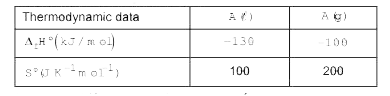
Assuming `DeltaH^(@)` and `S^(@)` do not change with temperature. Calculate, the boiling point of liquid A using the thermodynamic data given below.

A

300 K

B

130 K

C

150 K

D

50 K

Text Solution

Verified by Experts

The correct Answer is:

A

`A(l) to A(g)` at boiling point
`DeltaH = -100 -(-130) = 30 kJ//mol, DeltaS = 200 -100 = 100 kJ//mol`
For equilibrium `DeltaG = 0 rArr T_(b) =(DeltaH)/(DeltaS) = 300K`
Promotional Banner

Topper's Solved these Questions

  • THERMODYNAMICS

    VMC MODULES ENGLISH|Exercise LEVEL-2|50 Videos
  • THERMODYNAMICS

    VMC MODULES ENGLISH|Exercise LEVEL-2 (NUMERICAL VALUE TYPE)|15 Videos
  • THERMODYNAMICS

    VMC MODULES ENGLISH|Exercise LEVEL-0 (LONG ANSWER TYPE (5 MARKS))|6 Videos
  • THERMOCHEMISTRY

    VMC MODULES ENGLISH|Exercise JEE ADVANCED (ARCHIVE)|31 Videos
  • THERMODYNAMICS & THERMOCHEMISTRY

    VMC MODULES ENGLISH|Exercise Impeccable|48 Videos

Similar Questions

Explore conceptually related problems

Assuming Delta H^(0) and Delta S^(0) do not change with temperature the boiling point of liquid ''A'' (the thermodynamics data given below) is

Explain what do you know about the boiling point of a liquid.

In conversion of limestone to lime , CaCO_3(s) rarrCaO(s)+CO_2(g) the values of DeltaH^@ and DeltaS^@ are +179.1 KJ/mol , 160.2J/K respectively at 298 K and 1 bar. Assuming that DeltaH^@ and DeltaS^@ do not change with temperature , temperature above which conversion of limestone to lime will be spontaneous is

The Haber's process of production of ammonia involves the equilibrium: N_(2)(g)+3H_(2)(g)hArr2NH_(2)(g) Assuming DeltaH^(@) and DeltaS^(@) for the reaction do not change with temperature, which of the statements is true? (DeltaH^(@)=-95kJ and DeltaS^(@)=-198JK^(-1))

The gaseous form of a liquid which occurs below the boiling point of a liquid is called

Sulphur exists in more than one solid form. The stable form at room temperature is rhombic sulphur. But above room temperature the following reaction occurs. S ("rhombic") rarrS("monoclinic") If DeltaH^(Theta) = 276.144J at 298 K and 1atm and DeltaG^(Theta) = 75.312J a. Calculate DeltaS^(Theta) at 298K . b. Assume that DeltaH^(Theta) and DeltaS^(Theta) do not vary significantly with temperature, calculate T_(eq) , the temperature at which rhombic and monoclinic sulphur exist in equilibrium with each other.

Impure glycerol decomposes at a temperature below its boiling point. How will you purify it ?

Two liquids (A) and (B) can be separated by the method of fractional distillation. The boiling point of liquid (A) is less than boiling point of liquid (B). Which of the liquids do you expect to come out first in the distillate ? Explain.

A solution of two liquids boils at a temperature more than the boiling point of either of them. Hence, the binary solution shows

The vapour pressure of fluorobenzene at t^(@)C is given by the equation log p(mm Hg)=7.0-(1250)/(t+220) Calculate the boiling point of the liquid in .^(@)C if the external (applied) pressure is 5.26% more than required for normal boiling point. (log 2=0.3 )

VMC MODULES ENGLISH-THERMODYNAMICS-LEVEL-1
  1. The enthalpy change for transition of liquid water to steam is 40.8 kJ...

    Text Solution

    |

  2. Which of the following statements is true?

    Text Solution

    |

  3. In a reversible process, the value of Delta S (sys) + Delta S(surr) is

    Text Solution

    |

  4. Consider the following cyclic process. I. Isothermal , II. Adiaba...

    Text Solution

    |

  5. The following diagram represents the (p-V) changes of gas. Thus, total...

    Text Solution

    |

  6. Which of the following proces is (are) expected to be spontaneous at h...

    Text Solution

    |

  7. Which of the plots of ln K vs (1/T) is/are correct?

    Text Solution

    |

  8. The value of DeltaH("transition") of C (graphite) rarr C (diamond) is ...

    Text Solution

    |

  9. Among the following , the state funcation (s) is (are)

    Text Solution

    |

  10. For an endothermic reaction, Delta H represents the enthalpy of the re...

    Text Solution

    |

  11. Match the following:

    Text Solution

    |

  12. Match the Column:

    Text Solution

    |

  13. For the gas phase reaction, PCl(5)(g) hArr PCl(3)(g) + Cl(2)(g) Wh...

    Text Solution

    |

  14. The Haber's process of production of ammonia involves the equilibrium:...

    Text Solution

    |

  15. If a gas, at constant temperature and pressure expands, then its

    Text Solution

    |

  16. Considering the reaction, C(s) + O(2)(g) to CO(2)(g) + 393.5 kJ th...

    Text Solution

    |

  17. Considering entropy (S) as a thermodynamic parameter, the criterion fo...

    Text Solution

    |

  18. Assuming DeltaH^(@) and S^(@) do not change with temperature. Calculat...

    Text Solution

    |

  19. For a phase change: H(2)O(l)hArrH(2)O(s) 0^(@)C, 1 bar

    Text Solution

    |

  20. For the process H(2)O(l) (1 "bar", 373 K) rarr H(2)O(g) (1"bar", 373 K...

    Text Solution

    |
