Home
Class 12
CHEMISTRY
for a diatomic ideal gas in a closed ...

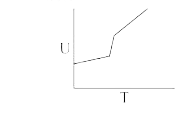
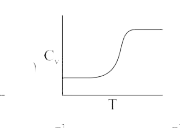
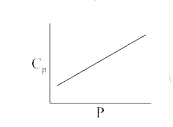
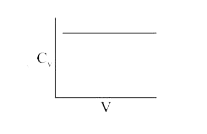
for a diatomic ideal gas in a closed system , which of the following plots does not correctly describe the relation between various thermodynamic quantities ?

A

B

C

D

Text Solution

AI Generated Solution

The correct Answer is:

To solve the question regarding which plot does not correctly describe the relation between various thermodynamic quantities for a diatomic ideal gas in a closed system, we will analyze each of the given plots step by step. ### Step 1: Understand the Thermodynamic Quantities - **Cp**: Heat capacity at constant pressure. - **Cv**: Heat capacity at constant volume. - **U**: Internal energy. - **T**: Temperature. - **P**: Pressure. - **V**: Volume. ### Step 2: Analyze Each Plot 1. **Plot of Cp vs P**: - For an ideal gas, the heat capacity at constant pressure (Cp) is generally considered to be constant for a given gas. - Therefore, as pressure (P) increases, Cp should not increase. - If the plot shows an increasing trend of Cp with P, this is incorrect. 2. **Plot of Cv vs V**: - The heat capacity at constant volume (Cv) is also generally constant for an ideal gas. - If this plot shows Cv remaining constant as volume (V) changes, this is correct. 3. **Plot of U vs T**: - The internal energy (U) of an ideal gas is a function of temperature (T). - For a diatomic ideal gas, U increases with an increase in T, which is correct. 4. **Plot of Cv vs T**: - Cv typically increases with temperature for a diatomic gas due to additional degrees of freedom being activated as temperature rises. - If this plot shows an increasing trend of Cv with T, this is also correct. ### Step 3: Identify the Incorrect Plot - From the analysis, the plot of **Cp vs P** does not correctly describe the relationship, as it incorrectly suggests that Cp increases with pressure. ### Conclusion The plot that does not correctly describe the relation between various thermodynamic quantities for a diatomic ideal gas in a closed system is the **Cp vs P plot**. ### Final Answer The answer is the plot of **Cp vs P**. ---

To solve the question regarding which plot does not correctly describe the relation between various thermodynamic quantities for a diatomic ideal gas in a closed system, we will analyze each of the given plots step by step. ### Step 1: Understand the Thermodynamic Quantities - **Cp**: Heat capacity at constant pressure. - **Cv**: Heat capacity at constant volume. - **U**: Internal energy. - **T**: Temperature. - **P**: Pressure. ...
Promotional Banner

Topper's Solved these Questions

  • THERMODYNAMICS

    VMC MODULES ENGLISH|Exercise JEE ADVANCED (ARCHIVE)|44 Videos
  • THERMODYNAMICS

    VMC MODULES ENGLISH|Exercise LEVEL-2 (NUMERICAL VALUE TYPE)|15 Videos
  • THERMOCHEMISTRY

    VMC MODULES ENGLISH|Exercise JEE ADVANCED (ARCHIVE)|31 Videos
  • THERMODYNAMICS & THERMOCHEMISTRY

    VMC MODULES ENGLISH|Exercise Impeccable|48 Videos

Similar Questions

Explore conceptually related problems

Which one of the following cellular parts is correctly described

Which of the following plots does not represent Boyle's law?

Which of the following relations is not correctly matched with the formula ?

Which of the following statements correctly describes the competitive release ?

Which of the following correctly describes the location of the organ of Corti?

Which one of the following equations does not correctly respresents the first law of thermodynamics for the given process?

Which of the following correctly describes the functions of FSH in females?

Which of the following relation is correct for an ideal gas ?

Which of the following does not represent ideal gas equation?

Which one of the following correctly describes the homologous structures?

VMC MODULES ENGLISH-THERMODYNAMICS-JEE (MAIN ARCHIVE)
  1. Consider the reversible isothermal expansion of an ideal gas in a clos...

    Text Solution

    |

  2. The entropy change associated with the conversion of 1 kg of ice at 27...

    Text Solution

    |

  3. An ideal gas undergoes isothermal compression from 5 m^(3) to 1 m^(3) ...

    Text Solution

    |

  4. The process with negative entropy change is

    Text Solution

    |

  5. Two bolcks to the same metal having same mass and at temperature T1 an...

    Text Solution

    |

  6. for a diatomic ideal gas in a closed system , which of the follo...

    Text Solution

    |

  7. A process has Delta H= 200 J mol^(-1) and DeltaS=40" JK"^(-1)mol^(-1)....

    Text Solution

    |

  8. The standard reaction Gibbs energy for a temperature T is given by ...

    Text Solution

    |

  9. The reaction, MgO(s) + C(s) to Mg(s) + CO(g), for which Delta(r)H...

    Text Solution

    |

  10. In which case, process will be spontaneous at all temperature?

    Text Solution

    |

  11. Among the following, the set of parameters that represents path functi...

    Text Solution

    |

  12. Maltose on treatment with dilute HCl gives:

    Text Solution

    |

  13. For silver, C(P)(J K^(-1)"mol"^(-1))=23+0.01T. If the temperature (T) ...

    Text Solution

    |

  14. Which of the following is not correct for an ideal gas as per first lo...

    Text Solution

    |

  15. During compression of a spring the work done is 10 kJ and 2 kJ escaped...

    Text Solution

    |

  16. 5 moles of an ideal gas at 100 K are allowed to undergo reversible com...

    Text Solution

    |

  17. At constant volume 4 mol of an ideal gas when heated form 300k to 50...

    Text Solution

    |

  18. The true statement amongst the following is :

    Text Solution

    |

  19. The magnitude of work done by a gas that undergoes a reversible expans...

    Text Solution

    |

  20. A ("(l)") to 2 B ( "(g)") Delta U = 2. 1 kcal , Delta...

    Text Solution

    |
