
Home
Class 12
CHEMISTRY
Dilution processes of different aqueous ...

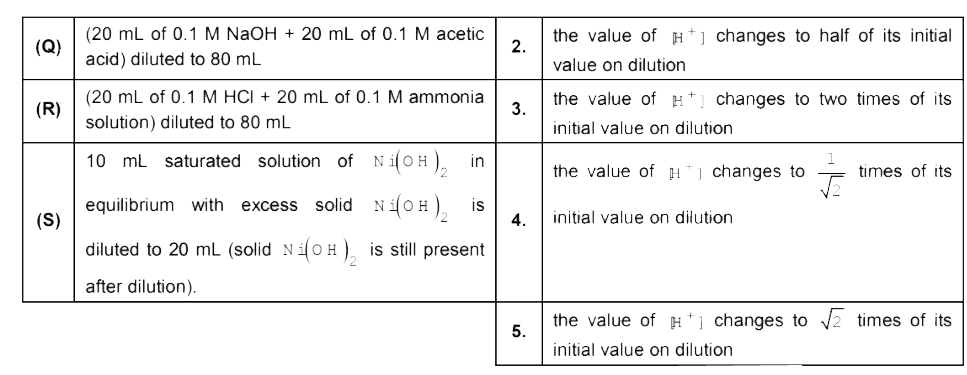
Dilution processes of different aqueous solutions, with water, are given in LIST-I. The effects of dilution of the solutions on `[H^(+)]`. are given in LIST-II.(Note: Degree of dissociation `(alpha)` of weak acid and weak base is`lt lt1`, degree of hydrolysis of salt `lt lt1`, `[H^(+)]` represents the concentration of `[H^(+)]` ions)
Match each process given in LIST-I with one or more effect(s) in LIST-II. The correct option is

A

`P to 4, Q to 2, R to 3, S to 1`

B

`P to 4, Q to 3, R to 2, S to 3`

C

`P to 1, Q to 4, R to 5, S to 3`

D

`P to 1, Q to 5, R to 4, S to 1`

Text Solution

Verified by Experts

The correct Answer is:

D

`P implies CH_(3)COOH + NaOH rarr CH_(3)COONa + H_(2)O`
No effect of dilution on H^(+)
`Q implies CH_(3)COOH + NaOH rarr CH_(3)COONa + H_(2)O`(salt of W/A and S/A)
`[H^(+)] = sqrt(K_(w) xx K_(a)/C),[H^(+)]_(old) = sqrt(K_(w) xx K_(a)/C), [H^(+)]_(n ew) = sqrt(K_(w) xx K_(a)/(C/2)) = [H^(+)]_(old) xx sqrt(2)`
`R implies NH_(3) + HCl rarr NH_(4)Cl`(salt of W/B and S/A)
`[H^(+)] = sqrt(K_(w) xx C/K_(b)),[H^(+)]_(old) = sqrt(K_(w) xx C/K_(b))`,` [H^(+)]_(n ew) = sqrt(K_(w) xx C/K_(b) xx 2) = [H^(+)]_(old) xx 1/sqrt(2)`
`S implies Ni(OH)_(2)(s) rarr Ni^(2+)(aq) + 2OH^(-)(aq)`
No effect of dilution on `[H^(+)]` as solution remain saturated.
Promotional Banner

Topper's Solved these Questions

  • IONIC EQUILIBRIUM

    VMC MODULES ENGLISH|Exercise Illustration - 1|1 Videos
  • IONIC EQUILIBRIUM

    VMC MODULES ENGLISH|Exercise Illustration - 2|1 Videos
  • IONIC EQUILIBRIUM

    VMC MODULES ENGLISH|Exercise JEE MAIN ( ARCHIVE )|50 Videos
  • INTRODUCTION TO ORGANIC CHEMISTRY

    VMC MODULES ENGLISH|Exercise JEE ADVANCED ARCHIVE|81 Videos
  • JEE MAIN - 5

    VMC MODULES ENGLISH|Exercise PART II : CHEMISTRY (SECTION - 2)|5 Videos

Similar Questions

Explore conceptually related problems

A block of mass m1 = 1 kg another mass m2 = 2 kg, are placed together (see figure) on an inclined plane with angle of inclination theta . Various values of theta are given in List I. The coefficient of friction between the block m_(1) and the plane is always zero. The coefficient of static and dynamic friction between the block m_(2) and the plane are equal to mu = 0.3 . In List II expressions for the friction on block m_(2) are given. Match the correct expression of the friction in List II with the angles given in List I, and choose the correct option. The acceleration due to gravity is denoted by g [Useful information : tan (5.5^(@)) ~~ 0.1, tan (11.5^(@)) ~~ 0.2 , tan (16.5^(@))~~ 0.3 ].

A block of mass m_(1) =1kg and another mass m_(2) = 2kg are placed together(see figure) on an inclined plane with angle of inclination theta varius value of theta are given in list 1 The coefficient of friction between the block m_(1) and the plank is always zero The coefficient of static and dynamic friction between the block m_(2) and the plank are equal to mu = 0.3 In List II experssions for the friction the block m_(2) are given Match the correct experssions of the frictionless in List II with the angle given in list 1 and choice the correct option The acceleration due too gravity detented by g [Useful information tan (5.5^(@)) = 0.1 tan (11.5^(@)) = 0.2 tan (16.5^(@)) = 0.3] List I P. theta = 5^(@) Q. theta = 10^(@) R. theta = 15^(@) S. theta = 20^(@) List 2 1. m_(2)g sin theta 2. (m_(1) + m_(2))g sin theta 3. mu m_(2)g cos theta 4. mu (m_(1) + m_(2))g cos theta

1.0 M solution of a weak base , BOH is only 0.5 % ionized . If 2 mL 1 M solution of BOH is mixed with 30 mL water , the degree of dissociation of the base in the resulting solution and H^(+) ion concentration of the solution will bee respectively

Calculate t the H^(+) ion concentration in 0.10 M acetic acid solution. Given that the dissociation constant of acetic acid in water is 1.8xx10^(-5)

Calculate the H^+ ion concentration in 0.10 M acetic acid solution- Given that the dissociation constant of acetic acid in water is 1.8 xx 10^(-6) .

An aqueous solution containing 12.48g of barium chloride in 1.0 kg of water boils at 373.0832 K. Calculate the degree of dissociation of barium chloride. [Given K_(b) for H_(2)O =0.52 Km^(-1) , Molar mass of BaCl_(2) =208.34 "g mol"^(-1) ]

Match list - I (hormones) with list - II (effect) and select the correct answer using the codes given below the lists

When a salt reacts with water to form acidic or basic solution , the process is called hydrolysis . The pH of salt solution can be calculated using the following relations : pH = 1/2 [pK_(w) +pK_(a) + logc] (for salt of weak acid and strong base .) pH = 1/2 [pK_(w) - pK_(b) - logc] (for salt of weak base and strong acid ) . pH = 1/2 [ pK_(w)+pK_(a)-pK_(b)] (for weak acid and weak base ). where 'c' represents the concentration of salt . When a weak acid or a weak base not completely neutralized by strong base or strong acid respectively , then formation of buffer takes place . The pH of buffer solution can be calculated using the following relation : pH = pK_(a) + log . (["Salt"])/(["Acid"]) , pOH = pK_(b) + log . (["Salt"])/([ "Base"]) Answer the following questions using the following data : pK_(a) = 4.7447 , pK_(b) = 4.7447 ,pK_(w) = 14 0.001 M NH_(4)Cl aqueous solution has pH :

When a salt reacts with water to form acidic or basic solution , the process is called hydrolysis . The pH of salt solution can be calculated using the following relations : pH = 1/2 [pK_(w) +pK_(a) + logc] (for salt of weak acid and strong base .) pH = 1/2 [pK_(w) - pK_(b) - logc] (for salt of weak base and strong acid ) . pH = 1/2 [ pK_(w)+pK_(a)-pK_(b)] (for weak acid and weak base ). where 'c' represents the concentration of salt . When a weak acid or a weak base not completely neutralized by strong base or strong acid respectively , then formation of buffer takes place . The pH of buffer solution can be calculated using the following relation : pH = pK_(a) + log . (["Salt"])/(["Acid"]) , pOH = pK_(b) + log . (["Salt"])/([ "Base"]) Answer the following questions using the following data : pK_(a) = 4.7447 , pK_(b) = 4.7447 ,pK_(w) = 14 When 100 mL of 0.1 M NH_(4)OH is added to 50 mL of 0.1M HCl solution , the pH is

When a salt reacts with water to form acidic or basic solution , the process is called hydrolysis . The pH of salt solution can be calculated using the following relations : pH = 1/2 [pK_(w) +pK_(a) + logc] (for salt of weak acid and strong base .) pH = 1/2 [pK_(w) - pK_(b) - logc] (for salt of weak base and strong acid ) . pH = 1/2 [ pK_(w)+pK_(a)-pK_(b)] (for weak acid and weak base ). where 'c' represents the concentration of salt . When a weak acid or a weak base not completely neutralized by strong base or strong acid respectively , then formation of buffer takes place . The pH of buffer solution can be calculated using the following relation : pH = pK_(a) + log . (["Salt"])/(["Acid"]) , pOH = pK_(b) + log . (["Salt"])/([ "Base"]) Answer the following questions using the following data : pK_(a) = 4.7447 , pK_(b) = 4.7447 ,pK_(w) = 14 50 mL 0.1 M NaOH is added to 50 mL of 0.1 M CH_(3)COOH solution , the pH will be

VMC MODULES ENGLISH-IONIC EQUILIBRIUM-JEE ADVANCED( ARCHIVE )
  1. For the reaction Ag(CN)(2)^(ɵ)hArr Ag^(o+)+2CN^(ɵ), the K(c ) at 25^...

    Text Solution

    |

  2. The average concentration of SO(2) in the atmosphere over a city on a ...

    Text Solution

    |

  3. For a sparingly soluble salt ApBq, the relationship of its solubility...

    Text Solution

    |

  4. Identify the correct order of solubility of Na(2)S,CuS and ZnS in aque...

    Text Solution

    |

  5. A solution containing Mn^(2+),Fe^(2+),Zn^(2+)andHg^(2+) with a molar c...

    Text Solution

    |

  6. 0.1 M of HA is titrated with 0.1 M NaOH, calculate the pH at end point...

    Text Solution

    |

  7. HX is a weak acid (K(a) = 10^(-5)). If forms a salt NaX(0.1M) on react...

    Text Solution

    |

  8. CH(3)NH(2)(0.1"mole",K(b)=5xx10^(-4)) is added to 0.08 moles of HCI a...

    Text Solution

    |

  9. The solubility product constant (K(sp)) of salts of types MX, MX(2), a...

    Text Solution

    |

  10. The dissociation constant of a substitued benzoic acid at 25^(@)C is 1...

    Text Solution

    |

  11. Amongst the following, the total number of compounds whose aqueous sol...

    Text Solution

    |

  12. Aqueous solution of HNO(3),CH(3),CH(3)COOH, and CH(3)COOK of identical...

    Text Solution

    |

  13. The total number of diprotic acids among the following is H(3)PO(4),...

    Text Solution

    |

  14. In 1L saturated solution of AgCl[K(SP)(AgCl)= 1.6xx10^(-10)], 0.1 mole...

    Text Solution

    |

  15. (A)Find the solubility product of a saturated solution of Ag(2)CrO(4) ...

    Text Solution

    |

  16. If K(sp) of Ag(2)CO(3) is 8xx10^(-12) the molar solubility of Ag(2)CO(...

    Text Solution

    |

  17. When 100mL of 1.0M HCl was mixed with 100 mL of 1.0 M NaOH in an insul...

    Text Solution

    |

  18. When 100mL of 1.0M HCl was mixed with 100 mL of 1.0 M NaOH in an insul...

    Text Solution

    |

  19. The solubility of a salt of weak acid (AB) at pH 3 is Y xx 10^(-3) "...

    Text Solution

    |

  20. Dilution processes of different aqueous solutions, with water, are giv...

    Text Solution

    |
