Home
Class 12
PHYSICS
A homogeneous rod AB of length L = 1.8 m...

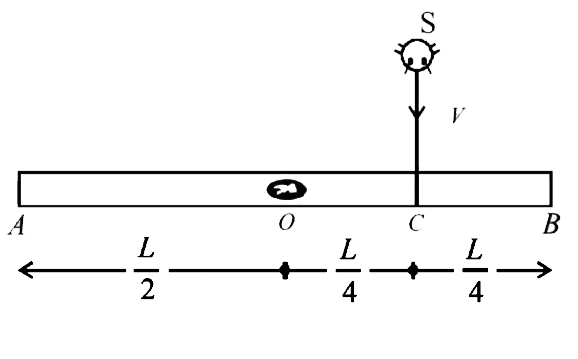
A homogeneous rod AB of length L = 1.8 m and mass M is pivoted at the center O in such a way that it can rotate it can rotate freely position. An insect S of the same mass M falls vertically with speed V on the point C, midway between the points O and B. Immediately after falling, the insect moves towards the end B such that the rod rotates with a constant angular velocity omega.
(a) Determine the angular velocity `omega` in terms of V and L.
(b) If the insect reaches the end B when the rod has turned through an angle of `90^@`, determine V.

Text Solution

Verified by Experts

(i) `(12V)/(7L)`, (ii) `35 ms^(-1)`

Let us take rod insect as a system. There is not external impulse acting on the system. Hence, we can apply conservation of angular momentum just before and just after collision about the point O. Angular momentum of the system before collision = angular momentum of the system after collision.
`MV xx L/4 = Iomega`
Where I is the moment of inertia of the system just after collision and `omega` is the angular velocity just after collision.
`rArr MV xx L/4 = [M (L/4)^(2) + 1/12 ML^(2)]omega`
`rArr MV xx L/4 =(ML^(2))/4[1/4 +1/3] omega = (ML^(2))/4[(3+4)/12]omega = (ML^(2))/4 xx 7/12 xx omega rArr omega = 12/7 xx V/L`.
Initially the rod was in equilibrium. But after collision there is an extra mass M of the insect which creates a torque in the clockwise direction, which tries to create angular acceleration in the rod. But the same is compensated by the movement of insect towards B due to which moment of inertia of the system increase.
Let at any instant of time t the insect be at a distance x from the centre of the rod and the rod has turned through an angle `theta(=omegat)` w.r.t. its original position

Torque acting on rod `tau = (dL)/(dt) = d/(dt)(Iomega) = omega (dI)/(dt)`
`=omega d/(dt)[112 MI^(2) + Mx^(2)] = 2M omega xx (dx)/(dt)`.......(i)
This torque is balanced by the torque due to weight of insect `tau`= Force `xx` Perpendicular distance of force with axis of rotation.
`=Mg xx (OM) = Mg xx x costheta`...........(ii)
From (i) and (ii)
`2Momega xx (dx)/(dt) = Mg xx x cos theta rArr dx =(g/(2omega)) cos omega tdt`
On integration taking limits
`int_(L//4)^(L//2) dx + g/(2omega^(2)) int_(0)^(pi//2omega) cos omega tdt` [when `x=L/4, omega t=0`, when `x=L/2 , omega t=pi/2`]
`[x]_(L//2)^(L//4) = g/(2omega^(2)) [sin omega t]_(0)^(pi//2omega)`
`rArr L/2 -L/4 =g/(2omega^(2))[sin pi/2 - sin 0] rArr L/4 =g/(2omega^(2)) rArr omega =sqrt((2g)/L)`
But `omega = 12/7 V/L rArr 12/7 V/L = sqrt((2g)/L) rArr V=7/12 sqrt(2gL) rArr V=7/12 sqrt(2 xx 10 xx 1.8) = 3.5 ms^(-1)`
Promotional Banner

Topper's Solved these Questions

  • ROTATIONAL MOTION

    VMC MODULES ENGLISH|Exercise JEE Advanced (Archive) (True/False Type)|3 Videos
  • ROTATIONAL MOTION

    VMC MODULES ENGLISH|Exercise JEE Advanced (Archive) (NUMERICAL VALUE TYPE)|15 Videos
  • REVISION TEST-2 JEE

    VMC MODULES ENGLISH|Exercise PHYSICS|25 Videos
  • SIMPLE HARMONIC MOTION

    VMC MODULES ENGLISH|Exercise 7-previous year question|46 Videos

Similar Questions

Explore conceptually related problems

A copper rod AB-of length / pivoted at one end A, rotates at constant angular velocity omega , at right angles to a uniformn magnetic field of induction B. The emf, developed between the mid point of the rod and end B is

A uniform rod of length L and mass m is free to rotate about a frictionless pivot at one end as shown in figure. The rod is held at rest in the horizontal position and a coin of mass m is placed at the free end. Now the rod is released The reaction on the coin immediately after the rod starts falling is

A uniform rod AB of length L and mass m is suspended freely at A and hangs vertically at rest when a particle of same mass m is fired horizontally with speed v to strike the rod at its mid point. If the particle is brought to rest after the impact. Then the impulsive reaction at A is horizontal direction is

A rod of mass 2 kg ad length 2 m is rotating about its one end O with an angular velocity omega=4rad//s . Find angular momentum of the rod about the axis rotation.

A rigid rod of mass m & length l is pivoted at one of its ends. If it is released from its horizontal position, find the speed of the centre of mass of the rod when it becomes vertical.

A rod of mass m and length L is pivoted at a point O and kept in horizontal position as shown in figure. Now it is released from this position so that it can rotates freely about the point O in downward direction. When it becomes vertical

A rod AC of length l and mass m is kept on a horizontal smooth plane. It is free to rotate and move. A particle of same mass m moving on the plane with velocity v strikes the rod at point B making angle 37^@ with the rod. The collision is elastic. After collision,

A slender uniform rod of mass M and length l is pivoted at one end so that it can rotate in a vertical plane, Fig. There is negligible friction at the pivot. The free end is held vertically above the pivot and then released. The angular acceleration of the rod when it makes an angle theta with the vertical is

A particle of mass m is fixed to one end of a light rigid rod of length l and rotated in a vertical ciorcular path about its other end. The minimum speed of the particle at its highest point must be

A uniform rod of length L and mass M is pivoted freely at one end and placed in vertical position. a. What is angular acceleration of the rod when it is at ann angle theta with the vertical? b. What is the tangential linear acceleration of the free end when the rod is horizontal?

