Home
Class 12
PHYSICS
A uniform disc of mass m and radius r is...

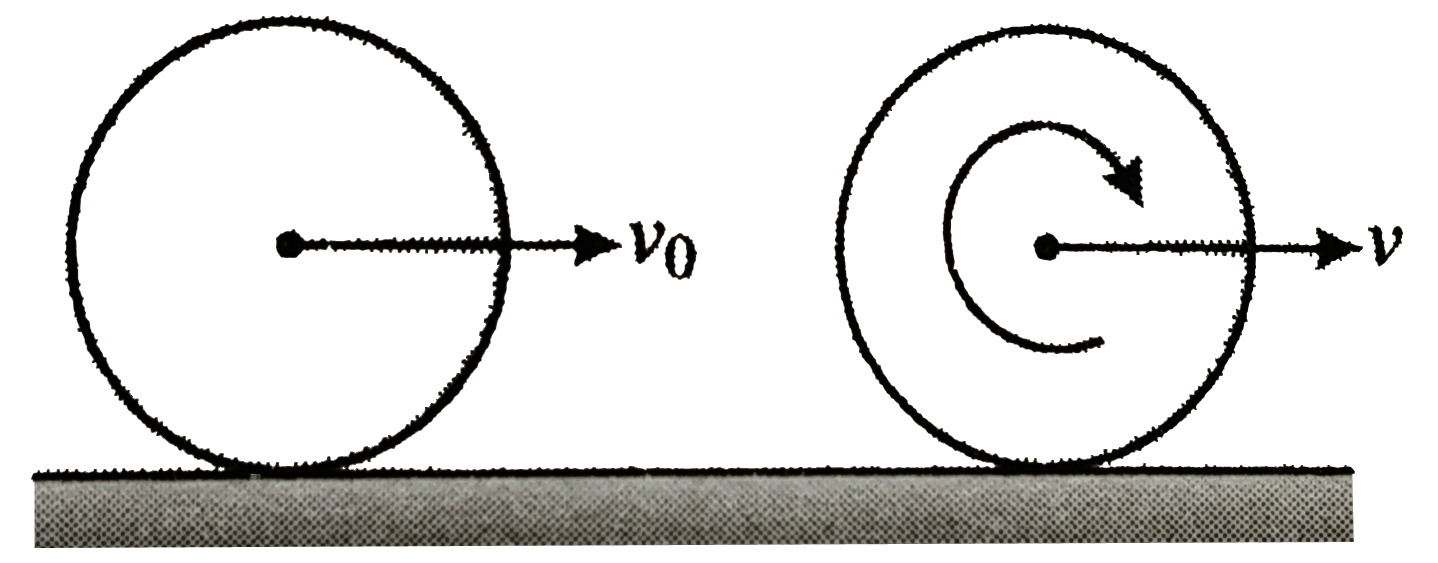
A uniform disc of mass `m` and radius `r` is projected horizontally with velocity `v_(0)` on a rough horizontal floor so that it starts off with a purely sliding motion at `t=0`. At `t=t_(0)` seconds it acquires a purely rolling motion.
a. Calculate the velocity of the centre of mass of the disc at `t=t_(0)`.

b. Assuming coefficient of friction to be `mu` calculate `t_(0)`.
The work done by the frictional force as a function of time.
Total work done by the friction over a time t much longer than `t_(0)`.

A

The velocity of the centre of mass of the disc at `t=t_(0)` is ………………………

B

Assuming coefficient of friction to be `mu` calculate `t_(0)`…………….

C

Findi the expression for work done by the functional force as a function of time………………

D

What is the total work done by the friction over a time t much longer time `t_(0)` ?........................

Text Solution

Verified by Experts

(i) `2/3v_(0)`, (ii) `v_(0)/(3mug)`, (iii) `1/2m(v_(0)-mug t^(2))+1/2(mr^(2))/2 ((2mug t)/r)^(2) -1/2 mv_(0)^(2)`,(iv) `-mv_(0)^(2)//6`
FBD of the disc is as shown.
When the disc is projected it starts sliding and hence there is a relative motion between the points of contact. Therefore, frictional force acts on the disc in the direction opposite to the motion.
(i) Now for translational motion.

`veca_(CM) =vecf/m`
`f=muN` (as it slides) `=mug rArr a_(cm) =-mug`, negative sign indicates that `a_(cm)` is opposite to `v_(cm) rArr v_(cm)(t) =v_(0)-mug t rArr t_(0)=(v_(0)-v)/(mug)`, when `v_(cm) (t_(0))=v` ..........(i)
For rotational motion about centre
`tau_(CM) =I_(CM)alpha rArr mum gr =(mr^(2))/2 alpha alpha =(2mug)/r`
`omega(t)=0 + (2mug)/r t rArr omega(t_(0)) (2mug)/r (v_(0)-v)/(mug) =(2(v_(0)-v))/r`
`v_(cm) = omegar rArr v=2(v_(0)-v) rArr v=2/3 v_(0)`
(ii) Putting the value of v in Eq. (i) , we get `t_(0) =v_(0)/(3mug)`
(iii) Work done by the frictional force equal to change in K.E.
`W_("friction") =1/2m(v_(0)-mug t)^(2) +1/2(mr^(2))/r -1/2mv_(0)^(2)`
(iv) Work done till time `t_(0) =1/2m((2v_(0))/2)^(2) + 1/2(mr^(2))/2 ((2v_(0))^(2)/(3r))^(2)-1/2mv_(0)^(2)`
`=1/2mv_(0)^(2) (4/9 + 2/9-1) = (mv_(0)^(2))/6`
For time, `t gt t_(0)`, work done by the friction is zero as friction stops acting. Therefore, for longer total work done is `W=-mv_(0)^(2)//6`.
Promotional Banner

Topper's Solved these Questions

  • ROTATIONAL MOTION

    VMC MODULES ENGLISH|Exercise JEE Advanced (Archive) (True/False Type)|3 Videos
  • ROTATIONAL MOTION

    VMC MODULES ENGLISH|Exercise JEE Advanced (Archive) (NUMERICAL VALUE TYPE)|15 Videos
  • REVISION TEST-2 JEE

    VMC MODULES ENGLISH|Exercise PHYSICS|25 Videos
  • SIMPLE HARMONIC MOTION

    VMC MODULES ENGLISH|Exercise 7-previous year question|46 Videos

Similar Questions

Explore conceptually related problems

A uniform disc of mass m and radius R is projected horizontally with velocity v_(0) on a rough horizontal floor so that it starts off with a purely sliding motion at t=0 . After t_(0) seconds, it acquires pure rolling motion as shown in the figure. (a) Calculate the velocity of the center of mass of the disc at t_(0) . Assuming that the coefficent of friction to be mu , calculate t_(0) .

A uniform ring of mass 'm' and radius 'R' is projected horizontally with velcoty v_(0) on a rough horizontal floor, so that it starts off with a purely sliding motion and it acquires a pure rolling motion after moving a distance d. If the coefficient of friction between the ground and ring is mu , then work done by the friction in the process is

A disc of mass M and radius R is rolling purely with centre's velcity v_(0) on a flat horizontal floor when it hits a step in the floor of height R//4 The corner of the step is sufficiently rough to prevent any slippoing of the disc against itself. What is the velocity of the centre of the disc just after impact?

A body of mass 2 kg is kept on a rough horizontal surface as shown in the figure. If coefficient of friction is 0.5, find the work done by frictional force in the interval t=0 to t=5 sec

A disc is in the condition of pure rolling on the horizontal surface. The velocity of center of mass is V_0 If radius of disc is R then the speed of point P is (OP =R/3)

A thin ring of mass m and radius R is in pure rolling over a horizontal surface. If v_0 is the velocity of the centre of mass of the ring, then the angular momentum of the ring about the point of contact is

A uniform disc of mass m and radius R is thrown on horizontal lawn in such a way that it initially slides with speed V_0 without rolling. The distance travelled by the disc till it starts pure rolling is (Coefficient friction between the contact is 0.5)

A uniform disc of mass m and radius R is released gentiy on a horizontal rough surface. Such that centre of the disc has velocity V_(0) towards right and angular velocity omega_(0) (anticlockwise) as shown. Disc will certainly come back to its intial position if

A sphere of mass M and radius r shown in the figure on a rough horizontal plane. At some instant it has translational velocity v_(0) , and rotational velocity about centre v_(0)//2r . The percentage change of translational velocity after the sphere start pure rolling:

A point on the rim of a disc starts circular motion from rest and after time t, it gains an angular acceleration given by alpha=3t-t^(2) . Calculate the angular velocity after 2 s.
