Home
Class 12
CHEMISTRY
The plote between concentration versus t...

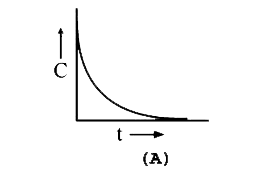
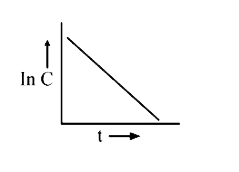
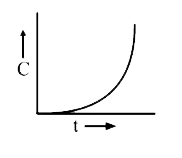
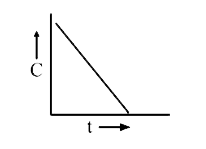
The plote between concentration versus time for a zero order reaction is represented by :

A

B

C

D

Text Solution

AI Generated Solution

The correct Answer is:

To determine the plot between concentration versus time for a zero-order reaction, we can follow these steps: ### Step-by-Step Solution: 1. **Understanding Zero-Order Reactions**: - In a zero-order reaction, the rate of reaction is constant and does not depend on the concentration of the reactant. This can be expressed as: \[ \text{Rate} = -\frac{d[C]}{dt} = k \] where \( [C] \) is the concentration of the reactant and \( k \) is the rate constant. 2. **Rearranging the Rate Equation**: - We can rearrange the equation to express the change in concentration over time: \[ -d[C] = k \, dt \] 3. **Integrating the Equation**: - We integrate both sides. The left side will be integrated from the initial concentration \( [C_0] \) to \( [C] \), and the right side from \( 0 \) to \( t \): \[ \int_{[C_0]}^{[C]} -d[C] = \int_{0}^{t} k \, dt \] 4. **Performing the Integration**: - The integration results in: \[ -([C] - [C_0]) = kt \] - Rearranging gives: \[ [C] = [C_0] - kt \] 5. **Identifying the Linear Relationship**: - The equation \( [C] = [C_0] - kt \) represents a linear equation of the form \( y = mx + b \), where: - \( y = [C] \) - \( x = t \) - The slope \( m = -k \) (negative slope) - The y-intercept \( b = [C_0] \) 6. **Plotting the Graph**: - When we plot concentration \( [C] \) on the y-axis against time \( t \) on the x-axis, we will obtain a straight line with a negative slope, starting from the initial concentration \( [C_0] \). ### Conclusion: The plot between concentration versus time for a zero-order reaction is a straight line with a negative slope, where the y-intercept is the initial concentration \( [C_0] \).

To determine the plot between concentration versus time for a zero-order reaction, we can follow these steps: ### Step-by-Step Solution: 1. **Understanding Zero-Order Reactions**: - In a zero-order reaction, the rate of reaction is constant and does not depend on the concentration of the reactant. This can be expressed as: \[ \text{Rate} = -\frac{d[C]}{dt} = k ...
Promotional Banner

Topper's Solved these Questions

  • CHEMICAL KINETICS

    VMC MODULES ENGLISH|Exercise Level-2 ( Numerical Value Type for JEE Main )|15 Videos
  • CHEMICAL KINETICS

    VMC MODULES ENGLISH|Exercise JEE Main (Archive)|56 Videos
  • CHEMICAL KINETICS

    VMC MODULES ENGLISH|Exercise Level-1|75 Videos
  • CHEMICAL EQUILIBRIUM

    VMC MODULES ENGLISH|Exercise IN-CHAPTER EXERCISE - G|10 Videos
  • CHEMICAL THERMODYNAMICS

    VMC MODULES ENGLISH|Exercise IN - CHAPTER EXERCISE - L|10 Videos

Similar Questions

Explore conceptually related problems

The graph plotted between concentration versus time

The rate constant for zero order reaction is

What type of plot is obtained for rate versus time for zero order reaction gt

The half life for the zero order reaction will be

For zero order reaction which is (are) true?

The plot of concentration of the reactant vs time for a reaction is a straight line with a negative slope. This reaction follows (a)zero order rate equation (b)first order rate equation (c)second order rate equation (d)third order rate equation

The order of reaction is an experimentally determined quanity. It may be zero, poistive, negative, or fractional. The kinetic equation of nth order reaction is k xx t = (1)/((n-1))[(1)/((a-x)^(n-1)) - (1)/(a^(n-1))] …(i) Half life of nth order reaction depends on the initial concentration according to the following relation: t_(1//2) prop (1)/(a^(n-1)) ...(ii) The unit of the rate constant varies with the order but general relation for the unit of nth order reaction is Units of k = [(1)/(Conc)]^(n-1) xx "Time"^(-1) ...(iii) The differential rate law for nth order reaction may be given as: (dX)/(dt) = k[A]^(n) ...(iv) where A denotes the reactant. The rate constant for zero order reaction is where c_(0) and c_(t) are concentration of reactants at respective times.

For a chemical reaction A rarr B , the rate of reaction increases by a factor of 1.837 when the concentration of A is increased by 1.5 time. The order of reaction with respect to A is:

When the concentration of a reactant of first order reaction is doubled, the rate becomes ........... times, but for ........ order reaction, the rate remains same.

VMC MODULES ENGLISH-CHEMICAL KINETICS -Level-2
  1. The half-life period of a first-order chemical reaction is 6.93 min. T...

    Text Solution

    |

  2. The unit of rate constant for a second order reaction is

    Text Solution

    |

  3. The plote between concentration versus time for a zero order reaction ...

    Text Solution

    |

  4. Under the same reaction conditions, the intial concentration of 1.386 ...

    Text Solution

    |

  5. For a reaction, A+2B to C, rate is given by +(d[C])/(dt)=k[A][B], henc...

    Text Solution

    |

  6. Which represents first order reaction out of I, II and III?

    Text Solution

    |

  7. For a 1^(st) order decomposition, overall k will be given by :

    Text Solution

    |

  8. For a first order reaction with rate constant 'k' and initial concentr...

    Text Solution

    |

  9. The rate constant of a first order reaction is 6.9xx10^(-3)s^(-1). How...

    Text Solution

    |

  10. For the homogeneous elementary reaction, A+B rarrC, the unit of rate ...

    Text Solution

    |

  11. How much time is requred for two - third completion of a first order r...

    Text Solution

    |

  12. A first orde reaction is 75% completed after 32min. When was 50% of th...

    Text Solution

    |

  13. In the reaction 2N(2)O(5) rarr 4NO(2) + O(2), initial pressure is 500...

    Text Solution

    |

  14. The activation energy of exothermic reaction ArarrB is 80 kJ "mol"^(-1...

    Text Solution

    |

  15. For a gaseous reaction, following data is given: ArarrB, k(1)= 10^(1...

    Text Solution

    |

  16. Given the following diagram for the reaction A+B rarr C+D The enthalpy...

    Text Solution

    |

  17. The rate constant of a first order reaction at 27^@C is 10–3 min–1. Th...

    Text Solution

    |

  18. For the reaction 2NH(3) to N(2) + 3H(2), If - (d[NH(3)])/(dt) = k(!)...

    Text Solution

    |

  19. A catalyst lowers the enrgy of activation by 25%, temperature at which...

    Text Solution

    |

  20. In the following graphical representation for the reaction A rarr B, t...

    Text Solution

    |
