Home
Class 12
CHEMISTRY
For a reaction of reversible nature, net...

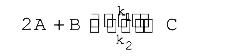
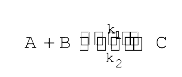
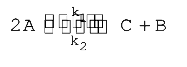
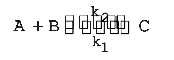
For a reaction of reversible nature, net rate is `((dx)/(dt))=k_(1)[A][B]-k_(2)[C]` hence, given reaction is :

A

B

C

D

Text Solution

AI Generated Solution

The correct Answer is:

To solve the problem, we need to analyze the given net rate equation for a reversible reaction and identify the correct form of the reaction based on the provided options. ### Step-by-Step Solution: 1. **Understanding the Net Rate Equation**: The net rate of a reversible reaction is given by: \[ \frac{dx}{dt} = k_1[A][B] - k_2[C] \] Here, \(k_1\) is the rate constant for the forward reaction, and \(k_2\) is the rate constant for the backward reaction. 2. **Identifying the Forward and Backward Reactions**: - The forward reaction can be represented as: \[ A + B \rightleftharpoons C \] - The rate of the forward reaction is proportional to the concentrations of the reactants: \[ R_{\text{forward}} = k_1[A][B] \] - The rate of the backward reaction is proportional to the concentration of the product: \[ R_{\text{backward}} = k_2[C] \] 3. **Formulating the Net Rate**: The net rate of the reaction can be expressed as: \[ \text{Net Rate} = R_{\text{forward}} - R_{\text{backward}} = k_1[A][B] - k_2[C] \] This matches the given equation. 4. **Analyzing the Options**: - We need to check each option provided to see which one matches the derived net rate equation. - The correct option should have the form \(k_1[A][B] - k_2[C]\). 5. **Conclusion**: After checking the options, we find that the option which states: \[ R_{\text{forward}} = k_1[A][B] \quad \text{and} \quad R_{\text{backward}} = k_2[C] \] matches the derived net rate equation. Therefore, the correct answer is option B.

To solve the problem, we need to analyze the given net rate equation for a reversible reaction and identify the correct form of the reaction based on the provided options. ### Step-by-Step Solution: 1. **Understanding the Net Rate Equation**: The net rate of a reversible reaction is given by: \[ \frac{dx}{dt} = k_1[A][B] - k_2[C] ...
Promotional Banner

Topper's Solved these Questions

  • CHEMICAL KINETICS

    VMC MODULES ENGLISH|Exercise Level-2 ( Numerical Value Type for JEE Main )|15 Videos
  • CHEMICAL KINETICS

    VMC MODULES ENGLISH|Exercise JEE Main (Archive)|56 Videos
  • CHEMICAL KINETICS

    VMC MODULES ENGLISH|Exercise Level-1|75 Videos
  • CHEMICAL EQUILIBRIUM

    VMC MODULES ENGLISH|Exercise IN-CHAPTER EXERCISE - G|10 Videos
  • CHEMICAL THERMODYNAMICS

    VMC MODULES ENGLISH|Exercise IN - CHAPTER EXERCISE - L|10 Videos

Similar Questions

Explore conceptually related problems

For a reaction of reversible nature , net rate is ((dx)/(dt))=k_(1)[A]^(2)[B]^(1)-k_(2)[C] , hence , given reactionis:

For a reaction whose rate expression is rate (dx)/(dt)=k[A]^(1//2) [B]^(3//2) the overall order of the reaction will be:

For a reaction, A+2B to C, rate is given by +(d[C])/(dt)=k[A][B], hence, the order of the reaction is

The rate of the reaction A+B+C to Product is given by: rate =-(d[A])/(dt)=k[A]^(1//2) [B]^(1//4) [C]^0 The order of reaction is:

For a reaction A+ B to Products, the rate law is -Rate = k[A][B]^(3//2) Can the reaction be an elementray reaction ? Explain.

If the rate of reaction between A and B is given by rate =k[A][B]^(2) , then the reaction is

(a) For a reaction ABrarrP , the rate law is given by, r=k[A]^(1//2)[B]^(2). What is the order of this reaction? (b) A first order reaction is found to have a rate constant k=5.5xx10^(-14)s^(-1) , Find the half life of the reaction.

The rate of certain hypothetical reaction A+B+C rarr Products, is given by r = -(dA)/(dt) = k[A]^(1//2)[B]^(1//3)[C]^(1//4) The order of a reaction is given by

The rate of certain hypothetical reaction A+B+C rarr Products, is given by r = -(dA)/(dt) = k[A]^(1//2)[B]^(1//3)[C]^(1//4) The order of a reaction is given by

The rate constant for a forward reaction in a reversible reaction (K_(eq) = 10^(6)) is 10^(2) . Calculate rate constant for its backward reaction

VMC MODULES ENGLISH-CHEMICAL KINETICS -Level-2
  1. A catalyst lowers the enrgy of activation by 25%, temperature at which...

    Text Solution

    |

  2. In the following graphical representation for the reaction A rarr B, t...

    Text Solution

    |

  3. For a reaction of reversible nature, net rate is ((dx)/(dt))=k(1)[A][B...

    Text Solution

    |

  4. Rate constant k varies with temperature by equation, log k (min+^(-1))...

    Text Solution

    |

  5. If a homogeneous catalytic reaction follows three alternative paths A,...

    Text Solution

    |

  6. Two different first order reactions have rate consants k(1) and k(2) "...

    Text Solution

    |

  7. Consider the following statement : 1 The rate of reaction is always ...

    Text Solution

    |

  8. In the reaction A+BrarrC+D, the rate ((dx)/(dt)) when plotted against ...

    Text Solution

    |

  9. Initial concentration of reactant for nth order reaction is 'a'. Which...

    Text Solution

    |

  10. According to collision theory, which of the following is the criteria ...

    Text Solution

    |

  11. For the first-order reaction (C=C(0)e^(-k(1)^(t))) and T(av)=k(1)^(-1)...

    Text Solution

    |

  12. A reactant (A) forms two products A overset (k(1))rarr B, Activation...

    Text Solution

    |

  13. Consider the reaction : 2H(2)(g)+2NO(g)rarrN(2)(g)+2H(2)(g) The r...

    Text Solution

    |

  14. Which of the following is correct?

    Text Solution

    |

  15. Consider the following reaction. The reaction is first order in each ...

    Text Solution

    |

  16. If -((dN)/(dt))(o) is the initial activity and -((dN)/(dt)) is the act...

    Text Solution

    |

  17. For the second order reaction, concentration (x) of the product at tim...

    Text Solution

    |

  18. Consider following two competing first ordr reactions, Poverset(k(1)...

    Text Solution

    |

  19. Which of the following is pseudo-unimolecular reaction ?

    Text Solution

    |

  20. If the rate law is -(d[A])/(dt) =k[A] State I, at t = 0 state I...

    Text Solution

    |
