Home
Class 12
CHEMISTRY
Following reaction can take place in bot...

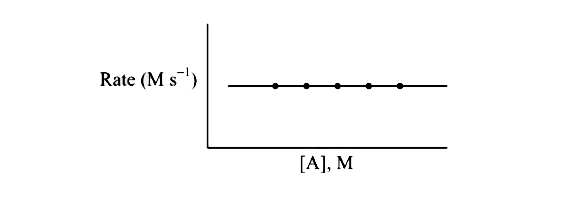
Following reaction can take place in both direction `A {:(k_(1)),(k_(2)):}B.` For the forward reaction and for the backward direction
`{:([B],"Rate"),(0.01M, 1xx10^(-2) Ms^(-1)),(0.02M, 2xx10^(-2) Ms^(-1)):}`
Hence, net reaction rate is :

A

`=k_(1) [A]-k_(2)[B]`

B

`=k_(1)-k_(2)[B]`

C

`=k_(1)[A]-k_(2)`

D

`=k_(1)-k_(2)`

Text Solution

Verified by Experts

The correct Answer is:

B

Based on (A), rate is independent of (A) and when (B) is doubled, rate is also doubled.
Thus, for forward reaction rate law `=k_(1) [A]^(o) =k_(1)` and for backward reaction are law `=k_(2) [B]`
Thus, net rate `=k_(1) -k_(2) [B]`
Promotional Banner

Topper's Solved these Questions

  • CHEMICAL KINETICS

    VMC MODULES ENGLISH|Exercise Level-2 ( Numerical Value Type for JEE Main )|15 Videos
  • CHEMICAL KINETICS

    VMC MODULES ENGLISH|Exercise JEE Main (Archive)|56 Videos
  • CHEMICAL KINETICS

    VMC MODULES ENGLISH|Exercise Level-1|75 Videos
  • CHEMICAL EQUILIBRIUM

    VMC MODULES ENGLISH|Exercise IN-CHAPTER EXERCISE - G|10 Videos
  • CHEMICAL THERMODYNAMICS

    VMC MODULES ENGLISH|Exercise IN - CHAPTER EXERCISE - L|10 Videos

Similar Questions

Explore conceptually related problems

For a given reaction A rarr Product, rate is 1xx10^(-4)M s^(-1) when [A]=0.01M and rate is 1.41xx10^(-4)M s^(-1) when [A]=0.02 M . Hence, rate law is :

In data given below. {:(,[A],[B],"rate"),(,mol//L,mol//L,mol L ^(-1)s^(-1)),(a., 0.02,1.2,3.0xx10^(-3)),(b.,0.04,2.4,6.0xx10^(-3)):} The reaction may be

The rate constant for a forward reaction in a reversible reaction (K_(eq) = 10^(6)) is 10^(2) . Calculate rate constant for its backward reaction

For a first order for the reaction A rarr products : the rate of reaction at [A]=0.2 M is 1.0 xx 10^(-3) mol L^(-1)s^(-1) . The reaction will occur to 75% completion in .

1 mole of a gas A is taken in a vessel of volume 1L . It dissociates according to the reaction A(g)hArrB(g)+C(g) "at" 27^(@)C . Forward and backward reaction rate constants for the reaction are 1.5xx10^(-2) "and" 3xx10^(-2) respectively. Find the concentrations of A,B "and" C at equilibrium.

Rate constant of two reactions are given below. Identifying their order of reaction k = 5.3 xx 10^(-2) L mol^(-1) s^(-1) k = 3.8 xx 10^(-4) s^(-1)

For the reaction A+B hArr C , the rate constants for the forward and the reverse reactions are 4xx10^(2) and 2xx10^(2) respectively. The value of equilibrium constant K for the reaction would be

Identify the reaction order from each of the following rate constants. (i) k = 2.3xx10^(-5)Lmol^(-1)s^(-1) (ii) k = 3xx 10^(-4)s^(-1)

VMC MODULES ENGLISH-CHEMICAL KINETICS -Level-2
  1. If a homogeneous catalytic reaction follows three alternative paths A,...

    Text Solution

    |

  2. Two different first order reactions have rate consants k(1) and k(2) "...

    Text Solution

    |

  3. Consider the following statement : 1 The rate of reaction is always ...

    Text Solution

    |

  4. In the reaction A+BrarrC+D, the rate ((dx)/(dt)) when plotted against ...

    Text Solution

    |

  5. Initial concentration of reactant for nth order reaction is 'a'. Which...

    Text Solution

    |

  6. According to collision theory, which of the following is the criteria ...

    Text Solution

    |

  7. For the first-order reaction (C=C(0)e^(-k(1)^(t))) and T(av)=k(1)^(-1)...

    Text Solution

    |

  8. A reactant (A) forms two products A overset (k(1))rarr B, Activation...

    Text Solution

    |

  9. Consider the reaction : 2H(2)(g)+2NO(g)rarrN(2)(g)+2H(2)(g) The r...

    Text Solution

    |

  10. Which of the following is correct?

    Text Solution

    |

  11. Consider the following reaction. The reaction is first order in each ...

    Text Solution

    |

  12. If -((dN)/(dt))(o) is the initial activity and -((dN)/(dt)) is the act...

    Text Solution

    |

  13. For the second order reaction, concentration (x) of the product at tim...

    Text Solution

    |

  14. Consider following two competing first ordr reactions, Poverset(k(1)...

    Text Solution

    |

  15. Which of the following is pseudo-unimolecular reaction ?

    Text Solution

    |

  16. If the rate law is -(d[A])/(dt) =k[A] State I, at t = 0 state I...

    Text Solution

    |

  17. For the following reaction, A overset(500 K)rarr Products A overse...

    Text Solution

    |

  18. Following reaction can take place in both direction A {:(k(1)),(k(2)):...

    Text Solution

    |

  19. The rate constant for the reaction in gaseous phase O+O(3) rarr 2O(2...

    Text Solution

    |

  20. The rate constant in numerically the same for the theee reaction of fi...

    Text Solution

    |
