Home
Class 12
CHEMISTRY
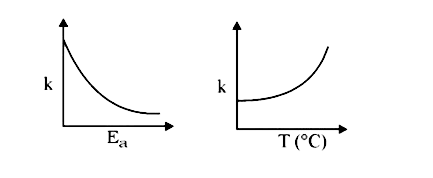
Consider the given plots for a reaction ...

Consider the given plots for a reaction obeying Arrhenius equation `(0^(@)C lt T lt 300^(@)C)` : `(k and E_(a)` are rate constant and activation energy, respectively) Choose the correct option :

A

Both I and II are correct

B

I is wrong but II is right

C

I is right but II is wrong

D

Both I and II are wrong

Text Solution

Verified by Experts

The correct Answer is:
A


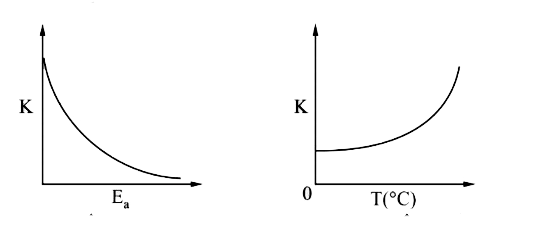
As per Arhenius equation As per Arhenius equation Hence both graphs are correct
Promotional Banner

Topper's Solved these Questions

  • CHEMICAL KINETICS

    VMC MODULES ENGLISH|Exercise JEE Advanced (Archive)|52 Videos
  • CHEMICAL KINETICS

    VMC MODULES ENGLISH|Exercise Level-2 ( Numerical Value Type for JEE Main )|15 Videos
  • CHEMICAL EQUILIBRIUM

    VMC MODULES ENGLISH|Exercise IN-CHAPTER EXERCISE - G|10 Videos
  • CHEMICAL THERMODYNAMICS

    VMC MODULES ENGLISH|Exercise IN - CHAPTER EXERCISE - L|10 Videos

Similar Questions

Explore conceptually related problems

Consider the given plots for a reaction obeying Arrhenius equation (0^(@)CltTlt300^(@)C) : (k and E_(a) are rate constant and activation energy, respectively)

Consider the given plots for a reaction obeying Arrhenius equation (k and E_a are rate constant and activation energy, respectively) Choose the correct option:

The variation of rate constant with temperature is given by the integrated from of the Arrhenius equation, log_10k = (-Ea)/(2.303 RT) + constant where k = rate cosntant and Ea is the experimental activation energy. If for a certain reaction, log_10k = (-3163.0)/T + 11.899 , calculate Ea.

Will the rate constant of the reaction depend upon T if the E_act (activation energy) of the reaction is zero?

The rate constant of a reaction at temperature 200 K is 10 times less than the rate constant at 400 K. What is the activation energy (E_(a)) of the reaction ? (R = gas constant)

Kinetic energy of a charged particle is zero at time t_(0) . K at time 2 t_(0) . 2K at time 3 t_(0) . It remains constant (i.e.2K) upto 4 t_(0) . Choose the correct option.

What would be the energy of activation for a reaction when a change of temperature from 20^@C " to " 30^@C exactly triples the reaction rate constant ?

Consider the following plots of rate constant versus (1)/(T) for four different reactions. Which of the following orders is correct for the activation energies of these reactions ?

For a first order reaction A rarr P , the temperature (T) dependent rate constant (k) was found to follow the equation log k = -2000(1//T) + 6.0 . The pre-exponential factor A and the activation energy E_(a) , respective, are

Arrhenius studies the effect of temperature on the rate of a reaction and postulted that rate constant varies with temperature exponentially as k=Ae^(E_(a)//RT) . Thuis method is generally used for finding the activation energy of a reaction. Keeping temperature constant, the effect of catalyst on the activation energy has also been studied. If the rate of reaction doubles for 10^(@)C rise of temperature form 290K to 300K, the activation energy of the reaction will be approximately :

VMC MODULES ENGLISH-CHEMICAL KINETICS -JEE Main (Archive)
  1. For the chemical reaction X Y , the standard reaction Gibbs energ...

    Text Solution

    |

  2. If a reation follows the Arrhensis equation the plot lnk vs1/(RT) give...

    Text Solution

    |

  3. Decomposition of X exhibits a rate constant of 0.5 mu g // year. How ...

    Text Solution

    |

  4. For a reaction, consider the plot of In K versus 1//T given in the fig...

    Text Solution

    |

  5. Consider the given plots for a reaction obeying Arrhenius equation (0^...

    Text Solution

    |

  6. The reactin 2X to B is a zeroth order reaction. If the initial concent...

    Text Solution

    |

  7. A bacterial infection in an internal wound grows as N'(t) = N(0) exp (...

    Text Solution

    |

  8. The given plots represent the variation of the concentration of a reac...

    Text Solution

    |

  9. For the reaction 2A + B rarrC, the values of ini concentrations are gi...

    Text Solution

    |

  10. In the following reaction, xA rarryB log(10)[-(d[A])/(dt)]=log(10)[...

    Text Solution

    |

  11. NO(2) required for a reaction is produced by the decomposition of N(2)...

    Text Solution

    |

  12. For the reaction of H(2) with I(2), the constant is 2.5 xx 10^(-4) dm^...

    Text Solution

    |

  13. Consider the given plot of enthalpy of the following reaction between ...

    Text Solution

    |

  14. For a reaction scheme Aoverset(k(1))toBoverset(k(2))toD , If the rate ...

    Text Solution

    |

  15. For the reaction 2H(2)(g)+2NO(g) rarr N(2)(g)+2H(2)O(g) the observ...

    Text Solution

    |

  16. Consider the following plots of rate constant versus (1)/(T) for four ...

    Text Solution

    |

  17. For following reactions A overset( 400K)( rarr) Product A underse...

    Text Solution

    |

  18. The rate of a certain biochemical reaction at physiological temperatur...

    Text Solution

    |

  19. During nuclear explosion, one of the products is""^(90(Sr)) with half-...

    Text Solution

    |

  20. Lacto bacillus has generation time 60 min. at 300 K and 40 min. at 400...

    Text Solution

    |

