Home
Class 12
CHEMISTRY
Solid NH(4)HS(s) (ammonium hydrogen sulp...

Solid `NH_(4)HS(s)` (ammonium hydrogen sulphate) dissociates to give `NH_(3)(g)` and `H_(2)S(g)` and is allowed to attain equilibrium at `100^(@)C`. If the value of `K_(p)` for its dissociation is found to be `0.34`, find the total pressure at equilibrium at `100^(@)C`. If the value of `K_(p)` for its dissociation is found to be `0.34`, find the total pressure at equilibrium and partial pressure of each component.

Text Solution

Verified by Experts
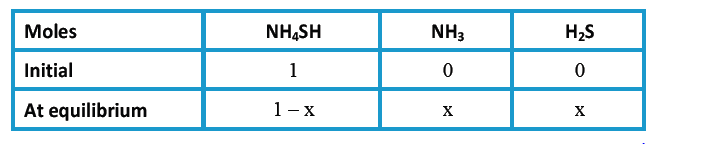
`NH_(4)SH(s) hArr NH_(3)(g)+H_(2)S(g)`, since `NH_(4)SH` is a solid, hence `a_(NH_(4)SH)=1` and its un-dissociated amount will not effect the total pressure (pressure will be due to gaseous `NH_(3)` and `H_(2)S` only). Let 'x' be its moles decomposed at equilibrium and P be the equilibrium pressure.

Total moles at equilibrium = moles of `NH_(3)+H_(2)S=2x`
`P=?" " K_(p)=0.34`
`P_(H_(2)S)=(x)/(2x)P=(P)/(2) and P_(NH_(3))=(x)/(2x)P=(P)/(2)`
(for equimolar proportions, partial pressures are equal)
`K_(P)=P_(H_(2)S). P_(NH_(3))" " (a_(NH_(4)HS)=1)`
`rArr 0.34=(P)/(2)xx(P)/(2)`
`rArr (P^(2))/(4)=0.34 rArr P= sqrt(4 xx 0.34)=1.17`
`rArr P_(NH_(3))=(P)/(2)=(1.17)/(2)=0.585` atm
and `P_(H_(2)S)=(P)/(2)=(1.17)/(2)=0.585` atm
Promotional Banner

Topper's Solved these Questions

  • CHEMICAL EQUILIBRIUM

    VMC MODULES ENGLISH|Exercise SOLVED EXAMPLES|20 Videos
  • CHEMICAL EQUILIBRIUM

    VMC MODULES ENGLISH|Exercise PRACTICE EXERCISE-1|4 Videos
  • CHEMICAL EQUILIBRIUM

    VMC MODULES ENGLISH|Exercise IMPECCABLE|50 Videos
  • CHEMICAL BONDING-I & II

    VMC MODULES ENGLISH|Exercise JEE Advanced (Archive)|98 Videos
  • CHEMICAL KINETICS

    VMC MODULES ENGLISH|Exercise JEE Advanced (Archive)|52 Videos

Similar Questions

Explore conceptually related problems

K_p for the equation A(s)⇋ B(g) + C(g) + D(s) is 9 atm^2 . Then the total pressure at equilibrium will be

A certain temperature, the degree of dissociationof PCI_(3) was found to be 0.25 under a total pressure of 15 atm. The value of K_(p) for the dissociation of PCl_(5) is

The Kp of the reaction is NH_4HS(s)⇌NH_3(g)+H_2S( g) . If the total pressure at equilibrium is 30 atm.

The Kp of the reaction is NH_4HS(s)⇌NH_3(g)+H_2S( g) . If the total pressure at equilibrium is 42 atm.

The value of K_(P) for NH_(2)COONH_(4(s))hArr 2NH_(3(g))+CO_(2(g)) if the total pressure at equilibrium is P :-

In the reaction AB(g) hArr A(g) + B(g) at 30^(@)C, k_(p) for the dissociation equilibrium is 2.56xx10^(-2) atm . If the total pressure at equilibrium is 1 atm, then the percentage dissociation of AB is

An equilibrium PCl_5(g) dissociate 50% ,then the value of (P +K_p) is (where P = total pressure at equilibrium)

For NH_(4)HS(s) hArr NH_(3)(g)+H_(2)S(g) , the observed, pressure for reaction mixture in equilibrium is 1.12 atm at 106^(@)C . What is the value of K_(p) for the reaction?

Calculate the volume percent of chlorine gas at equilibrium in the dissociation of PCl_(5)(g) under a total pressure of 1.5 atm. The K_(p) for its dissociation =0.3 .

Solid Ammonium carbamate dissociates as: NH_(2)COONH_(4)(s)hArr2NH_(3)(g)+CO_(2)(g). In a closed vessel, solid ammonium carbamate is in equilibrium with its dissociation products. At equilibrium, ammonia is added such that the partial pressure of NH_(3) at new equilibrium now equals the original total pressure. Calculate the ratio of total pressure at new equilibrium to that of original total pressure.

VMC MODULES ENGLISH-CHEMICAL EQUILIBRIUM-Illustration
  1. A vessel at 1000 K contains carbon dioxide with a pressure of 0.5 atm....

    Text Solution

    |

  2. When S in the form of S(8) is heated at 900 K, the initial pressure of...

    Text Solution

    |

  3. Solid NH(4)HS(s) (ammonium hydrogen sulphate) dissociates to give NH(3...

    Text Solution

    |

  4. The K(c) for A(2(g))+B(2(g))hArr2AB((g)) at 100^(@)C is 50. If one lit...

    Text Solution

    |

  5. In the reaction, H(2)(g)+I(2)(g)hArr2HI(g) The concentration of H(...

    Text Solution

    |

  6. The value of K(c) for the reaction: H(2)(g)+I(2)(g) hArr 2HI (g) is 48...

    Text Solution

    |

  7. For the reaction, N(2)(g)+3H(2)(g) hArr 2NH(3)(g) the partial pres...

    Text Solution

    |

  8. At 1000K, the pressure of iodine gas is found to be 0.112 atm due to p...

    Text Solution

    |

  9. Calculate the precentage dissociation of H(2)S(g) if 0.1 mol of H(2)S ...

    Text Solution

    |

  10. For the reaction CO(2)(g)+H(2)(g) hArr CO(g)+H(2)O(g) K is 0.63 at...

    Text Solution

    |

  11. What would be the effect of increasing the volume of each of the follo...

    Text Solution

    |

  12. What happens when an inert gas is added to i. PCl(5)(g) hArr PCl(3)(...

    Text Solution

    |

  13. For the dissociation of gaseous HI, 2HI(g) hArr H(2)(g)+I(2)(g). If 2 ...

    Text Solution

    |

  14. The equilibrium constant for the reaction H(2)(g)+S(s) hArr H(2)S(g)...

    Text Solution

    |

  15. When PCl(5) is heated, it dissociates into PCl(3) and Cl(2). The vapou...

    Text Solution

    |

  16. The vapour density of N(2)O(4) at a certain temperature is 30. Calcula...

    Text Solution

    |

  17. K(p) for the reaction PCl(5)(g)ghArrPCl(3)(g)+Cl(2)(g) at 250^(@)C...

    Text Solution

    |

  18. At a given temperature and a total pressure of 1.0 atm for the homogen...

    Text Solution

    |

  19. One mole of N(2) and 3 moles of PCl(5) are placed in a 100L vessel hea...

    Text Solution

    |

  20. At temperature ,T, a compound AB2(g) dissociates according to the rea...

    Text Solution

    |

