Home
Class 12
PHYSICS
A car accelerates from rest at a constan...

A car accelerates from rest at a constant rate a for some time and then decelerates at a constant rate `b` to come to rest. The total time elapsed is `t`.
Total distance travelled by the car is .

Text Solution

Verified by Experts
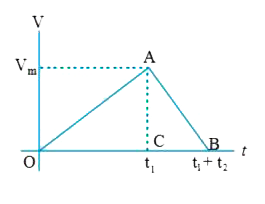
The velocity time graph for the motion of the car is shown in figure.
Let `t_(1)` be the time taken by the car during its accelerated motion represented by OA part of thegraph. Let `v_(m)` to be the maximum velocity attained by the car after time `t_(1)`.
We know, acceleration = slope of curve OA
` ? a =(AC)/(OC) =(v_(m))/(t_(1))" or "t_(1) =(v_(m))/(a)" ....(i)"`
Let `t_(2)` be the time taken by the car during its retardation motion represented by AB part of the graph. Now, retardation = Slope of curve AB
`p =(AC)/(CB) =(v_(m))/(t_(2))" or "t_(2) =(V_(m))/(p)" ....(ii)"`
Since, total time = T
`? t_(1) +t_(2) =T" or "(v_(m)+v_(m))/(a) = (T)/(p)" or "v_(m) (a+p)/(ap) = T`
or `v_(m) =(ab)/(a+p)" ...(iii)"`
Distance traveled by car, s = area of OAOB
`=(1)/(2) xx" base "xx" height "=(1)/(2) xx T xx v_(m) =(1)/(2) (ap)/(a+p) T^(2)`
Promotional Banner

Topper's Solved these Questions

  • Motion in Straight Line

    VMC MODULES ENGLISH|Exercise SOLVED EXAMPLES|20 Videos
  • Motion in Straight Line

    VMC MODULES ENGLISH|Exercise PRACTICE EXERCISE|80 Videos
  • MOTION IN A STRAIGHT LINE & PLANE

    VMC MODULES ENGLISH|Exercise IMPECCABLE|52 Videos
  • Motion in Two Dimensions

    VMC MODULES ENGLISH|Exercise MCQ|2 Videos

Similar Questions

Explore conceptually related problems

A car accelerates from rest at a constant rate alpha for some time, after which it decelerates at a constant rate beta, to come to rest. If the total time elapsed is t seconds. Then evalute the maximum velocity aquired by the car is

A car accelerates from rest at a constant rate alpha for some time, after which it decelerates at a constant rate beta, to come to rest. If the total time elapsed is t seconds. Then evalute (a) the maximum velocity reached and (b) the total distance travelled.

A car accelerates from rest at a constant rate alpha for some time, after which it decelerates at a constant rate beta, to come to rest. If the total time elapsed is t seconds. Then evalute (a) the maximum velocity reached and (b) the total distance travelled.

A car accelerates from rest at a constant rate alpha for some time, after which it decelerates at a constant rate beta, to come to rest. If the total time elapsed is t seconds. Then evalute (a) the maximum velocity reached and (b) the total distance travelled.

A car accelerates from rest at a constant rate 'alpha' for some time after which it decelerates at a constant rate beta to come to rest. If the total time elapsed is t, the maximum velocity acquired by the car is given by :

A bus accelerates from rest at a constant rate alpha for some time, after which it decelerates at a constant rate beta to come to rest. If the total time elapsed is t seconds then, evaluate. (a)the maximum velocity achieved and (b)the total distance travelled graphically.

A car accelerates from rest at a constant rate of 2 m s^(-2) for some time. The it retatds at a constant rate of 4 m s^(-2) and comes to rest. It remains in motion for 6 s .

A train accelerates from rest at a constant rate alpha for some time and then it retards to rest at the constant rate beta . If the total distance covered by the train is s, then the velocity of the train is

A car accelerates from rest at a constant rate of 2ms^(-2) for some time. Then, it retards at a constant rete of 4ms^(-2) and comes and rest. If the total time for which it remains in motion is 3 s, Then the total distance travelled is

A train accelerates from rest at a constant rate a for time t_(1) and then it retards at the constant rate b for time t_(2) then comes to rest. Find the ratio t_(1) / t_(2) .

