Home
Class 12
PHYSICS
Two points of a rod move with velocities...

Two points of a rod move with velocities `3v` and `v` perpendicular to the rod and in the same direction rod is separated by a distance `'r'`. The angular velocity of the rod is

Text Solution

Verified by Experts
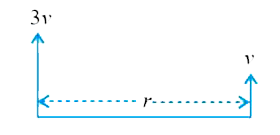
`? X=(3v-v)/(r ) =(2v)/(r )`
Promotional Banner

Topper's Solved these Questions

  • Motion in Straight Line

    VMC MODULES ENGLISH|Exercise SOLVED EXAMPLES|20 Videos
  • Motion in Straight Line

    VMC MODULES ENGLISH|Exercise PRACTICE EXERCISE|80 Videos
  • MOTION IN A STRAIGHT LINE & PLANE

    VMC MODULES ENGLISH|Exercise IMPECCABLE|52 Videos
  • Motion in Two Dimensions

    VMC MODULES ENGLISH|Exercise MCQ|2 Videos

Similar Questions

Explore conceptually related problems

Two points of a rod move with velocity 3 v and v perpendicular to the rod and in the same direction. Separated by a distance r . Then the angular velocity of the rod is :

A uniform rod of mass M and length l is placed on a smooth- horizontal surface with its one end pivoted to the surface. A small ball of mass m moving along the surface with a velocity v_(0) , perpendicular to the rod, collides elastically with the free end of the rod. Find: a. the angular velocity of the rod after collision. b. the impulse applied by the pivot on the rod during collision. (Take M//m = 2 )

A uniform rod of length 8 a and mass 6 m lies on a smooth horizontal surface. Two point masses m and 2 m moving in the same plane with speed 2 v and v respectively strike the rod perpendicular at distances a and 2a from the mid point of the rod in the opposite directions and stick to the rod. The angular velocity of the system immediately after the collision is

A uniform rod of mass m=2 kg and length l is kept on a smooth horizontal plane. If the ends A and B of the rod move with speeds v and 2v respectively perpendicular to the rod, find the: a. angulr velocity of CM of the rod. b. Kinetic energy of the rod (in Joule).

A uniform rod of mass m , length l rests on a smooth horizontal surface. Rod is given a sharp horizontal impulse p perpendicular to the rod at a distance l//4 from the centre. The angular velocity of the rod will be

A uniform rod of mass m and length L is at rest on a smooth horizontal surface. A ball of mass m, moving with velocity v_0 , hits the rod perpendicularly at its one end and sticks to it. The angular velocity of rod after collision is

A rod AB is moving on a fixed circle of radius R with constant velocity 'v' as shown in figure. P is the point of intersection of the rod and the circle. At an instant the rod is at a distance x=(3R)/(5) from centre of the circle. The velocity of the rod is perpendicular to the rod and the rod is always parallel to the diameter CD . (a) Find the speed of point of intersection P (b) Find the angular speed of point of intersection P with respect to centre of the circle.

A rod AB is moving on a fixed circle of radius R with constant velocity v as shown in figure. P is the point of intersection of the rod and the circle. At an instant the rod is at a distance x=(3R)/(5) from centre of the circle. The velocity of the rod is perpendicular to the rod and the rod is always parallel to the diameter CD. (i) Find the speed of point of intersection P. (b) Find the angular speed of point of intersection P with respect to centre of the circle.

In the figure shown, the instantaneous speed of end A of the rod is v to the left. The angular velocity of the rod of length L must be

A rod AB of length L and mass M is free to move on a frictionless horizontal surface. It is moving with a velocity v, as shown in figure. End B of rod AB strikes the end of the wall. Assuming elastic impact, the angular velocity of the rod AB, just after impact, is

