Home
Class 12
PHYSICS
Figure shows a small wheel fixed coaxial...

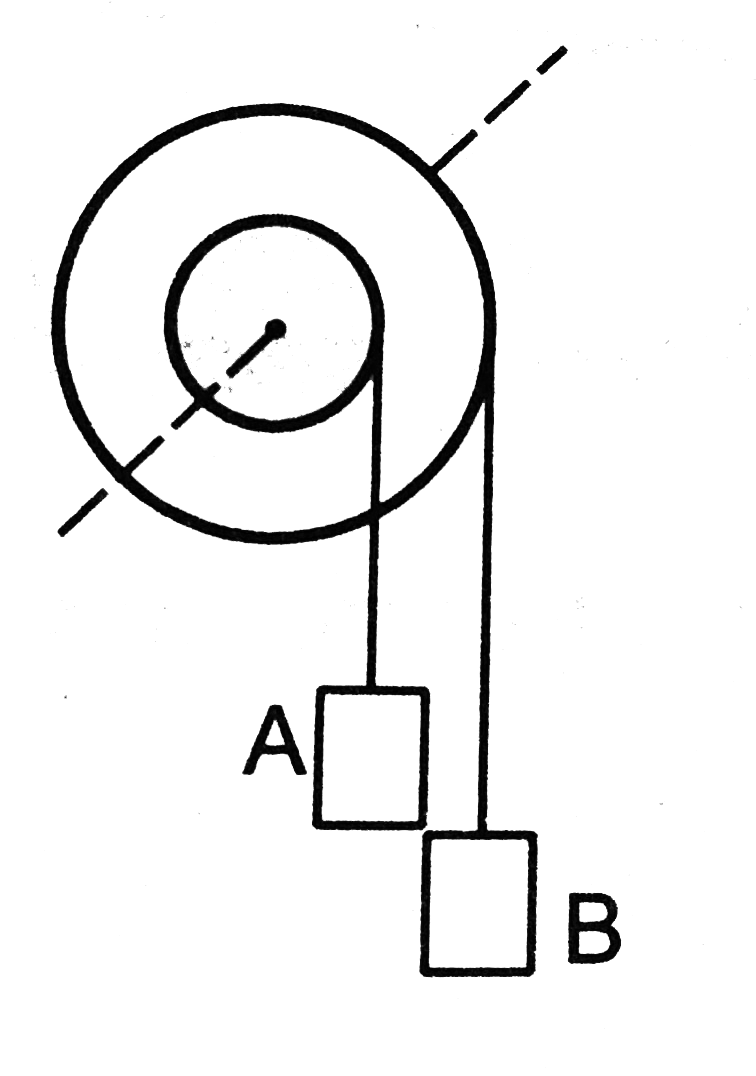
Figure shows a small wheel fixed coaxially on a bigger one of double the radius. The system rotates about the common axis. The strings supporting A and B do not slip on the wheels. If x and y be the distances travelled by A and B in the same time interval, then

Text Solution

Verified by Experts

Linear displacement (S) = Radius (r) x Angular displacement (`theta`) `because` S `prop` r(if `theta` constant) Distance travelled by mass A(x) /Distance travelled by mass B( y)= Radius of pulley concerned with mass A( r )/Radius of pulley concerned with mass B(2r )=1/2 `rArr y=2x.`
Promotional Banner

Topper's Solved these Questions

  • SYSTEM OF A PARTICLES & ROTATIONAL MOTION

    VMC MODULES ENGLISH|Exercise PRACTICE EXERCISE-3|5 Videos
  • SYSTEM OF A PARTICLES & ROTATIONAL MOTION

    VMC MODULES ENGLISH|Exercise PRACTICE EXERCISE-4|7 Videos
  • SYSTEM OF A PARTICLES & ROTATIONAL MOTION

    VMC MODULES ENGLISH|Exercise PRACTICE EXERCISE-1|4 Videos
  • SIMPLE HARMONIC MOTION

    VMC MODULES ENGLISH|Exercise 7-previous year question|46 Videos
  • SYSTEM OF PARTICLES AND ROTATIONAL MOTION

    VMC MODULES ENGLISH|Exercise IMPECCABLE|56 Videos

Similar Questions

Explore conceptually related problems

figure shows the graph of velocity versus tie for a particle going along the X-axis. Find a. the acceleration, b. The distance travelled in 0 to 10 s and c. the displacement in 0 to 10 s.

Fig. shows the graph of velocity versus time for a particle going along the x-axis. Find (a) acceleration, (b) the distance traveled in 0 to 10 s and (c) the displacement in 0 to 10 s.

A wheel of moment of inertia I and radius r is free to rotate about its centre as shown in figure. A string is wrapped over its rim and a block of mass m is attached to the free end of the string. The system is released from rest. Find the speed of the block as it descends through a height h.

A 4kg block is attached to a vertical rod by means of two strings of equal length. When the system rotates about the axis of the rod, the strings are extended as shown in figure. (a) How many revolutions per minute must the system make in order for the tension in the upper string to be 200N ? (b) What is the tension in the lower string then ?

A 4kg block is attached to a vertical rod by means of two strings of equal length. When the system rotates about the axis of the rod, the strings are extended as shown in figure. (a) How many revolutions per minute must the system make in order for the tension in the upper string to be 200N ? (b) What is the tension in the lower string then ?

Figure shows a solid uniform cylinder of radius R and mass M , which is free to rotate about a fixed horizontal axis O and passes through centre of the cylinder. One end of an ideal spring of force constant k is fixed and the other end is higed to the cylinder at A . Distance OA is equal to (R)/(2) . An inextensible thread is wrapped round the cylinder and passes over a smooth, small pulley. A block of equal mass M and having cross sectional area A is suspended from free end of the thread. The block is partially immersed in a non-viscous liquid of density rho . If in equilibrium, spring is horizontal and line OA is vertical, calculate frequency of small oscillations of the system.

A wheel A is connected to a second wheel B by means of in extensible string, passing over a pulley C , which rotates about a fixed horizontal axle O , as shown in the figure. The system is released from rest. The wheel A rolls down the inclined plane OK thus pulling up wheel B which rolls along the inclined plane ON . Determine the velocity (in m/s) of the axle of wheel A , when it has traveled a distance s = 3.5 m down the to be slope. Both wheels and the pulley are assumed homogeneous disks of identical weight and radius. Neglect the weight of the string. The string does not slip over C . [Take alpha =53^@ and beta=37^@ ]

A wheel A is connected to a second wheel B by means of inextensible string, passing over a pulley C , which rotates about a fixed horizontal axle O , as shown in the figure. The system is released from rest. The wheel A rolls down the inclined plane OK thus pulling up wheel B which rolls along the inclined plane ON . Determine the velocity (in m/s) of the axle of wheel A , when it has travelled a distance s = 3.5 m down the to be slope. Both wheels and the pulley are assumed homogeneous disks of identical weight and radius. Neglect the weight of the string. The string does not over C . [Take alpha =53^@ and beta=37^@ ]

A wheel is released on a rough horizontal floor after imparting it an initial horizontal velocity v_(0) and angular velocity omega_(0) as shown in the figure below. Point O is the centre of mass of the wheel and point P is its instantaneous point of contact with the groundl. The radius of wheel is r and its radius of gyration about O is k . Coefficient of friction between wheel and ground is mu . A is a fixed point on the ground. If above question , distance travelled by centre of mass of the wheel before it stops is -

Two discs A and B are mounted coaxially ona vertical axle. The discs have moments of inertia l and 2l respectively about the common axis. Disc A is imparted an initial angular velocity 2 omega using the centre potential energy of a spring compressed by a distance x_(1) . Disc B is imparted angular velocity omega by a spring having the same spring constant and compressed by a distance x_(2) . Both the disc rotate in the clockwise direction. The loss of kinetic energy the above process is -
