Home
Class 12
PHYSICS
A battery of 15 V and negligible interna...

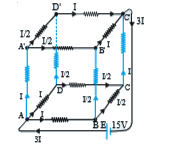
 A battery of 15 V and negligible internal resistance is connected across the diagonally opposite corners of a cubical network consisting of 12 resistors each of resistance `5Omega` . Determine the equivalent resistance of the network and the current along each edge of the cube.

Text Solution

Verified by Experts

The network is not reducible to a simple series and parallel combinations of resistors. There is, however, a clear symmetry in the problem which we can exploit to obtain the equivalent resistance of the network. The paths AA., AD and AB are obviously symmetrically placed in the network. Thus, the current in each must be the same, say, I. Further, at the corners A., B and D, the incoming current I must split equally into the two outgoing branches. In this manner, the current in all the 12 edges of the cube are easily written down in terms of I, using Kirchhoff.s first rule and the symmetry in the problem. Next take a closed loop, say, ABCC.EA, and apply Kirchhoff.s second rule:
`-IR - (1//2)IR - IR + E` = 0 where R is the resistance of each edge and E the emf of battery. Thus, E =`(5)/(2)IR`
The equivalent resistance Ras of the network is
`R_(eq)`=`(E)/(3I)`=`(5)/(6)R`
For R = `6Omega`,` R_(eq)` = `5Omega` and for E = 15 V 
the total current = 31 ) in the network is
3I = `15//5 `= 3 A, i.e., I = 1A
The current flowing in each edge can now be read off from the figure.
Promotional Banner

Topper's Solved these Questions

  • CURRENT ELECTRICITY

    VMC MODULES ENGLISH|Exercise SOLVED EXAMPLES|24 Videos
  • CURRENT ELECTRICITY

    VMC MODULES ENGLISH|Exercise PRACTICE EXERCISE-1|5 Videos
  • CAPACITORS

    VMC MODULES ENGLISH|Exercise JEE Advance ( Archive ) LEVEL 48|1 Videos
  • DC CIRCUIT

    VMC MODULES ENGLISH|Exercise JEE ADVANCED ARCHIVE|68 Videos

Similar Questions

Explore conceptually related problems

Battery of 10 V and negligible internal resistance is connected across the diagonally opposite corners of a cubical network consisting of 12 resistors each of resistance 1 Omega (Fig. 3.23). Determine the equivalent resistance of the network and the current along each edge of the cube.

In the adjoining network of resistors each is of resistance rOmega . Find the equivalent resistance between A and B.

In the given network of resistors, each of resistance R, calculate the equivalent resistance between the junctions A and E

In the adjoining network of resistors, each is of resistance r ohm, the equivalent resistance between points A and B is–

Calculate battery current and equivalent resistance of the network shown in figure.

Calculate battery current and equivalent resistance of the network shown in figure.

Resistance of each resistor is R. Then the equivalent resistance across A and B is

Figure (a) shows a cube made of 12 resistors each of resistance R. Find the equivalent resistance it the terminals A and B are connected to an emf source.

A 10 V storage battery of negligible internal resistance is connected across a 50Omega resistor. How much heat energy is produced in the resistor in 1 hour

In the network shown, each resistance is R. Calculate the equivalent resistance between A and B.
