Home
Class 12
PHYSICS
A particle of mass m and charge -q is ...

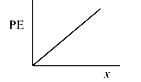
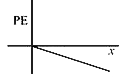
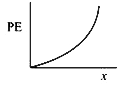
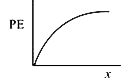
A particle of mass `m` and charge `-q` is released from rest in a uniform electric field. If there is no other force on the particle, the dependence of its potential energy on the distance `x` travelled by it is correctly given by (assume initial potential energy to be zero ,graphs are schematic and not drawn to scale)

A

B

C

D

Text Solution

AI Generated Solution

The correct Answer is:

To solve the problem of how the potential energy \( U \) of a particle with mass \( m \) and charge \( -q \) changes as it moves through a uniform electric field, we can follow these steps: ### Step-by-Step Solution 1. **Understand the Electric Field**: The electric field \( E \) is uniform, meaning it has a constant magnitude and direction throughout the region. The force \( F \) acting on the charged particle is given by: \[ F = qE \] Since the charge is negative, the force will act in the opposite direction to the electric field. 2. **Potential Energy Definition**: The potential energy \( U \) of a charge \( q \) in an electric field is given by: \[ U = -qV \] where \( V \) is the electric potential at a distance \( x \). 3. **Electric Potential in a Uniform Electric Field**: The electric potential \( V \) at a distance \( x \) in a uniform electric field can be expressed as: \[ V = -Ex \] Here, \( E \) is the magnitude of the electric field, and the negative sign indicates that the potential decreases in the direction of the electric field. 4. **Substituting for Potential Energy**: Substituting the expression for \( V \) into the potential energy equation gives: \[ U = -q(-Ex) = qEx \] This indicates that the potential energy \( U \) is directly proportional to the distance \( x \) travelled by the particle. 5. **Initial Conditions**: We are given that the initial potential energy is zero when the particle is at rest. Therefore, at \( x = 0 \), \( U = 0 \). 6. **Graphical Representation**: Since \( U \) is proportional to \( x \), the graph of potential energy \( U \) versus distance \( x \) will be a straight line passing through the origin. The slope of this line will be \( qE \). 7. **Conclusion**: The dependence of potential energy on the distance travelled by the particle is linear, and the correct representation of this relationship is a straight line graph starting from the origin. ### Final Expression: Thus, the potential energy \( U \) as a function of distance \( x \) is given by: \[ U(x) = qEx \]

To solve the problem of how the potential energy \( U \) of a particle with mass \( m \) and charge \( -q \) changes as it moves through a uniform electric field, we can follow these steps: ### Step-by-Step Solution 1. **Understand the Electric Field**: The electric field \( E \) is uniform, meaning it has a constant magnitude and direction throughout the region. The force \( F \) acting on the charged particle is given by: \[ F = qE ...
Promotional Banner

Topper's Solved these Questions

  • MOCK TEST 6

    VMC MODULES ENGLISH|Exercise PHYSICS (SECTION 2)|5 Videos
  • MOCK TEST 5

    VMC MODULES ENGLISH|Exercise PHYSICS ( SECTION-2)|5 Videos
  • MOCK TEST 7

    VMC MODULES ENGLISH|Exercise PHYSICS (SECTION 2)|5 Videos

Similar Questions

Explore conceptually related problems

A particle of mass and charge is released from rest in a uniform electric field. If there is no other force on the particle, the dependence of its kinetic energy on the distance travelled by it is correctly given by (graphs are schematic and not drawn to scale)

A particle of mass and charge is released from rest in a uniform electric field. If there is no other force on the particle, the dependence of its kinetic energy on the distance travelled by it is correctly given by (graphs are schematic and not drawn to scale)

A charged particle of mass m and charge q is released from rest in an electric field of constant magnitude E . The kinetic energy of the particle after time t is

A particle of mass .m. and charge q is placed at rest in a uniform electric field E and then released. The K.E. attained by the particle after moving a distance y is

A charge particle of mass m and charge q is released from rest in uniform electric field. Its graph between velocity (v) and distance travelled (x) will be :

A charge particle of mass m and charge q is released from rest in uniform electric field. Its graph between velocity (v) and distance travelled (x) will be :

A particle of mass m and charge q is placed at rest in a uniform electric field E and then released, the kinetic energy attained by the particle after moving a distance y will be

A particle of mass m and charge q is released from rest in uniform electric field of intensity E. Calculate the kinetic energy it attains after moving a distance y between the plates.

In a uniform electric field, a point charge of mass m and charge q is released from rest. If there are no other forces acting on the particle, then which of the following graphs, correctly show the dependence of the particles speed v on the distance x travelled by the particles speed v on the distance x travelled by it? [Graphs are schmatic and not drawn to scale]

A positively charged particle is released from rest in a uniform electric field. The electric potential energy of the charge.
