Home
Class 12
PHYSICS
Point charge q moves from point P to poi...

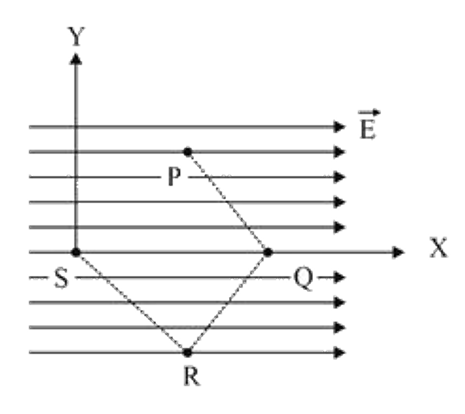
Point charge q moves from point P to point S along the path PQRS (figure shown) in a uniform electric field E pointing co-parallel to the positive direction of the x-axis. The coordinates of the points P, Q, R and S are `(a, b, 0), (2a, 0, 0) , (a, -b, 0) and (0, 0,0)` respectively. The work done by the field in the above process is given by the expression.

A

qEa

B

`-qEa`

C

`qEa sqrt2`

D

`qE sqrt([(2a)^(2) + b^(2)])`

Text Solution

Verified by Experts

The correct Answer is:

B

`W= q overset(ᶭ)(E ). Delta overset(ᶭ)(S ) = q E.overset($)(i)overset(ᶭ)(PS)`
`= (q E overset($)(i)).(- a overset($)(i)- b overset($)(j))= - q Ea`
Promotional Banner

Topper's Solved these Questions

  • MOCK TEST 3

    VMC MODULES ENGLISH|Exercise PART I : PHYSICS (SECTION-2)|10 Videos
  • MOCK TEST 2

    VMC MODULES ENGLISH|Exercise PART I : PHYSICS (SECTION - 2)|10 Videos
  • MOCK TEST 4

    VMC MODULES ENGLISH|Exercise PHYSICS (SECTION 2)|5 Videos

Similar Questions

Explore conceptually related problems

A point charge q moves from point P to pont S along the path PQRS (fig.) in a uniform electric field E pointing parallel to the poistive direction of the X-axis. The coordinates of the points P, Q, R and S are(a, b, O), (2a, O, O)(a, -b, ulO ) and (O, O, O) respectively. The work done by the field in the above process is given by the expresison............

A point charge q moves from point P to pont S along the path PQRS (fig.) in a uniform electric field E pointing parallel to the poistive direction of the X-axis. The coordinates of the points P, Q, R and S are(a, b, O), (2a, O, O)(a, -b, ulO ) and (O, O, O) respectively. The work done by the field in the above process is given by the expresison............

The coordinates of the point equidistant from the points A(0, 0, 0), B(4, 0, 0), C(0, 6, 0) and D(0, 0, 8) is

The coordinates of the point which is equidistant from the points O(0,0,0) A (a,0,0), B(0,b,0) and C(0,0,c)

Find the coordinates of a point equidistant from the four points O(0,0,0), A(p,0,0), B(0,q,0) and C(0,0,r)

If P(0, 1, 2), Q(4, -2, 1) and R(0, 0, 0) are three points, then anglePRQ is

In a uniform electric field, the potential is 10V at the origin of coordinates , and 8 V at each of the points (1, 0, 0), (0, 1, 0) and (0, 0, 1). The potential at the point (1, 1,1 ) will be .

The coordinates of the point A and B are (a,0) and (-a ,0), respectively. If a point P moves so that P A^2-P B^2=2k^2, when k is constant, then find the equation to the locus of the point P .

A point charge is taken from a point A to a pint B in an electric field. Does the work done by the electric field depend on the path of the charge ?

Poistive and negative point charges of equal magnitude are kept at (0, 0, a/2) and (0, 0, (-a)/(2)) respectively. The work done by the electric field when another poistive point charge is moved from (-a, 0, 0) to (0, a, 0) is
