Home
Class 12
PHYSICS
A solid cube is placed on a horizontal s...

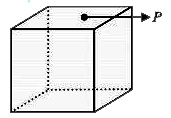
A solid cube is placed on a horizontal surface. The coefficient of friction between them is `mu=0.25`. A variable horizontal force is applied on the cube’s upper face, perpendicular to one edge and passing through the mid-point of edge, as shown in figure. The maximum acceleration with which it can move without toppling is (take `g=10m//s^(2)` )

Text Solution

Verified by Experts

The correct Answer is:

5

`mu mg xx (l//2) + P xx (l//2) = mg(l//2)`
`P =mg - mu m g and P- mu mg = ma`
hence `a=g(1-2mu) =5`
Promotional Banner

Topper's Solved these Questions

  • MOCK TEST 4

    VMC MODULES ENGLISH|Exercise PHYSICS (SECTION 2)|5 Videos
  • MOCK TEST 3

    VMC MODULES ENGLISH|Exercise PART I : PHYSICS (SECTION-2)|10 Videos
  • MOCK TEST 5

    VMC MODULES ENGLISH|Exercise PHYSICS ( SECTION-2)|5 Videos

Similar Questions

Explore conceptually related problems

A thin uniform spherical shell of mass m = 2 kg and radius R = 10 cm is placed on a rough horizontal surface with a coefficient of friction mu = 0.4 . A horizontal force 'F' is applied to the spherical shell at a height R//3 ablove the centre as shown. The maximum magnitude of the applied force 'F' for which the spherical shell will be rolling without slipping is (taking g = 10 m//a^(2) )

A 3 kg block is placed over a 10 kg block and both are palced on a smooth horizontal surface. The coefficient of friction between the block is 0.2 . If a horizontal force of 20 N is applied to 3 kg block, accelerations of the two block in ms^(-2) are (take, g=ms^(-2) )

A block of mass m=5kg is resting on a rough horizontal surface for which the coefficient of friction is 0.2 . When a force F=40N is applied, the acceleration of the block will be (g=10m//s^(2)) .

A 2kg block is placed over a 5kg block and both are placed on a smooth horizontal surface. The coefficient of friction between the blocks is 0.10. Find the acceleration of the two blocks if a horizontal force of 14N is applied to the upper block (g = 10ms^(-2) ).

A block is projected with speed 20 m/s on a rough horizontal surface. The coefficient of friction (mu) between the surface varies with time (t) as shown in figure. The speed of body at the end of 4 second will be (g=10m//s^(2))

A block of mass 5 kg is placed on a rough horizontal plane . The coefficients of stastic and kinetic friction between the block and surface are 0*5 and 0*3 respectively. A force of 100 N is applied at an angle 30^(@) with the horizontal as shown in the figure . The acceleration of the block will be [ g = 10 m//s^(2) ]

A cubical block of edge length 1 m and density 800 kg m^-3 rests on a rough horizontal surface with coefficient of friction mu . A horizontal force F is applied on the block as shown in figure. If the coefficient of friction is sufficiently large so that the block does not slide bofore toppling, then the minimum value of F to topple the block is [Take g = 10 ms^-2 ]

A bolck of mass m =2 kg is placed on a plank of mass M = 10 kg, which is placed on a smooth horizontal plane as shown in the figure. The coefficient of friction between the block and the plank is mu=(1)/(3) . If a horizontal force F is applied on the plank, then the maximum value of F for which the block and the plank move together is (g=10m//s^(2))

A heavy box of mass 20 kg is placed on a horizontal surface . If coefficient of kinetic friction between the box and the horizontal surface is 0.25, calculate the force of kinetic friction Also calculate acceleration produced under a force of 98 N applied horizontally ?

A block of mass 1 kg lies on a horizontal surface in a truck. The coefficient of static friction between the block and the surface is 0.6. If the acceleration of the truck is 5m//s^2 , the frictional force acting on the block is…………newtons.
