Home
Class 12
PHYSICS
In the following circuit i1 and i2are r...

In the following circuit `i_1` and `i_2`are respectively

A

`0,0`

B

`5mA,5 mA `

C

`5mA ,0`

D

`0,5 mA `

Text Solution

Verified by Experts

The correct Answer is:
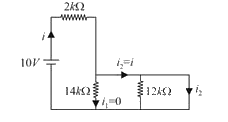
D

`i=(10)/(2) = 5 mA =i_2`
`i_1 =0`
Promotional Banner

Topper's Solved these Questions

  • MOCK TEST 5

    VMC MODULES ENGLISH|Exercise PHYSICS ( SECTION-2)|5 Videos
  • MOCK TEST 4

    VMC MODULES ENGLISH|Exercise PHYSICS (SECTION 2)|5 Videos
  • MOCK TEST 6

    VMC MODULES ENGLISH|Exercise PHYSICS (SECTION 2)|5 Videos

Similar Questions

Explore conceptually related problems

In the given circuit, if I_1 and I_2 be the current in resistances R_1 and R_2 , respectively, then .

In the following circuit, the current through the resistor R (=2Omega) is I amperes. The value of I is

Two circular coils P & Q are coaxially & carry currents I_1 and I_2 respectively (all direction are w.r.t. the observer)

In the following circuit , E_1 = 4V, R_1 = 2 Omega, E_2 = 6 V, R_2 = 2Omega, and R_3 = 4Omega. Find the currents i_1 and i_2

Given : R_1 =1ohm, R_2 = 2ohm, C_1 = 2 muF, C_2 = 4muF The time constants (in muS ) for the circuits I, II, III are respectively

Two loops P and Q are made from a uniform wire. The redii of P and Q are r_(1)and r_(2) respectively, and their moments of inertia are I_(1)and I_(2) respectively, If I_(2)=4I_(1),"then" r_(2)/r_(1)"equals" -

Two bodies with moment of inertia I_1 and I_2 (I_1 gt I_2) have equal angular momenta. If their kinetic energy of rotation are E_1 and E_2 respectively, then.

In the following circuit (Fig.) the switch is closed at t = 0 . Find the current i_(1),i_(2),i_(3) and di_(3)//dt at t = 0 and at t = oo . Initially, all current are zero.

In the following circuit (Fig.) the switch is closed at t = 0 . Find the current i_(1),i_(2),i_(3) and di_(3)//dt at t = 0 and at t = oo . Intitially, all current are zero.

Two loops P and Q are made from a uniform wire. The radii of P and Q are R_(1) and R_(2) , respectively, and their moments of inertia about their axis of rotation are I_(1) and I_(2) , respectively. If (I_(1))/(I_(2))=4 , then (R_(2))/(R_(1)) is

