Home
Class 11
MATHS
A is a set containing n elements, A subs...

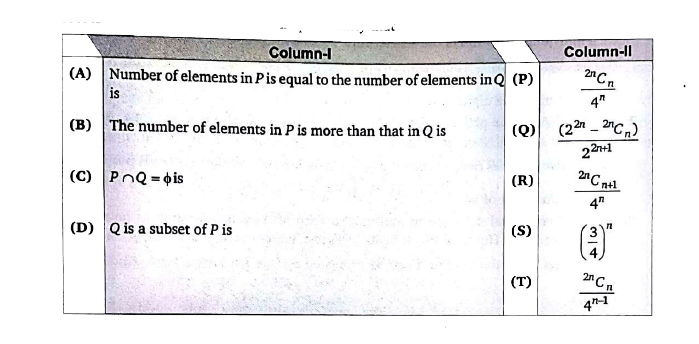
A is a set containing n elements, A subset P (may be void also) is selected at random from set A and the set A is then reconstructed by replacing the elements of P. A subset Q (may be void also) of A is again chosen at random. The probability that

A

`2^(n)`

B

`4^(n)`

C

`2n`

D

`3^(n)`

Text Solution

Verified by Experts

The correct Answer is:

b

The set A has n elemeats. So, it has `2^(n)` sunbsets.
Therefore, set P can be chosen in`""^(2^(n))C_(1)` ways. Similarly, set Q can
also be chosen in `""^(2^(n))C_(1)` ways .
`because ` Sets P and Q can be chosen in `""^(2^(n))C_(1)xx""^(2^(n))C_(1)=2^(n) xx2^(n) = 4^(n)`
ways.
Promotional Banner

Topper's Solved these Questions

  • BINOMIAL THEOREM AND ITS APPLCIATIONS

    OBJECTIVE RD SHARMA ENGLISH|Exercise Section I - Solved Mcqs|100 Videos
  • BINOMIAL THEOREM AND ITS APPLCIATIONS

    OBJECTIVE RD SHARMA ENGLISH|Exercise Section I - Assertion Reason Type|13 Videos
  • CARTESIAN CO-ORDINATE SYSTEM

    OBJECTIVE RD SHARMA ENGLISH|Exercise Exercise|27 Videos

Similar Questions

Explore conceptually related problems

A is a set containing n elements. A subset P of A is chosen at random. The set A is reconstructed by replacing the elements of P. A subset Q is again chosen at random. The probability that P =Q, is

A is a set containing n elements. A subset P of A is chosen at random. The set A is reconstructed by replacing the elements of P. A subset Q is again chosen at random. The Probability that P cup Q=A , is

A is a set having n elements. A subset P of A is chosen at random. The set A is reconstructed by replacing the elements of A. A subset Q of A is again chosen at random. Find the probability that P and Q have no common elements.

Let A be a set containing elements. A subset P of the set A is chosen at random. The set A is reconstructed by replacing the elements of P, and another subset Q of A is chosen at random. The probability that P cap Q contains exactly m (m lt n) elements, is

A is a set containing n elements. A subset P of A is chosen at random. The set A is reconstructed by replacing the elements of P. A subset Q is again chosen at random. The probability that Q contains just one element more than P, is

A is a set containing n elements. A subset P of A is chosen at random. The set A is reconstructed by replacing the elements of P. A subset Q is again chosen at random. The Probability that P and Q have equal number of elements, is

A is a set containing n elements . A subet P of A is chosen at random. The set A is reconstructed by replacing the elements of P.A subet Q is again chosen at random. The number of ways of selecting P and Q, is .

A is a set containing n elements. A subset P of A is chosen at random. The set A is reconstructed by replacing the elements of P. A subset Q is again chosen at random. The Probability that P cap Q contain just one element, is

A is a set containing n elements. A subset P of A is chosen at random. The set A is reconstructed by replacing the elements of P. A subset Q is again chosen at random. The Probability that P cup Q contain just one element, is

P is a set containing n elements . A subset A of P is chosen and the set P is reconstructed by replacing the element of A. B such that A and B have no common elements, is

OBJECTIVE RD SHARMA ENGLISH-BINOMIAL THEOREM AND ITS APPLCIATIONS -Chapter Test
  1. A is a set containing n elements, A subset P (may be void also) is sel...

    Text Solution

    |

  2. The term independent of x in (1+x)^(m)(1+1/x)^(n) is :

    Text Solution

    |

  3. The expression [x+(x^(3)-1)^((1)/(2))]^(5)+[x-(x^(3)-1)^((1)/(2))]^(...

    Text Solution

    |

  4. The coefficient of x^(53) in the expansion sum(m=0)^(100)^(100)Cm(x-3)...

    Text Solution

    |

  5. If (1 + x)^(n)= C(0) + C(1) x C(2) x^(2) + …+ C(n) x^(n) , prove th...

    Text Solution

    |

  6. Find the numerically grates term in the expansion of 3-5x^(15)w h e nx...

    Text Solution

    |

  7. In the expansion of (1+x)^(50), find the sum of coefficients of odd po...

    Text Solution

    |

  8. Find the position of the term independent of x in the expansion of (sq...

    Text Solution

    |

  9. If the coefficients of x^(7) and x^(8) in the expansion of (2+x/3)^(n)...

    Text Solution

    |

  10. If the rth term in the expansion of (x/3-2/x^(2))^(10 contains x^(4), ...

    Text Solution

    |

  11. If the third in the expansion of [x + x^(logx)]^(6) is 10^(6) , th...

    Text Solution

    |

  12. the value of x , for which the 6th term in the expansions of[2^log2sqr...

    Text Solution

    |

  13. If the coefficients of (p+1)th and (P+3)th terms in the expansion of (...

    Text Solution

    |

  14. about to only mathematics

    Text Solution

    |

  15. The value of C(0)+3C(1)+5C(2)+7C(3)+….+(2n+1)C(n) is equal to :

    Text Solution

    |

  16. Find the following sum : (1)/(n!) + (1)/(2!(n-2)!) + (1)/(4!(n-4)!)+...

    Text Solution

    |

  17. The coefficient of x^(n) y^(n) in the expansion of [(1 + x)(1+y) (x...

    Text Solution

    |

  18. If (1 + x - 2 x^(2))^(6) = 1 + C(1) x + C(2) x^(2) + C(3) x^(3) + …+ C...

    Text Solution

    |

  19. Find the ratio of the coefficient of x^(15) to the term independent of...

    Text Solution

    |

  20. Find the number of terms in the expansion of (x+y+z)^(n).

    Text Solution

    |

  21. In the expansion of (1+x)^30 the sum of the coefficients of odd powers...

    Text Solution

    |
