

Home
Class 7
MATHS
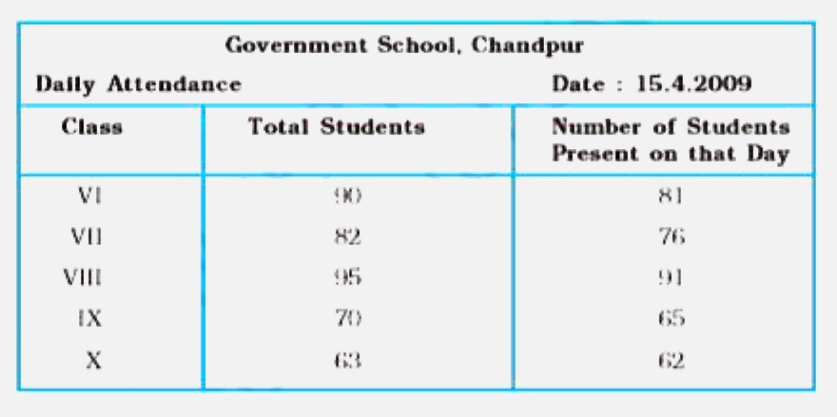
Observe the following data: (a) Dra...

Observe the following data:

(a) Draw a double bar graph choosing an appropriate scale. What do you infer from the bar graph?
(b) Which class has the maximum number of students?
(c) In which class, the difference of total students and number of students present is minimum?
(d) Find the ratio of number of students present to the total number of students of Class IX.
(e) What per cent of Class VI students were absent?

Promotional Banner

Topper's Solved these Questions

  • DATA HANDLING

    NCERT EXEMPLAR|Exercise THINK AND DISCUSS |3 Videos
  • DATA HANDLING

    NCERT EXEMPLAR|Exercise EXERCISE(TRUE OR FALSE)|18 Videos
  • COMPARING QUANTITIES

    NCERT EXEMPLAR|Exercise THINK AND DISCUSS|24 Videos
  • EXPONENTS AND POWERS

    NCERT EXEMPLAR|Exercise EXERCISE|136 Videos

Similar Questions

Explore conceptually related problems

There are 20 girls and 15 boys in a class. What is the ratio of number of girls to the total number of students in the class?

There are 20 girls and 15 boys in a class. What is the ratio of number of girls to the total number of students in the class?

The class, in which the marks of maximum number of students lies, is

Out of 30 students in a class, 20 like cricket and 10 like Hockey. The ratio of the number of students liking Hockey to the total number of students is

There are ‘b’ boys and ‘g’ girls in a class. The ratio of the number of boys to the total number of students in the class is:

There are 'b' boys and 'g' girls in a class. The ratio of the number of boys to the total number of students in the class is:

The pie chart given below shows the number of students in 6 different sections. The total number of students is 1800. What is the ratio of number of students in section D to the number of students in section F and B?

From the following bar graph, find the class in which number of students are half of the other class :

NCERT EXEMPLAR-DATA HANDLING-EXERCISE
  1. Observe the given bar graph carefully and answer the questions that fo...

    Text Solution

    |

  2. The bar graph given below shows the marks of students of a class in a ...

    Text Solution

    |

  3. Study the bar graph given below and answer the questions that follow. ...

    Text Solution

    |

  4. Study the bar graph given below and answer the questions that follow ...

    Text Solution

    |

  5. The bar graph given below represents the circulation of newspapers (da...

    Text Solution

    |

  6. Study the double bar graphs given belwo and answer the following ques...

    Text Solution

    |

  7. Study the double bar graph shown below and answer the questions that f...

    Text Solution

    |

  8. Study the double bar graph given below and answer the questions that f...

    Text Solution

    |

  9. The following table shows the average intake of nutrients in calories ...

    Text Solution

    |

  10. Study the double bar graph and answer the quesions that follow: ...

    Text Solution

    |

  11. In a public library, the following observations were recorded by the l...

    Text Solution

    |

  12. Observe the following data: (a) Draw a double bar graph choosing ...

    Text Solution

    |

  13. Observe the given data: (a) Draw a bar graph to represent the abo...

    Text Solution

    |

  14. Below is a list of 10 tallest buildings in India. This list ranks bu...

    Text Solution

    |

  15. The marks out of 100 obtained by Kunal and Soni in the Half Yearly Exa...

    Text Solution

    |

  16. The students of Class VII have to choose one club from Music, Dance, Y...

    Text Solution

    |

  17. The data given below shows the production of motor bikes in a factory ...

    Text Solution

    |

  18. The table below compares the population (in hundreds) of 4 towns over ...

    Text Solution

    |

  19. The table below gives the data of tourists visiting 5 hill stations ov...

    Text Solution

    |

  20. The table below gives the flavours of ice cream liked by children (boy...

    Text Solution

    |