Home
Class 11
CHEMISTRY
Explain aromatic electroplhilic substitu...

Explain aromatic electroplhilic substitution reactions of benzene.

Text Solution

Verified by Experts

(1) Halogenation : Benzene reacts with bromine or chlorine in the presence of Lewis acids like `Fe Cl _(2), Al Cl _(3)` et. , to give corresponding halobenzene.

Similarly with bromine, bromobenzene is formed.
(2) Nitration: Benzene undergoes nitrogoes nitration when hated with a mixture of 1:1 (by vulume) concentrated nitric acid, and concentrated sulphuric acid (nitration mixiture) at a temperature below `60^(@)C.`

(3) Berizene reacts with fuming sulphuric acid (oleum) and gives benzene sulphonic acid.

(4) Friedel - Craft.s alkylation and acylation : Benzene reacts with alkyl halides and acyl h in the presence of Lewis acids `(Al Cl _(3), Fe Cl _(3))` and gives alkyl benzenes and acyl benzenes.

Benzene reacts with acetyl chloride in te presence of anhydrous aluminium chloride and acetophenone.

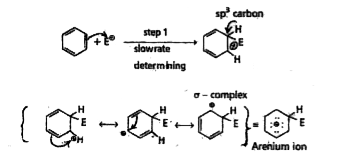
General Mechanisms : Electrophilic substitution reaction (s) proceeds in two steps as
l. Generation of electrophile
II. a) Formation of carbocation intermediate
b) Removal of proton from carbocation intermediate. . "
l. Generation of electrophite` E^(+) :` In the reactions halogenation, alkylation and acylatio benzene anhydrous `AlCl _(3)` the Lewis.acid produces electrophile `X^(+)` say `Cl^(+), R^(+) and RCO^(+)` by reacting the reagent chlorine, alkyl halide and acylhalide respectively.

ll a) Formation of carbocation : Electrophile generated above attacks one of the benz carbons to change it to `sp ^(3)` hydridised. The carbocation (Arrhenium ion) is stabilised through resonal.

Sigma complec loses aromatic character due to delocalisation of electrons stopping at `sp ^(3)` carbon
b) Losing of proton : To regain, aromatic character the `overset(+) (C)` loses one proton to `sp ^(3)` carbon on attacked of `(Al Cl _(4)) ` in case of halogenation , alklation and acylation and `HSO _(4) ^(-)` in case of nitration .
Promotional Banner

Topper's Solved these Questions

  • ORGANIC CHEMISTRY SOME BASIC PRINCIPLES AND TECHNIQUES

    VIKRAM PUBLICATION ( ANDHRA PUBLICATION)|Exercise IMPORTANT QUESTIONS|42 Videos
  • ORGANIC CHEMISTRY SOME BASIC PRINCIPLES AND TECHNIQUES

    VIKRAM PUBLICATION ( ANDHRA PUBLICATION)|Exercise SHORY ANSWER QUESTIONS |15 Videos
  • MARCH - 2016 (TELANGANA)

    VIKRAM PUBLICATION ( ANDHRA PUBLICATION)|Exercise SECTION C |3 Videos
  • STATES OF MATTER GASES AND LIQUIDS

    VIKRAM PUBLICATION ( ANDHRA PUBLICATION)|Exercise LONG ANSWER QUESTIONS|22 Videos

Similar Questions

Explore conceptually related problems

Give all the electrophilic substitution reactions of benzene.

Explain electrophilic substitution reactions of chloro benzene .

Explain the electrophilic substitution reaction of Anisole.

Explain the electrophilic substitution reactions of phenol. Write two uses of phenol.

Discuss the mechanism of electrophilic substitution reactions in benzene with halogenation and nitration as examples.

Regarding Benzene some statements are given A) It is aromatic B) It burns with smoky and sooty flame C) It can't decolourise Br_2 water D) It mainly participates in electrophilic substitution reactions

The correct arrangement for decreasing order of electrophilic Substitution reactions of I) Toluene II) Benzene III) Phenol IV) Chlorobenzene

Discuss the general mechanism of electrophilic substitution in benzene.

Explain why benzene mainly undergoes electrophilic substitution reaction ?

Write a note on deactivating groups towards electrophilic substitution in benzene.

VIKRAM PUBLICATION ( ANDHRA PUBLICATION)-ORGANIC CHEMISTRY SOME BASIC PRINCIPLES AND TECHNIQUES -LONG ANSWER QUESTIONS
  1. Differentiate between the principal of estimation of nitrogen in an or...

    Text Solution

    |

  2. Explain inductive effect with a suitable example.

    Text Solution

    |

  3. Write a note on mesomeric effect.

    Text Solution

    |

  4. Describe resonance effect with one example.

    Text Solution

    |

  5. Explain how many types of organic reactlons are possible.

    Text Solution

    |

  6. Write the possible conformations of ethane and explain which is more s...

    Text Solution

    |

  7. Explain aromatic electroplhilic substitution reactions of benzene.

    Text Solution

    |

  8. Explain electrophilic addition reactions of ethylene with mechanism.

    Text Solution

    |

  9. With the help of mechamism explain free radical halogenationis of allk...

    Text Solution

    |

  10. Discuss Markovnikov's rule and Kharash effect.

    Text Solution

    |

  11. How would you convert the following compounds into benzene ? Chloro...

    Text Solution

    |

  12. How would you convert the following compounds into benzene ? Toluene

    Text Solution

    |

  13. How would you convert the following compounds into benzene ? p - nit...

    Text Solution

    |

  14. Why is Wurtz reaction not preferred for the preparation of alkanes con...

    Text Solution

    |

  15. Write the equations involved in the detection of Nitrogen, Halogens an...

    Text Solution

    |

  16. How are carbon and hydrogen of an organic compound estimated?

    Text Solution

    |

  17. In the Duma's method for the estimation of nitrogen in an organic comp...

    Text Solution

    |

  18. Explain the estimation of phosphorus and sulphur present in the organi...

    Text Solution

    |

  19. Explain Carius method for the determination of Halogens quantitatively...

    Text Solution

    |

  20. Discuss carcinogenicity and toxicity in atomatic hydrocarbons. Give tw...

    Text Solution

    |