Home
Class 10
PHYSICS
Explain the structure and functioning of...

Explain the structure and functioning of the human eye. How are we able to see nearby and distant objects ?

Text Solution

Verified by Experts
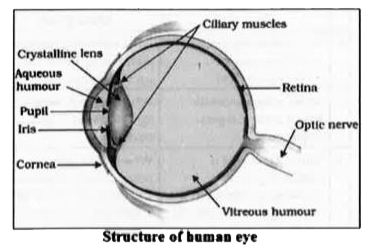
The human eye is the most preious and complex organ of the human body. It is a natural camera and a combination of several optical instruments which helps us to see the beautiful world around us.

The parts of the human eye are :
* Cornea - The transparent thin membrane at the front of the eye through which light enters. Its outer part is convex in shape and bulges outwards.
* Iris - Dark muscular ring-shaped diaphragm behind the cornea which controls the size of the pupil.
* Pupil - A hole in the middl of the iris which controls the amount of light entering the eye. In bright light, iris contracts the pupil and in dim light, iris expands the pupil so that suitable around of light can enter the eye to view the objects clearly.
* Crystalline lens - Soft and flexible jelly-like material made up of protein which can change shape to finely focus light on the retina. It acts as a convex lens.
* Ciliary muscles - They help eye lens to change its shape and hence its focal length according to distance of th object to be viewed.
* Suspensory ligaments - Extend from eye lens to ciliary muscles and hold the eye lens in proper position.
* Retina - A delicate membrane behind the eye which acts as screen on which the images are formed. it has a number of light-sensitive cells .rods. [which sense intensity of light] and .cones. [which sense colours].
* Aqueous humour - Watery liquid which fills the space between eye lens and the cornea.
* Vitreous humour - Transparent jelly-like substance which fills the space between eye lens and the retina.
* Blind spot - Small region at the junction of retina and the optical nerve. There are no light-sensitive cells in this region and hence vision is not possible.
Working of the human eye : Light rays from the objects enter through the cornea and pupil into the eye lens. The pupil regulates the amount of light entering into the eye. The outer surface of the cornea and eye lens together converge the light rays on the retina to form a real inverted image of the object. The light-sensitive cells of the retina get activated and generate electrical signals which are sent to the brain through the optical nerve. The brain interprets and processes these signals so that we are able to .view. the erect object.
While viewing a distant object, the ciliary muscles relax and the eye lens becomes thin, thereby increasing its focal length. While viewing a nearby object, the ciliary muscles contract, making the eye lens thicker and decreasing its focal length. Thus, we are able to see the nearby and distant objects clearly.
Promotional Banner

Topper's Solved these Questions

  • THE HUMAN EYE AND THE COLOURFUL WORLD

    ZEN PUBLICATION|Exercise ZEN ADDITIONAL QUESTIONS SECTION - HIGHER ORDER THINKING SKILLS (HOTS)|26 Videos
  • THE HUMAN EYE AND THE COLOURFUL WORLD

    ZEN PUBLICATION|Exercise ZEN ADDITIONAL QUESTIONS SECTION - SHORT ANSWER TYPE QUESTIONS - II|28 Videos
  • SOURCES OF ENERGY

    ZEN PUBLICATION|Exercise ZEN ADDITIONAL QUESTIONS SECTION (HIGHER-ORDER THINKING SKILLS [HOTS] )|14 Videos

Similar Questions

Explore conceptually related problems

How are we able to see nearby and also the distant objects clearly ?

Explain the structure and functions of Parenchyma.

Explain the structure and function of stamen and carpel.

Explain the structures function and location of nervous tissue

ZEN PUBLICATION-THE HUMAN EYE AND THE COLOURFUL WORLD-ZEN ADDITIONAL QUESTIONS SECTION - Problem Section
  1. Write an activity for observing scattering of light in colloidal solut...

    Text Solution

    |

  2. Mention any four differences between a glass slab and a glass prism.

    Text Solution

    |

  3. Calculate maximum power of accomodation of a person having normal visi...

    Text Solution

    |

  4. How can we determine the focal length and power of the concave lens re...

    Text Solution

    |

  5. How can we determine the focal length and power of the convex lens req...

    Text Solution

    |

  6. A person with a myopia eye cannot see objects beyond a distance of 1.5...

    Text Solution

    |

  7. A doctor prescribes a corrective lens of power -0.5 D to a person. Fin...

    Text Solution

    |

  8. Why does the power to clearly see near objects and far-off objects dim...

    Text Solution

    |

  9. The far point of a myopia eye is 60 cm. Find the focal length of the l...

    Text Solution

    |

  10. Ravi kept a book at a distance of 10 cm from the eyes of his friend Ha...

    Text Solution

    |

  11. A lens of focal length 5 cm is being used by a student in the laborato...

    Text Solution

    |

  12. A myopia person can see things clearly only when they lie between 10 c...

    Text Solution

    |

  13. A person wants to read a book placed at 20 cm whereas the near poit of...

    Text Solution

    |

  14. The far point of a myopia person is 200 cm. Calculate the power of a l...

    Text Solution

    |

  15. Explain the structure and functioning of the human eye. How are we abl...

    Text Solution

    |

  16. What is atmospheric refraction ? Use this phenomenon to explain the fo...

    Text Solution

    |

  17. What is Tyndall effect? What is its cause ? Name two phenomena observe...

    Text Solution

    |

  18. A beam of light is allowed to pass through two beakers A and B, contai...

    Text Solution

    |

  19. Write an activity for observing scattering of light in colloidal solut...

    Text Solution

    |

  20. Mention any four differences between a glass slab and a glass prism.

    Text Solution

    |

