Home
Class 12
PHYSICS
A block of mass m is placed on a smooth ...

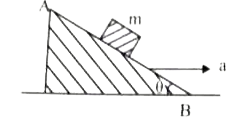
A block of mass m is placed on a smooth inclined wedge ABC of inclination `theta` as shown in the figure. The wedge is given an acceleration 'a' towards the right. The relation between a and for the block to remain stationary on the wedge is:

A

`a = g cos theta`

B

`a = g/(sin theta)`

C

`a = g/( "cosec"theta)`

D

`a = g tan theta`

Text Solution

Verified by Experts

The correct Answer is:

D

From wedge reference framee
For block to be at rest
`ma cos theta = mg sin theta`
`a = g tan theta`
Promotional Banner

Topper's Solved these Questions

  • LAWS OF MOTION

    PHYSICS WALLAH|Exercise LEVEL-2|18 Videos
  • KINETIC THEORY

    PHYSICS WALLAH|Exercise NEET PAST 5 YEARS QUESTIONS |11 Videos
  • MAGNETISM AND MATTER

    PHYSICS WALLAH|Exercise NEET PAST 5 YEARS QUESTIONS |10 Videos

Similar Questions

Explore conceptually related problems

A block of mass m is placed on a smooth inclined wedge ABC of inclination theta as shown in the figure. The wedge is given an acceleration a towards the right. The relation between a and theta for the block to remain stationary on the wedge is.

A block of mass m resting on a wedge of angle theta as shown in the figure. The wedge is given an acceleration a. What is the minimum value of a so that the mass m falls freely ?

A smooth block of mass m is held stationary on a smooth wedge of mass M and inclination theta as shown in figure .If the system is released from rest , then the normal reaction between the block and the wedge is

A block of mass m is placed on a smooth wedge of inclination theta & mass M. The whole system is slip on the wedge. Then the normal reaction on the wedge acting from the ground :

A block of mass m is placed on the rough incline of a wedge of mass M and inclination alpha to the horizontal. Calculate the maximum and minimum acceleration that can be imparted to the wedge so that the block may remain stationary relative to the wedge. The coefficient iof friction between the block and the wedge is mu .

A block of mass m is placed on a wedge of mass M. Coefficient between then is mu lt cot theta . The wedge is given an acceleration to its left. Find the maximum acceleration at which block apears stationary relative to wedge.

A block of mass m is placed on a smooth wedge of incination theta . The whole system s acelerated horizontally so tht the block does not slip on the wedge. The force exerted by the wedge on the block has a magnitude

A block of mass 2kg slides down the face of a smooth 45^@ wedge of mass 9 kg as shown in the figure. The wedge is placed on a frictionless horizontal surface. Determine the acceleration of the wedge.

A block of mass m is placed on a smooth wedge of inclination theta . The whole system is accelerated horizontally, so that the block does not slip on the wedge. The force exerted by the wedge on the block (g is acceleration due to gravity) will be

A block of mass m is placed on a smooth wedge of inclination theta . The while system is acceleration horizontally so that the block does not slip. Find (a) horizontal acceleration, (b) normal force between the block and the wedge and (c) the horizontal force applied on the wedge.
