A
B
C
D
Text Solution
Verified by Experts
The correct Answer is:
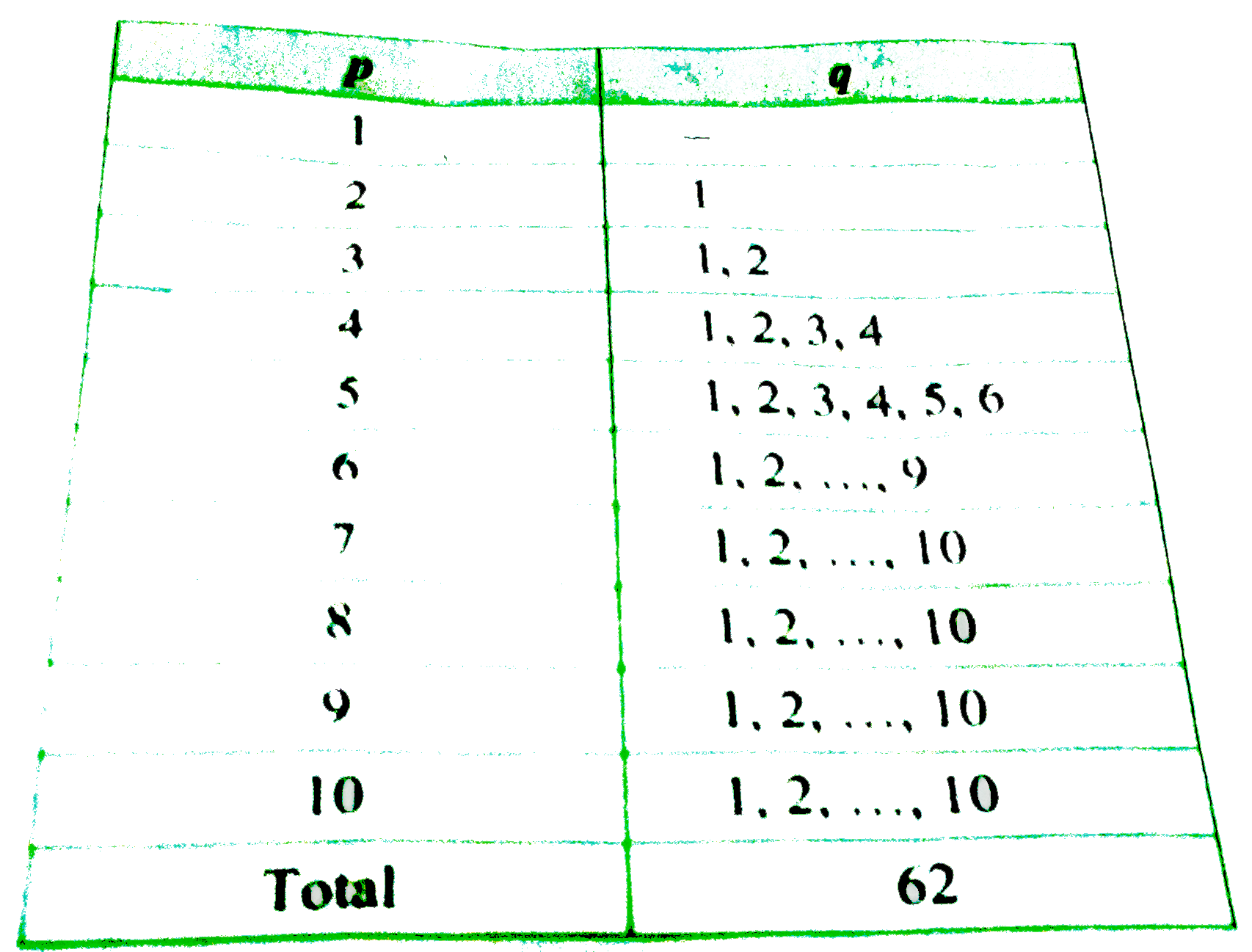



Topper's Solved these Questions
PROBABILITY I
CENGAGE|Exercise Exercise (Comprehension)|14 VideosPROBABILITY I
CENGAGE|Exercise Exercise (Matrix)|2 VideosPROBABILITY I
CENGAGE|Exercise Exercise (Single)|46 VideosPROBABILITY AND STATISTICS
CENGAGE|Exercise Question Bank|24 VideosPROBABILITY II
CENGAGE|Exercise JEE Advanced Previous Year|25 Videos
Similar Questions
Explore conceptually related problems
CENGAGE-PROBABILITY I -Exercise (Multiple)
- If A and B are any two events, then the probability that exactly one o...
Text Solution
|
- If p and q are chosen randomly from the set {1, 2, 3, 4, 5, 6, 7, 8, 9...
Text Solution
|
- If A and B are two events such that P(A) = 3/4 and P(B) = 5/8, and P(A...
Text Solution
|
- If A and B are mutually exclusive events, then
Text Solution
|
- Probability if n heads in 2n tosses of a fair coin can be given by pro...
Text Solution
|
- The chance of an event happening is the square of the chance of a seco...
Text Solution
|
- A bag contains 6 blue balls and 5 green balls and 2 red balls. A ball ...
Text Solution
|
- Two numbers are chosen from {1, 2, 3, 4, 5, 6, 7, 8} one after another...
Text Solution
|