Home
Class 12
MATHS
There are some experiment in which the o...

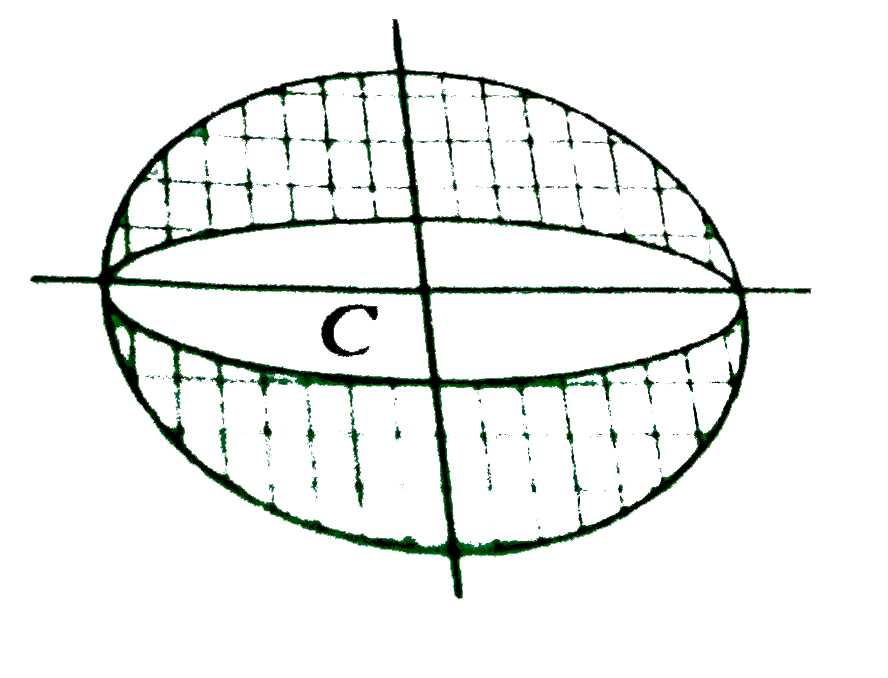
There are some experiment in which the outcomes cannot be identified discretely. For example, an ellipse of eccentricity `2sqrt(2)//3` is inscribed in a circle and a point within the circle is chosen at random. Now, we want to find the probability that this point lies outside the ellipse. Then, the point must lie in the shaded region shown in Figure. Let the radius of the circle be a and length of minor axis of the ellipse be 2b. Given that
`1 - (b^(2))/(a^(2)) = (8)/(9) or (b^(2))/(a^(2)) = (1)/(9)`
Then, the area of circle serves as sample space and area of the shaded region represents the area for favorable cases. Then, required probability is
`p= ("Area of shaded region")/("Area of circle")`
`=(pia^(2) - piab)/(pia^(2)) = 1 - (b)/(a) = 1 - (1)/(3) = (2)/(3)`
Now, answer the following questions.

A point is selected at random inside a circle. The probability that the point is closer to the center of the circle than to its circumference is

A

`1//4`

B

`1//2`

C

`1//3`

D

`1//sqrt(2)`

Text Solution

Verified by Experts

The correct Answer is:
A

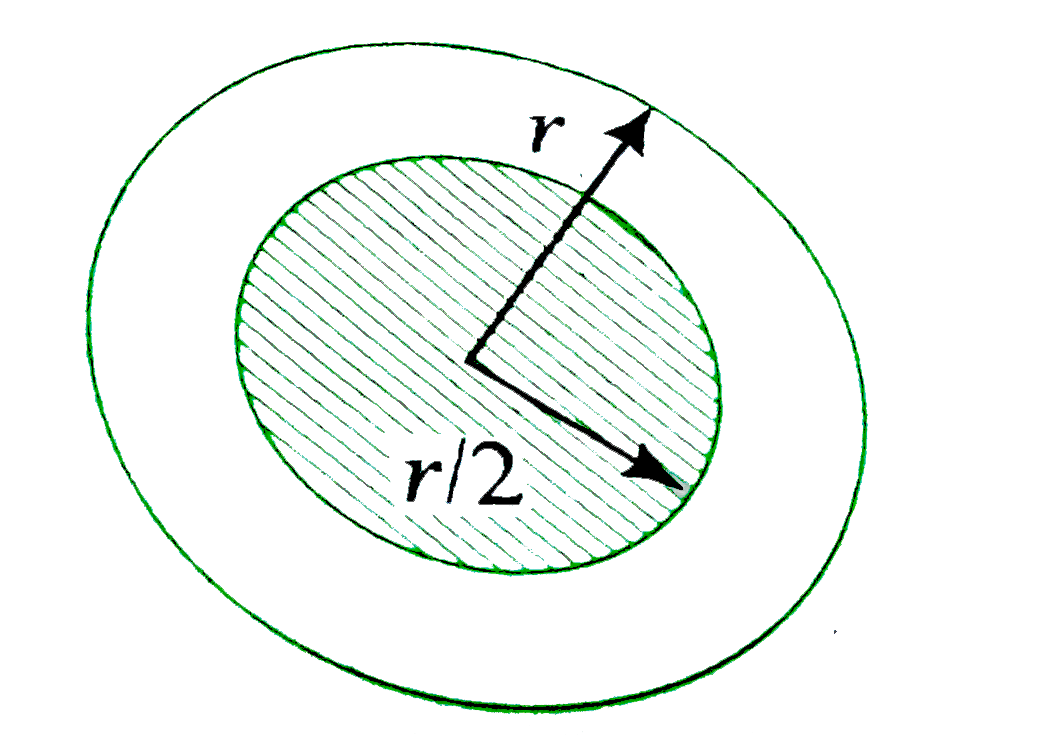
For the favorable cases, the points should lie inside the concentric circle of radius `r//2`. So the desired probability is given by

`("Area of smaller circle")/("Area of larger circle")=(.^(pi((r)/(2))^(2)))/(pir^(2)) = (1)/(4)`
Promotional Banner

Topper's Solved these Questions

  • PROBABILITY I

    CENGAGE|Exercise Exercise (Matrix)|2 Videos
  • PROBABILITY I

    CENGAGE|Exercise Exercise (Numerical)|7 Videos
  • PROBABILITY I

    CENGAGE|Exercise Exercise (Multiple)|8 Videos
  • PROBABILITY AND STATISTICS

    CENGAGE|Exercise Question Bank|24 Videos
  • PROBABILITY II

    CENGAGE|Exercise JEE Advanced Previous Year|25 Videos

Similar Questions

Explore conceptually related problems

There are some experiment in which the outcomes cannot be identified discretely. For example, an ellipse of eccentricity 2sqrt(2)//3 is inscribed in a circle and a point within the circle is chosen at random. Now, we want to find the probability that this point lies outside the ellipse. Then, the point must lie in the shaded region shown in Figure. Let the radius of the circle be a and length of minor axis of the ellipse be 2b. Given that 1 - (b^(2))/(a^(2)) = (8)/(9) or (b^(2))/(a^(2)) = (1)/(9) Then, the area of circle serves as sample space and area of the shaded region represents the area for favorable cases. Then, required probability is p= ("Area of shaded region")/("Area of circle") =(pia^(2) - piab)/(pia^(2)) = 1 - (b)/(a) = 1 - (1)/(3) = (2)/(3) Now, answer the following questions. Two persons A and B agree to meet at a place between 5 and 6 pm. The first one to arrive waits for 20 min and then leave. If the time of their arrival be independant and at random, then the probability that A and B meet is

The normal at the point (3, 4) on a circle cuts the circle at the point (-1,-2). Then the equation of the circle is

A polygon of nine sides, each side of length 2, is inscribed in a circle. The radius of the circle is ____________.

A circle touches the y-axis at the point (0, 4) and cuts the x-axis in a chord of length 6 units. Then find the radius of the circle.

The line 2x-y+1=0 is tangent to the circle at the point (2, 5) and the center of the circle lies on x-2y=4. The radius of the circle is

An ellipse is inscribed in a reactangle and the angle between the diagonals of the reactangle is tan^(-1)(2sqrt(2)) , then find the ecentricity of the ellipse

Draw a circle of radius 4.5 cm. Take a point on the circle. Draw the tangent at that point using the alternate segment theorem.

Find the locus of the point of intersection of tangents to the ellipse if the difference of the eccentric angle of the points is (2pi)/3dot

The line 2x-y+1=0 is tangent to the circle at the point (2, 5) and the center of the circle lies on x-2y=4 . Then find the radius of the circle.

Prove that any three points on a circle cannot be collinear.

