Home
Class 12
MATHS
Consider the graph of y = f(x) as shown...

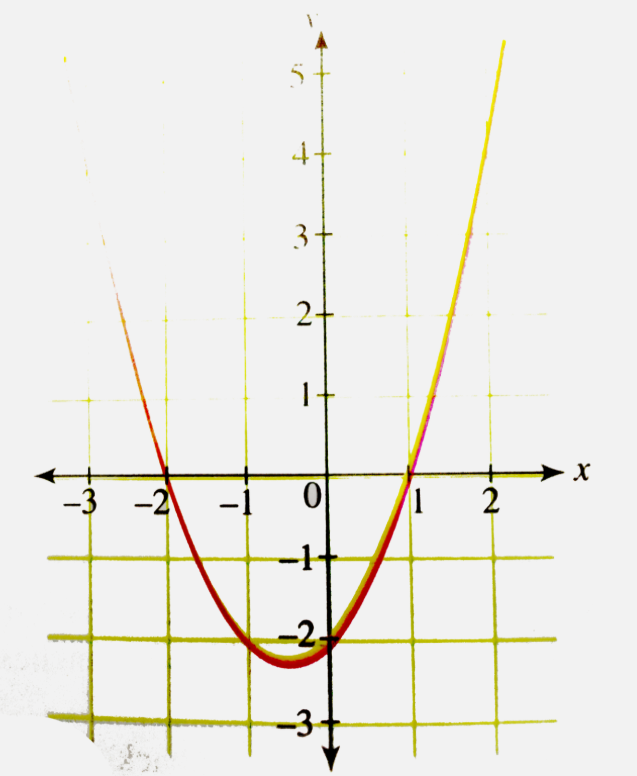
Consider the graph of y = f(x) as shown in the following figure.

(i) Find the sum of the roots of the equation f (x) = 0.
(ii) Find the product of the roots of the equation f(x) = 4.
(iii) Find the absolute value of the difference of the roots of the equation f(x) = x+2 .

Text Solution

Verified by Experts


(i) Roots of the equation f(x) = 0 occur where the graph of y = f(x) and y = 0 intersect.
From the diagram, the points of intersection of intersection are x =- 2 and x= 1. Hence sum of the roots is - 1.
(ii) Roots of the equation f(x) = 4 occur where the graph of y = f(x) and y = 4 intersect. From the diagram, the points of intersection are x =- 3 and x = 2. Hence the product of the roots is -6.
(iii) Roots of the equation f(x) = x+2 occur where the graph of y = f(x) and y = x+2 intersect. From the diagram, the points of intersection are x =- 2 and x = 2. Hence the difference of the roots is 4.
Promotional Banner

Topper's Solved these Questions

  • GETTING STARTED WITH GRAPHS

    CENGAGE|Exercise Exercise|18 Videos
  • FUNCTIONS

    CENGAGE|Exercise Question Bank|21 Videos
  • GRAPH OF INVERSE TRIGONOMETRIC FUNCTIONS

    CENGAGE|Exercise Exercise|18 Videos

Similar Questions

Explore conceptually related problems

Graph of y = f(x) is as shown in the following figure. Find the roots of the following equations f(x) = 0 f(x) = 4 f(x) = x + 2

Find the real roots of the equation . x^2+5|x|+6=0

Find the roots of the equation 100x^2-20x+1

Find the roots of the equation x+(1)/(x)=3, x ne 0

Find the roots of the equation x^2+sqrt(3) x+3/4

Find the roots of the polynomial equations. x + 3 = 0

Find the roots of the polynomial equations. 9x -4 = 0

If the sum of the roots of the equation (a+1)x^(2)+(2a+3)x+(3a+4)=0 , is -1.Find its product.

CENGAGE-GETTING STARTED WITH GRAPHS-Exercise
  1. Does the following graph pass the vertical or horizontal line test ?

    Text Solution

    |

  2. Consider the graph of y = f(x) as shown in the following figure. ...

    Text Solution

    |

  3. Which of the following functions has (have) y-symmetry or origin symme...

    Text Solution

    |

  4. The graph of functions are given in the following fingure. Discuss the...

    Text Solution

    |

  5. Check weather the following function/functions is/are periodic or not?...

    Text Solution

    |

  6. Suppose that f is even, periodic function with period 2, and that f(x)...

    Text Solution

    |

  7. The graph of y = f(x) is as shown in the following figure. Find t...

    Text Solution

    |

  8. The graph of f is shown. State, with reason, the numbers at which f is...

    Text Solution

    |

  9. If f:R→R, g:R→R are given by f(x)=(x+1)^2 and g(x)=x^2+1 , then w...

    Text Solution

    |

  10. (a) Can the graph of the function intersect the horizontal asymptote? ...

    Text Solution

    |

  11. The graph of y = f(x) is given with six labelled points. Anser the fol...

    Text Solution

    |

  12. Graph of functions are given in the following figure. Check the funct...

    Text Solution

    |

  13. In the following graph, state the absolute and local maximum and mini...

    Text Solution

    |

  14. Prove : ((1+cot^2 A)/(1+tan^2 A​))=((1−cotA)/(1−tanA​))^2=tan^2 A

    Text Solution

    |

  15. Evaluate int(0)^(pi/2)(sinx/(cosx+sinx))dx

    Text Solution

    |

  16. The figure shows the graphs of f, f' and f''. Indentify each curve and...

    Text Solution

    |

  17. Match the graph of y = f(x) in Column I with the corresponding graph ...

    Text Solution

    |

  18. If f(x) is an even function, then f'(x). If in a △ABC, atan A+ btan B=...

    Text Solution

    |

