Home
Class 12
MATHS
Prove that [lim(xto0) (tan^(-1)x)/(x)]=0...

Prove that `[lim_(xto0) (tan^(-1)x)/(x)]=0,` where `[.]` represents the greatest integer function.

Text Solution

Verified by Experts
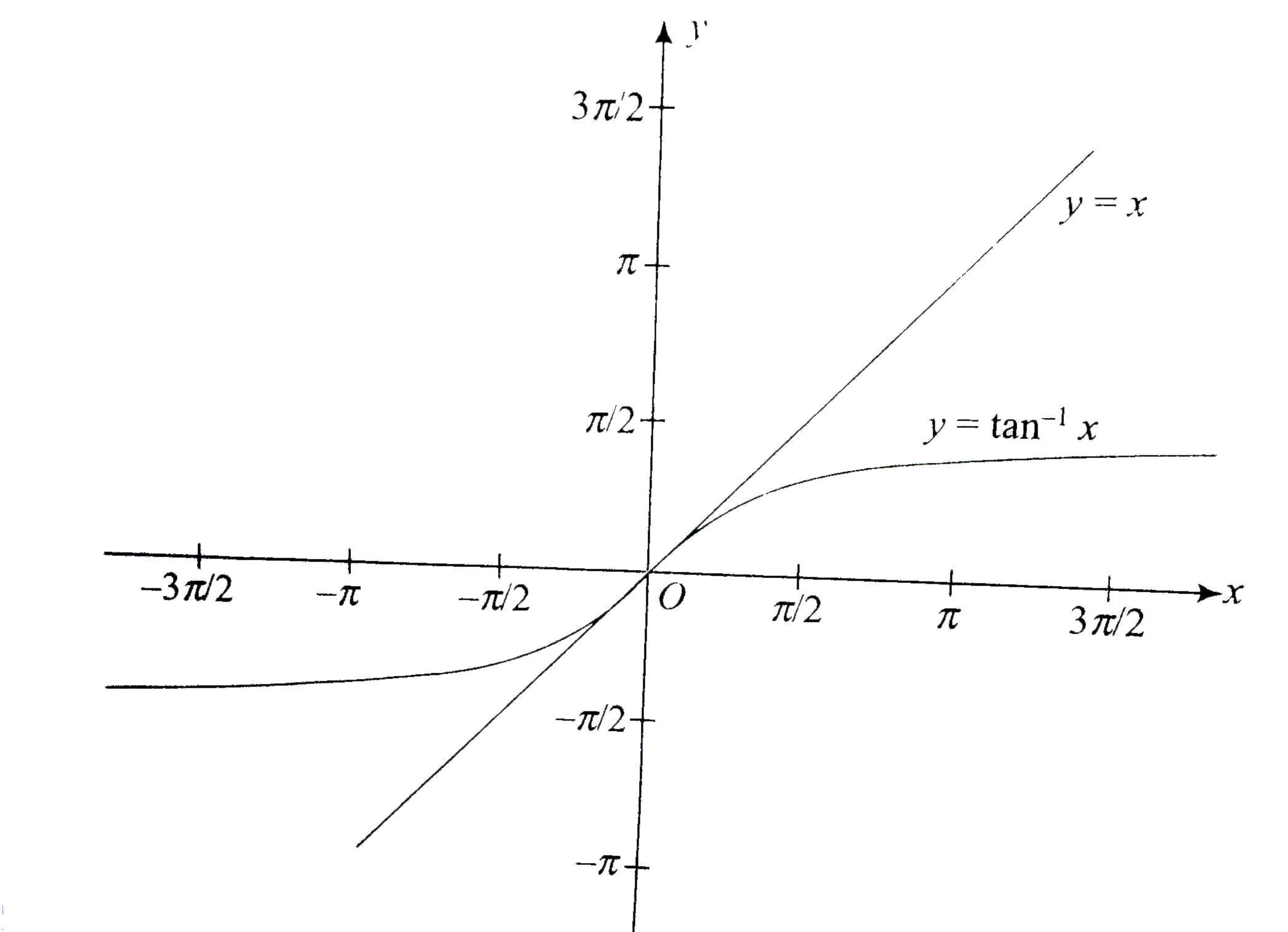
See the graph of y=x and `tan^(-1)x` in the figure:

From the figure, when `xto0^(+)`, graph of y=x is above the graph
So,`" "tan^(-1)xltx" or "(tan^(-1)x)/(x)lt1`
`implies" "underset(xto0^(+))lim(tan^(-1)x)/(x)=1^(-)`
`implies" "[underset(xto0^(+))lim(tanx)/(x)]=0`
Thus`" "[underset(xto0)lim(tan^(-1)x)/(x)]=0`
Promotional Banner

Topper's Solved these Questions

  • LIMITS

    CENGAGE|Exercise Exercise 2.1|10 Videos
  • LIMITS

    CENGAGE|Exercise Exercise 2.2|7 Videos
  • JEE 2019

    CENGAGE|Exercise Chapter 10|9 Videos
  • LINEAR COMBINATION OF VECTORS, DEPENDENT AND INDEPENDENT VECTORS

    CENGAGE|Exercise DPP 1.2|10 Videos

Similar Questions

Explore conceptually related problems

Prove that [lim_(xto0) (sinx)/(x)]=0, where [.] represents the greatest integer function.

Evaluate : [lim_(x to 0) (tan x)/(x)] , where [*] represents the greatest integer function.

Prove that [lim_(xrarr0) (sinx.tanx)/(x^(2))]=1 ,where [.] represents greatest integer function.

lim_(xrarr0) [(sin^(-1)x)/(tan^(-1)x)]= (where [.] denotes the greatest integer function)

Evaluate: ("lim")_(xvec0)(tanx)/x where [dot] represents the greatest integer function

lim_(xto0)(tan2x)/(sin5x)

Find x satisfying [tan^(-1)x]+[cot^(-1)x]=2, where [.] represents the greatest integer function.

Draw the graph of f(x)=[tan^(-1)x]," where "[*]" represents the greatest integer function".

lim_(xto0)(tan2x)/x

Evaluate: int_0^(100)x-[x]dx where [dot] represents the greatest integer function).

CENGAGE-LIMITS-Question Bank
  1. Prove that [lim(xto0) (tan^(-1)x)/(x)]=0, where [.] represents the gre...

    Text Solution

    |

  2. If Lim(x rarr 0) (1-cosx)/(e^(ax)-bx-1) exist and is equal to 1, then ...

    Text Solution

    |

  3. If graph of a function f(x) is shown in the adjacent figure, then Lim(...

    Text Solution

    |

  4. Let f(x) =(sec x)^(cosecx) + (cot x)^(sin x). Then the value of Lim(x ...

    Text Solution

    |

  5. Lim(z rarr 0){{max((sin^(-1)x + cos^(-1)x)^(2), min(x^(2)+4x+7))}. (si...

    Text Solution

    |

  6. The reciprocal of the value of: ("lim")(ntooo)(1-1/(2^2))(1-1/(3^2))(1...

    Text Solution

    |

  7. The value of Lim(x rarr 0)(sum(k =1)^(2016){(sinx)/x+2015k})/2016 is [...

    Text Solution

    |

  8. Lim(x rarr oo) (30+4sqrtx+7root(3)(x))/(2+sqrt(4x-7)+root(3)(6x-2) )eq...

    Text Solution

    |

  9. If Lim(x rarr0) ((a sin x + b tan x)/x^(3))= 3/2 then |a+2b| is equal ...

    Text Solution

    |

  10. lim(n rarr 0)(1/(1+n^(2))+2/(1+n^(2))+3/(1+n^(2))+....+n/(1+n^(2))) is...

    Text Solution

    |

  11. Find the value of lim(n rarr oo)sum(k=1)^(n)(k^(2)+k-1)/((k+1)!) .

    Text Solution

    |

  12. The value of Lim(x rarr 0)((tanx)^(1/x)+(1+sinx)^(x)) where x gt0 is e...

    Text Solution

    |

  13. If Lim(x rarr 0) (a sinx + bxe^(x)+3x^(2))/(sin x-2x+tanx) exists and ...

    Text Solution

    |

  14. If Lim(x rarr a) (sqrt(x-b)-sqrt(a-b))/(x^(2)-a^(2))(a gt b) = 1/64 an...

    Text Solution

    |

  15. If lim(x rarr 0) (k+cos lx)/x^(2)exists and has the value equal to -4 ...

    Text Solution

    |

  16. Lim(x rarr 0)((3sin x- sin 3x)^(4))/((sec x - cosx)^(6)) is equal to

    Text Solution

    |

  17. Lim(x rarr 0)(tanx sqrt (tanx)-sin x sqrt(sinx))/(x^(3).sqrtx) equals

    Text Solution

    |

  18. f(x)=("ln"(x^(2)+e^(x)))/("ln"(x^(4)+e^(2x)))." Then "underset(xtooo)l...

    Text Solution

    |

