Home
Class 12
MATHS
sin^(-1) ((2x)/(1 + x^(2)))...

`sin^(-1) ((2x)/(1 + x^(2)))`

Text Solution

Verified by Experts
We have `y=f(x)=sin^(-1)((2x)/(1-x^(2)))`
Let x `=tan, theta, theta in (-pi//2,pi//2)`
`rArr" "theta=tan^(-1)x`
`"Now "sin^(-1)((2x)/(1+x^(2)))=sin^(-1)((2tantheta)/(1+tan^(2)theta))`
`=sin^(-1)(sin2theta)`
`=sin^(-1)(sinalpha), "where "alpha in (-pi, pi)`
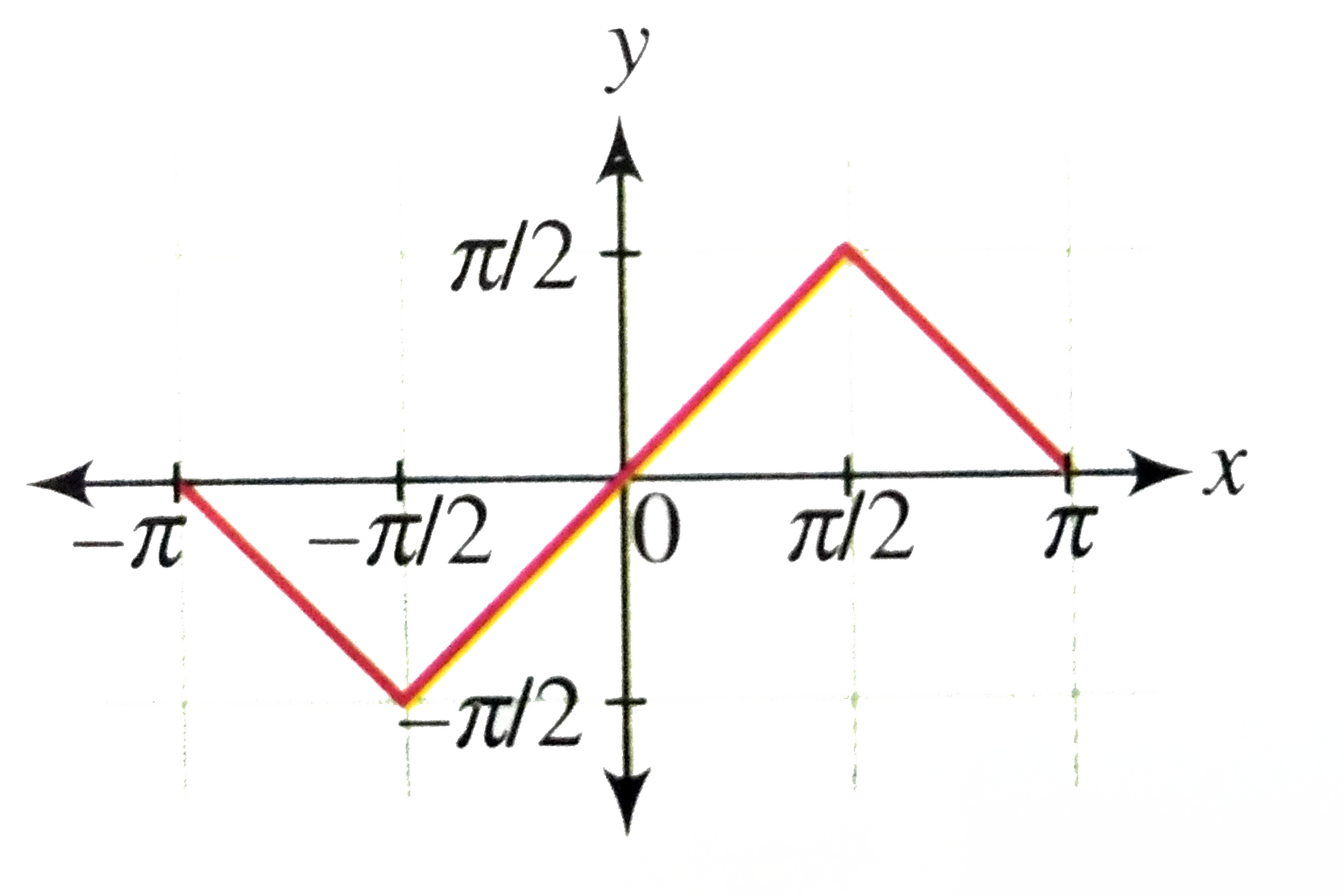
Now consider the graph of `y=sin^(-1)(sin alpha),"where "alpha in (-pi, pi)`

From the graph.
`sin^(-1)((2x)/(1+x^(2)))=sin^(-1)(sinalpha)`
`={{:(-alpha-pi, -piltalphalt-pi//2),(alpha, -pi//2lealphalepi//2),(-alpha+pi,pi//2ltalphaltpi):}`
`={{:(-2tan^(-1)x-pi,-pilt2tan^(-1)xlt-pi//2),(2tan^(-1)x-pi, -pi//2le2tan^(-1)xlepi//2),(-2tan^(-1)x+pi,-pi//2lttan^(-1)xltpi):}`
`={{:(-2tan^(-1)x-pi,-pilt2tan^(-1)xlt-pi//4),(2tan^(-1)x-pi, -pi//2le2tan^(-1)xlepi//4),(-2tan^(-1)x+pi,-pi//4lttan^(-1)xltpi//2):}`
`={{:(-2tan^(-1)x-pi,xlt-1),(2tan^(-1)x, -1lexle1),(-2tan^(-1)x+pi,xgt1):}`
`f(x)={{:(-2/(1+x^(2)),xlt-1),(2/(1+x^(2)),-1ltxlt1),(-2/(1+x^(2)),xgt1):}`
So f(x) decreases for `xlt-1xgt" and f(x) increases for"-1ltxlt1`
`underset(xto-oo)(lim)(-2tan^(-1)x-pi)=0" and "-2tan^(-1)(-1)-pi-pi/2`
Thus, `sin^(-1)((2x)/(1+x^(2)))"decreses form 0 to"-pi/2"when x increases form "-oo" to "-1`
`f(-1)=2tan^(-1)-pi/2,f(1)=2tan^(-1)(1)=pi/2`
Thus, `sin^(-1)((2x)/(1+x^(2)))" increases form "-pi/2" to "pi/2" when x increases form -1 to 1"`
`-2tan^(-1)(1)+pi=pi/2" and"underset(xtooo)(lim)(-2tan^(-1)x+pi)=0`
Thus, `sin^(-1)((2x)/(1+x^(2)))"decreases form "pi/2" to 0 when x increases form 1 to "oo`.
Also f(x) is non-differentiable at `x=+-1`
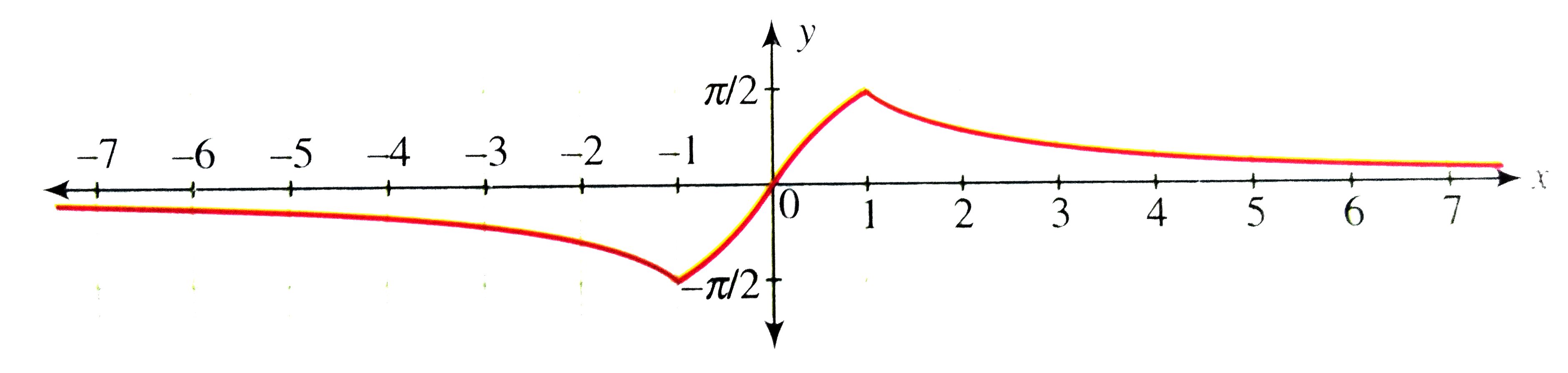
From the above information, the graph of `y=f(X) ` is as shown in the following figure.

From this information, we can draw the graph of `y=sin^(-1)((2x)/(1+x^(2)))` as follows.
Here y = 0 is an asymtote.
Promotional Banner

Topper's Solved these Questions

  • GRAPH OF INVERSE TRIGONOMETRIC FUNCTIONS

    CENGAGE|Exercise Exercise|18 Videos
  • GETTING STARTED WITH GRAPHS

    CENGAGE|Exercise Exercise|18 Videos
  • GRAPHICAL TRANSFORMATIONS

    CENGAGE|Exercise Exercise|14 Videos

Similar Questions

Explore conceptually related problems

Sove 2 cos^(-1) x = sin^(-1) (2 x sqrt(1 - x^(2)))

Differentiate the following : y=sin^(-1)((1-x^(2))/(1+x^(2)))

find the derivative; y= sin^(-1) ((1-x^(2))/(1+x^(2)))

Differentiate the following : y=sin^(-1)((1-x^(2))/(1+x^(2)))

Find (dy)/(dx) in the following : y= sin^(-1) (2x sqrt(1-x^(2))), (1)/(sqrt(2)) lt x lt (1)/(sqrt(2)) .

Find (dy)/(dx) in the following : y= sin^(1)((1-x^(2))/(1+x^(2))), 0 lt x lt 1 .

If (x -1) (x^(2) + 1) gt 0 , then find the value of sin((1)/(2) tan^(-1).(2x)/(1 - x^(2)) - tan^(-1) x)

Find the value of x for which f(x) = 2 sin^(-1) sqrt(1 - x) + sin^(-1) (2 sqrt(x - x^(2))) is constant

Integrate with respect to x (sin^(-1)x) (e^(sin^(-1)x))/(sqrt(1 - x^2))