Home
Class 12
MATHS
Consider int(x^(3)+3x^(2)+2x+1)/(sqrt(...

Consider
`int(x^(3)+3x^(2)+2x+1)/(sqrt(x^(2)+x+1))dx`
`=(ax^(2)+bx+c)sqrt(x^(2)+x+1)+lambda int(dx)/(sqrt(x^(2)+x+1))`
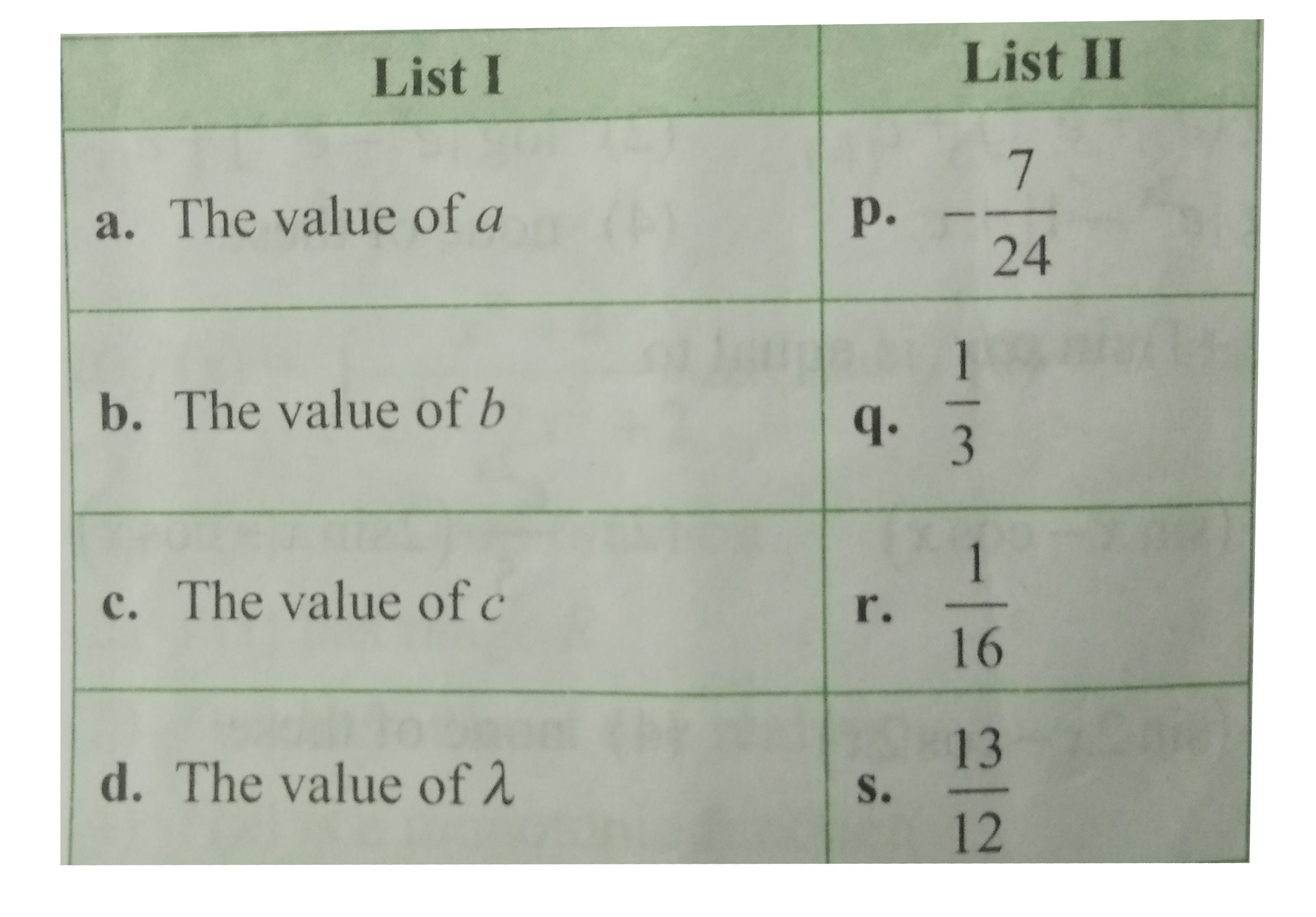
Now, match the following lists and then choose the correct code.

Codes:
`{:(,a,b,c,d),((1),q,p,s,r),((2),s,p,q,r),((3),r,q,p,s),((4),q,s,p,r):}`

Text Solution

Verified by Experts

The correct Answer is:

4

` int(x^(3)+3x^(2)+2x+1)/(sqrt(x^(2)+x+1))dx`
`=(ax^(2)+bx+c)sqrt(x^(2)+x+1)+lambda int(dx)/(sqrt(x^(2)+x+1))`
Differentiating both side, we get
`(x^(3)+3x^(2)+2x+1)/(sqrt(x^(2)+x+1))=((ax^(2)+bx+c)(2x+1))/(2sqrt(x^(2)+x+1))+(2ax+b)sqrt(x^(2)+x+1)+lambda(1)/(sqrt(x^(2)+x+1))`
`=(6ax^(3)+(5a+4b)x^(2)+(4a+3b+2c)x+(c+2b+2lambda))/(2sqrt(x^(2)+x+1))`
Now, compare coefficients on both sides and solve equations.
Promotional Banner

Topper's Solved these Questions

  • INDEFINITE INTEGRATION

    CENGAGE|Exercise Exercise (Numerical)|10 Videos
  • INDEFINITE INTEGRATION

    CENGAGE|Exercise JEE Main Previous Year|7 Videos
  • INDEFINITE INTEGRATION

    CENGAGE|Exercise Exercise (Comprehension)|17 Videos
  • HYPERBOLA

    CENGAGE|Exercise JEE Advanced Previous Year|14 Videos
  • INEQUALITIES AND MODULUS

    CENGAGE|Exercise Single correct Answer|21 Videos

Similar Questions

Explore conceptually related problems

Evaluate int (x^(2)-sqrt(3x)+1)/(x^(4)-x^(2)+1)dx

Match the following lists (where [x] represents the greatest integer function) and then choose the correct code. Codes : {:(,"a b c d"),((1),"s r q p"),((2),"q p s p"),((3), "s r p q"),((4),"p p q r"):}

int(x^4-1)/(x^2sqrt(x^4+x^2+1))dx= sqrt(x^2+1/(x^2)+1)+C (sqrt(x^4+x^2+1))/(x^2)+C (sqrt(x^4+x^2+1))/x+C (d) none of these

int(sqrt(1-x^(2))-x)/(sqrt(1-x^(2))(1+xsqrt(1-x^(2))))dx is

If int x((ln(x+sqrt(1+x^2)))/sqrt(1+x^2)) dx=asqrt(1+x^2)ln(x+sqrt(1+x^2))+bx+c then

Evaluate int(x dx)/(x^(3)sqrt(x^(2)-1)).

Evaluate: int(dx)/((x-p)sqrt((x-p)(x-q)))

int (x^2 -1 )/ (x^3 sqrt(2x^4 - 2x^2 +1))dx is equal to

If int(x+(cos^(-1)3x)^(2))/(sqrt(1-9x^(2)))dx=Asqrt(1-9x^(2))+B(cos^(-1)3x)^(3)+C, then A-B is

int_(1/sqrt(3))^(sqrt(3))(dx)/(1+x^(2))
