Home
Class 12
MATHS
Let ABCD is a unit square and each side ...


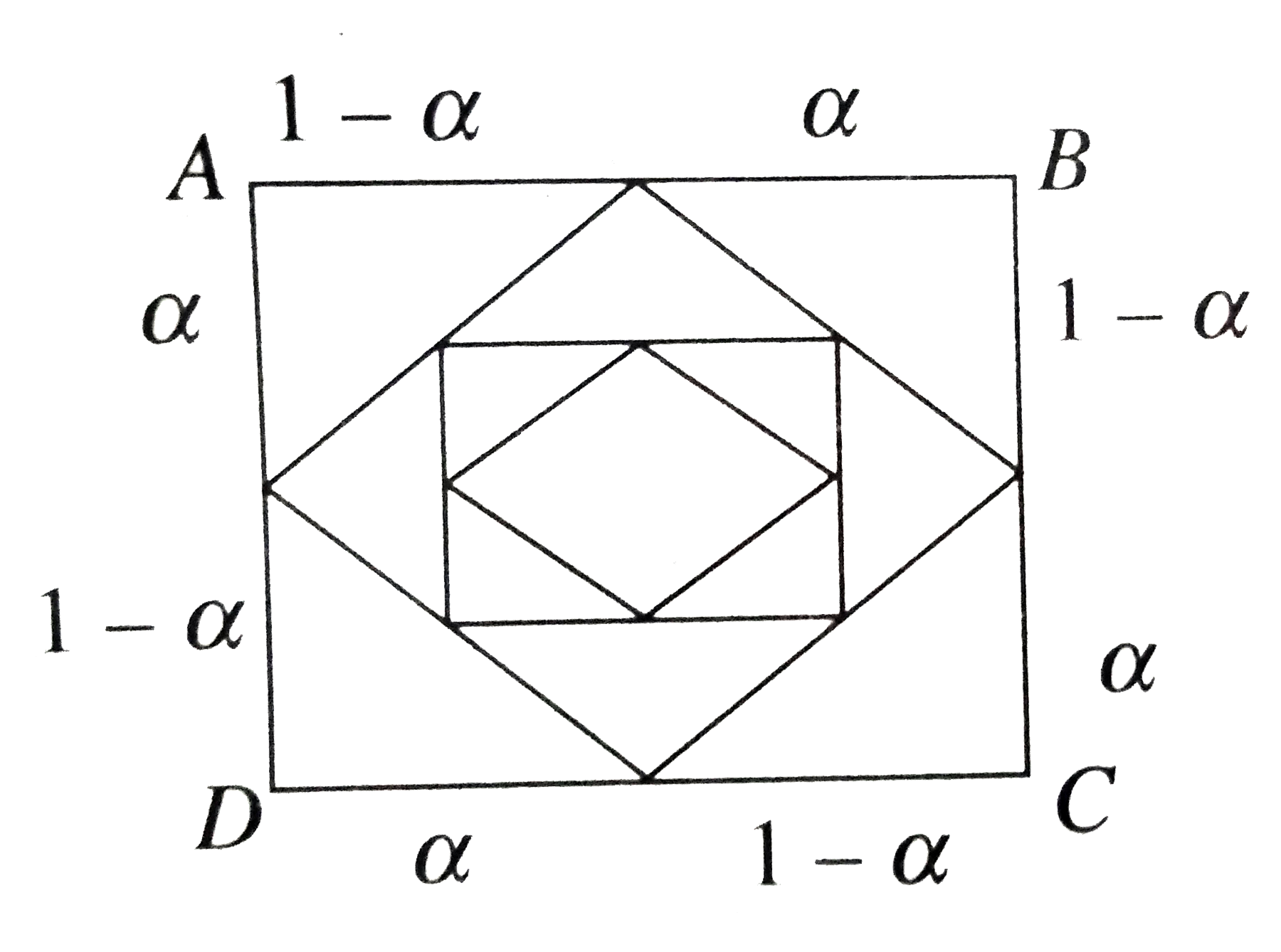
Let `ABCD` is a unit square and each side of the square is divided in the ratio `alpha : (1-alpha) (0 lt alpha lt 1)` . These points are connected to obtain another square. The sides of new square are divided in the ratio `alpha : (1-alpha)` and points are joined to obtain another square. The process is continued idefinitely. Let `a_(n)` denote the length of side and `A_(n)` the area of the `n^(th)` square
If`alpha=(1)/(3)`, then the least value of `n` for which `A_(n) lt (1)/(10)` is

A

`4`

B

`5`

C

`6`

D

`7`

Text Solution

Verified by Experts

The correct Answer is:
B

`(b)`
Clearly from the diagram,
`a_(1)=1`
`(a_(n+1))^(2)=[(1-alpha)^(2)+alpha^(2)](a_(n))^(2)impliesA_(n+1)=[2alpha^(2)-2alpha+1]A_(n)`
For `alpha=(1)/(3)`, `(a_(n+1))^(2)=(5)/(9)(a_(n))^(2)`
`implies(A_(n+1))/(A_(n))=(5)/(9)`
`impliesA_(2)=(5)/(9)`, `A_(3)=((5)/(9))^(2)`,...
`impliesA_(n)=((5)/(9))^(n-1)`
`A_(n) lt (1)/(10) implies ((5)/(9))^(n-1) lt (1)/(10)`
`implies` Least value of `n` is `5`.
`sum_(n=1)^(oo)A_(n)=(8)/(3)`
`implies(1)/(1-(2alpha^(2)-2alpha+1))=(8)/(3)`
`implies16alpha^(2)-16alpha+3=0`
`implies16alpha^(2)-12alpha-4alpha+3=0`
`implies(4alpha-1)(4alpha-3)=0`
`impliesalpha=(1)/(4)`, `(3)/(4)`
The side of `n^(th)` square equal to the diagonal of `(n+1)^(th)` square. ,brgt `impliessqrt(2)a_(n)=a_(n+1)`
`implies((a_(n+1))^(2))/((a_(n))^(2))=(1)/(2)`
`implies4alpha^(2)-4alpha+1=0`
`impliesalpha=1//2`
Promotional Banner

Topper's Solved these Questions

  • PROGRESSION AND SERIES

    CENGAGE|Exercise Multiple Correct Answer|4 Videos
  • PROGRESSION AND SERIES

    CENGAGE|Exercise Examples|120 Videos
  • PROGRESSION AND SERIES

    CENGAGE|Exercise ARCHIVES (MATRIX MATCH TYPE )|1 Videos
  • PROBABILITY II

    CENGAGE|Exercise JEE Advanced Previous Year|25 Videos
  • PROPERTIES AND SOLUTIONS OF TRIANGLE

    CENGAGE|Exercise JEE Advanced Previous Year|11 Videos

Similar Questions

Explore conceptually related problems

ltimg src="https://d10lpgp6xz60nq.cloudfront.net/physics_images/CEN_ALG_DPP_4_2_E01_233_Q01.png" width="80%"gt Let ABCD is a unit square and each side of the square is divided in the ratio alpha : (1-alpha) (0 lt alpha lt 1) . These points are connected to obtain another square. The sides of new square are divided in the ratio alpha : (1-alpha) and points are joined to obtain another square. The process is continued idefinitely. Let a_(n) denote the length of side and A_(n) the area of the n^(th) square The value of alpha for which side of n^(th) square equal to the diagonal of (n+1)^(th) square is

Find the area of the square whose side length is m + n -q

Let f(x ) = ( alpha x^2 )/(x+1),x ne -1 the value of alpha for which f(a) =a , (a ne 0) is

xa n dy are the sides of two squares such that y=x-x^2 . Find the rate of the change of the area of the second square with respect to the first square.

xa n dy are the sides of two squares such that y=x-x^2 . Find the rate of the change of the area of the second square with respect to the first square.

The sides of a triangle are sin alpha , cos alpha and sqrt( 1+ sin alpha cos alpha ) for some 0 lt alpha lt pi/2 then the greater angle of the triangle is

If 0 lt alpha lt (pi)/(3) , then prove that alpha (sec alpha) lt (2pi)/(3).

Two sides of a square lie on the lines x+y=1a n dx+y+2=0. What is its area?

